

Chinese dialogue with translation · A1 · 14 lines
我买,不卖! I'm buying, not selling!
Comic · 10 panels

- 伊利亚
今天星期天,菜市场人很多。
Today is Sunday, and there are a lot of people at the food market.

- 伊利亚
我想买一些水果,也想买碗和筷子。
I want to buy some fruit, and I also want to buy bowls and chopsticks.
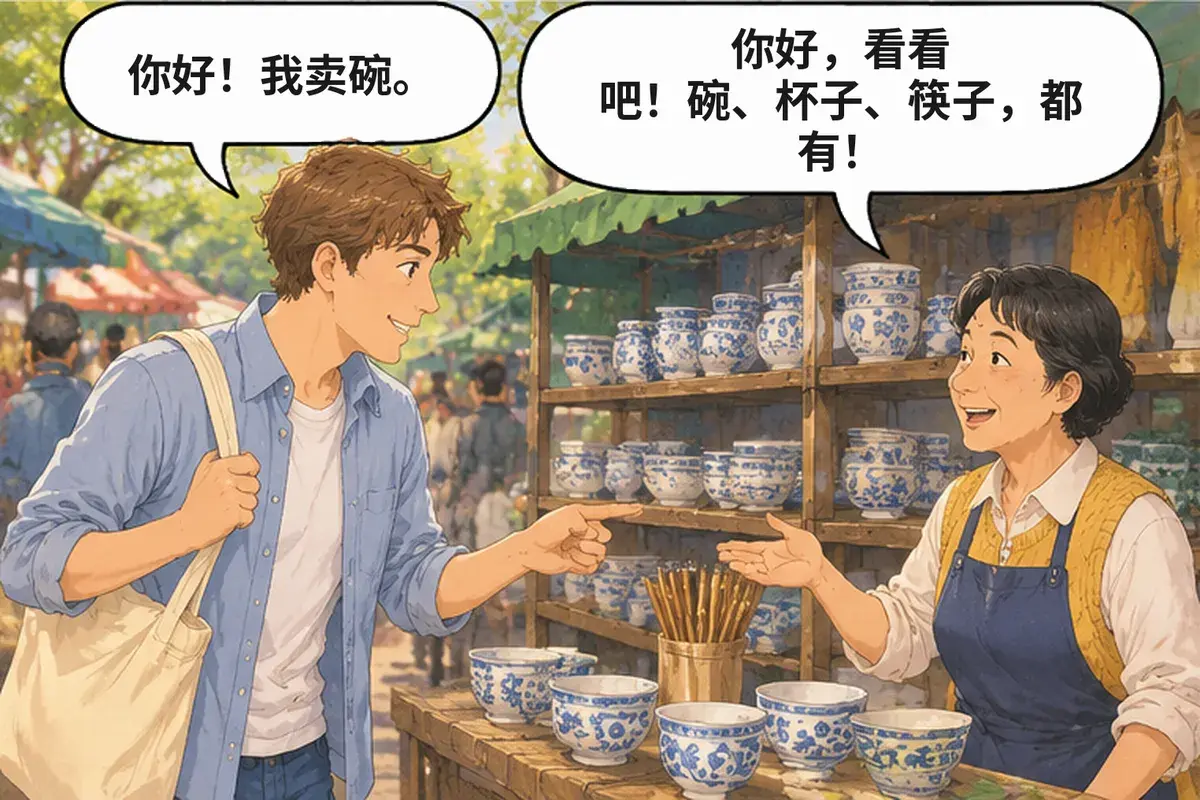
- 店员
你好,看看吧!碗、杯子、筷子,都有!
Hi, take a look! Bowls, cups, chopsticks, we have it all!
- 伊利亚
你好!我卖碗。
Hi! I sell bowls.

- 店员
你也卖碗?
You sell bowls too?
- 伊利亚
不不不!我买,不卖!
No, no, no! I'm buying, not selling!

- 店员
好好好,你买!你拿一个看看。
OK, OK, OK, you're buying! Take one and have a look.

- 伊利亚
这些碗多少钱一个?
How much are these bowls each?
- 店员
这些二十块,那些十块。
These are twenty yuan, those are ten.
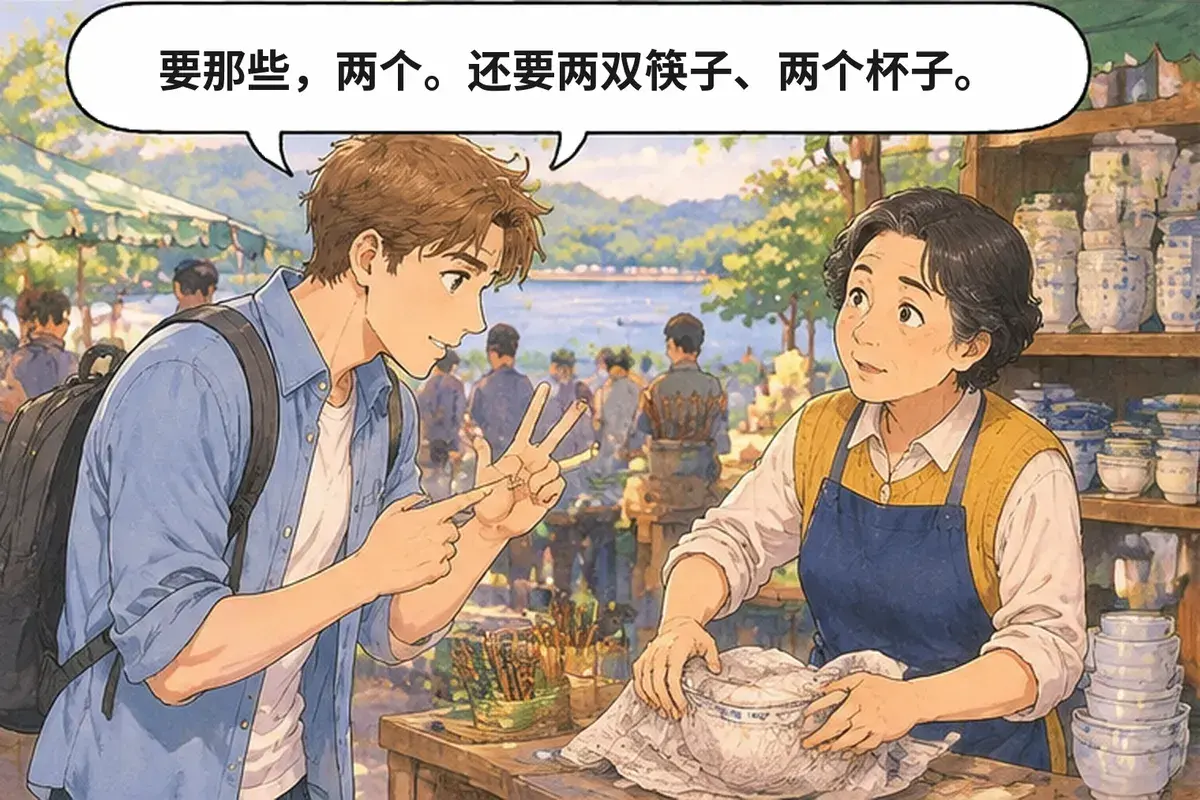
- 伊利亚
要那些,两个。还要两双筷子、两个杯子。
I'll take those, two of them. I also want two pairs of chopsticks and two cups.
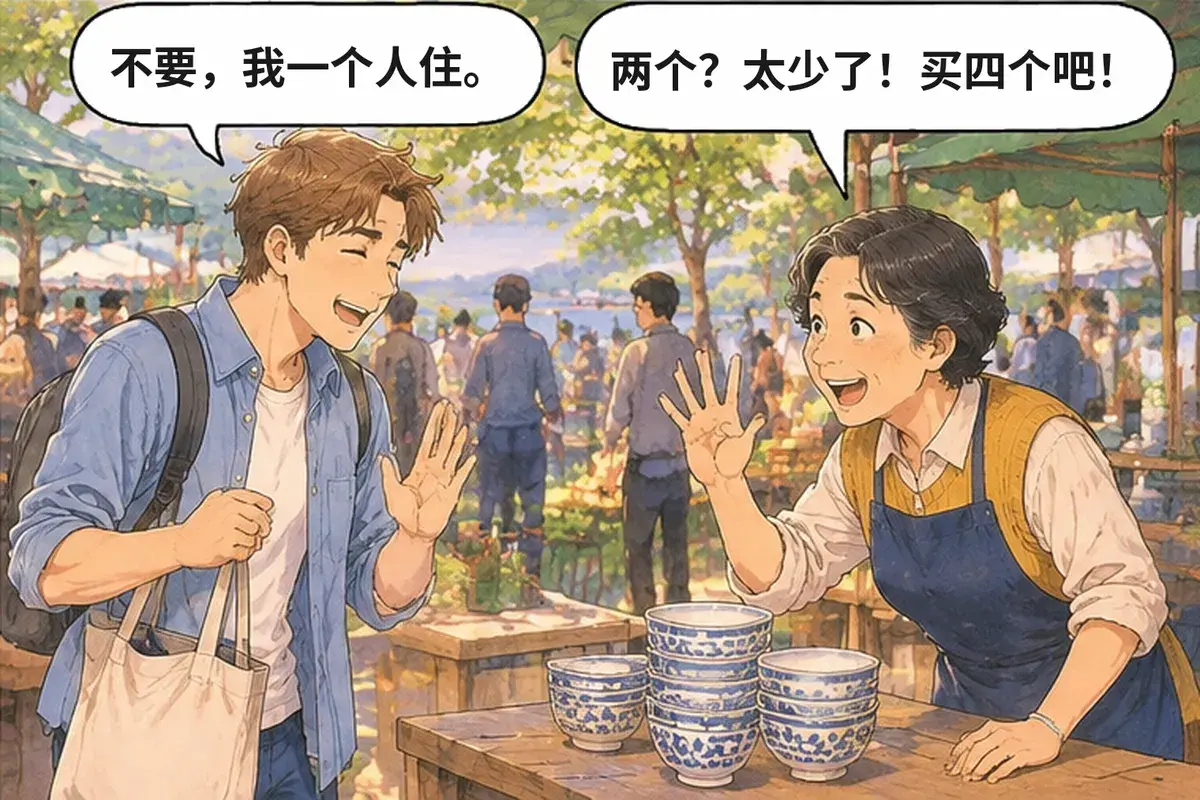
- 店员
两个?太少了!买四个吧!
Two? That's too few! Come on, buy four!
- 伊利亚
不要,我一个人住。
I don't want them, I live alone.
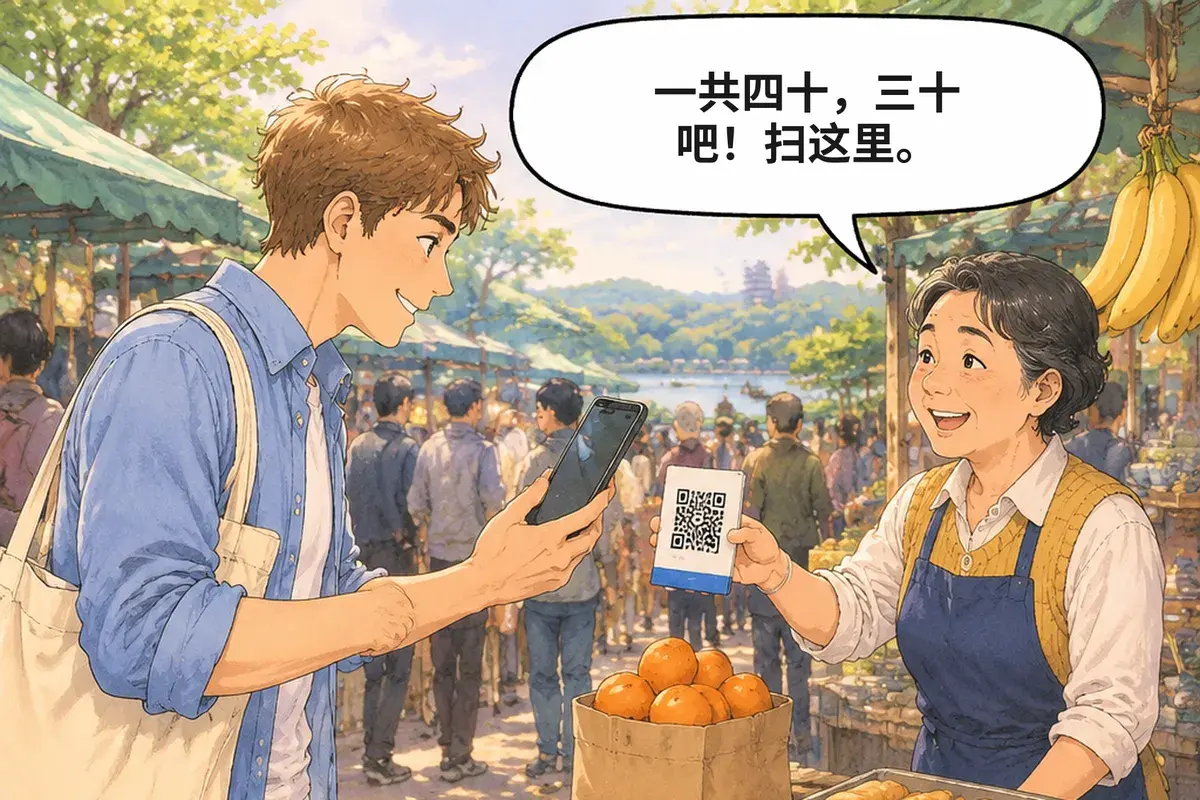
- 店员
一共四十,三十吧!扫这里。
Forty altogether... OK, thirty! Scan here.

- 伊利亚
谢谢!我很喜欢这个菜市场!
Thanks! I really like this food market!
Grammar for this text
我 卖 碗。 — Ilya wanted to say "I'm buying bowls", with 买 (mǎi, 3rd tone), but he said 卖 (mài, 4th tone), "I sell". Same syllable, only the tone is different. 我 买,不 卖! — "I'm buying, not selling!": where English says "not", Chinese just uses a comma and 不 before the second verb.
你 也 卖 碗? — a question without 吗, just with surprised intonation, like English "You sell bowls too?".
这些 碗 多少 钱 一 个? — after 这些 ("these") no measure word is needed. The price "per piece" is 一 个 at the end, like 一 斤 in a price by weight.
要 那些,两 个。 — the bowls have already been named, so the word 碗 is dropped: 两 个 is "two (of them)". Chopsticks are counted in pairs, 两 双 筷子, and cups with 个, 两 个 杯子. 、 is a Chinese comma for lists.
你 拿 一 个 看看。 — "take one and have a look": two verbs in a row, with no "and". 看看 is "have a quick look" (unit 7).
今天 星期天,菜市场 人 很 多。 — "there are a lot of people", literally "at the market, people are many". 多 and 少 are adjectives, so they go with 很 or 太…了 (太 少 了!), without 是.
我 想 买 一些 水果 — 一些 (yìxiē) is "some": it goes before the thing, with no measure word. It's the same 些 as in 这些 and 那些.
我 一 个 人 住。 — "I live alone", literally "I live as one person".
一共 四十,三十 吧! — "forty altogether... OK, thirty!": the joke about 买 and 卖 made the seller laugh so much that she gives a discount herself. 扫 这里。 — "scan here": the seller's QR code hangs on the stall, and you pay by phone.
Words and grammar of the unit: Bargain at the market.
Learn the words from the texts with flashcards
In the app, you can tap any word in a text to see its translation, forms and examples, and new words stick with flashcards. 15 minutes a day.
Start for freeEverything is open for free. No card needed to sign up.