

French dialogue with translation · B1 · 18 lines
Tu aurais pu me prévenir ! You could have warned me!
Comic · 18 panels

- Inès
Bonne nouvelle, les garçons ! J'ai trouvé la solution pour Biarritz : j'ai pris trois billets d'avion.
Good news, guys! I've found the solution for Biarritz: I've bought three plane tickets.

- Hugo
Des billets d'avion. Répète, s'il te plaît, j'ai mal entendu.
Plane tickets. Say that again, please, I didn't hear you right.

- Inès
Tu as très bien entendu. Toulouse-Paris, puis Paris-Biarritz, avec une correspondance. Il n'y a pas d'avion direct.
You heard just fine. Toulouse–Paris, then Paris–Biarritz, with a connection. There's no direct flight.

- Hugo
On passe par Paris pour aller de Toulouse à Biarritz ? On avait dit : pas d'avion. Tu aurais pu me prévenir !
We're going through Paris to get from Toulouse to Biarritz? We said no planes. You could have warned me!

- Inès
Je te préviens maintenant ! J'ai mes raisons : on parle d'une grève, et j'ai peur que la grève bloque tous les trains.
I'm warning you now! I have my reasons: there's talk of a strike, and I'm afraid the strike will shut down all the trains.

- Hugo
Pacha, tu étais au courant ?
Pacha, did you know about it?

- Pacha
Moi ? Je te jure que non ! Mais en avion, avec la correspondance, ça prend combien de temps ?
Me? I swear I didn't! But by plane, with the connection, how long does it take?

- Inès
Un peu plus de onze heures, je crois. Mais les avions, eux, ne sont pas en grève.
A little over eleven hours, I think. But the planes, they're not on strike.

- Pacha
Et le train direct de la journée ? Il met environ trois heures et demie. Si on le prenait, on arriverait trois fois plus vite.
And the direct train during the day? It takes about three and a half hours. If we took it, we'd get there three times faster.

- Hugo
Tu as payé pour arriver plus tard. Je suis furieux que tu décides toute seule : c'est injuste, c'est égoïste.
You paid to arrive later. I'm furious that you're deciding everything on your own: it's unfair, it's selfish. (man speaking, to a woman)
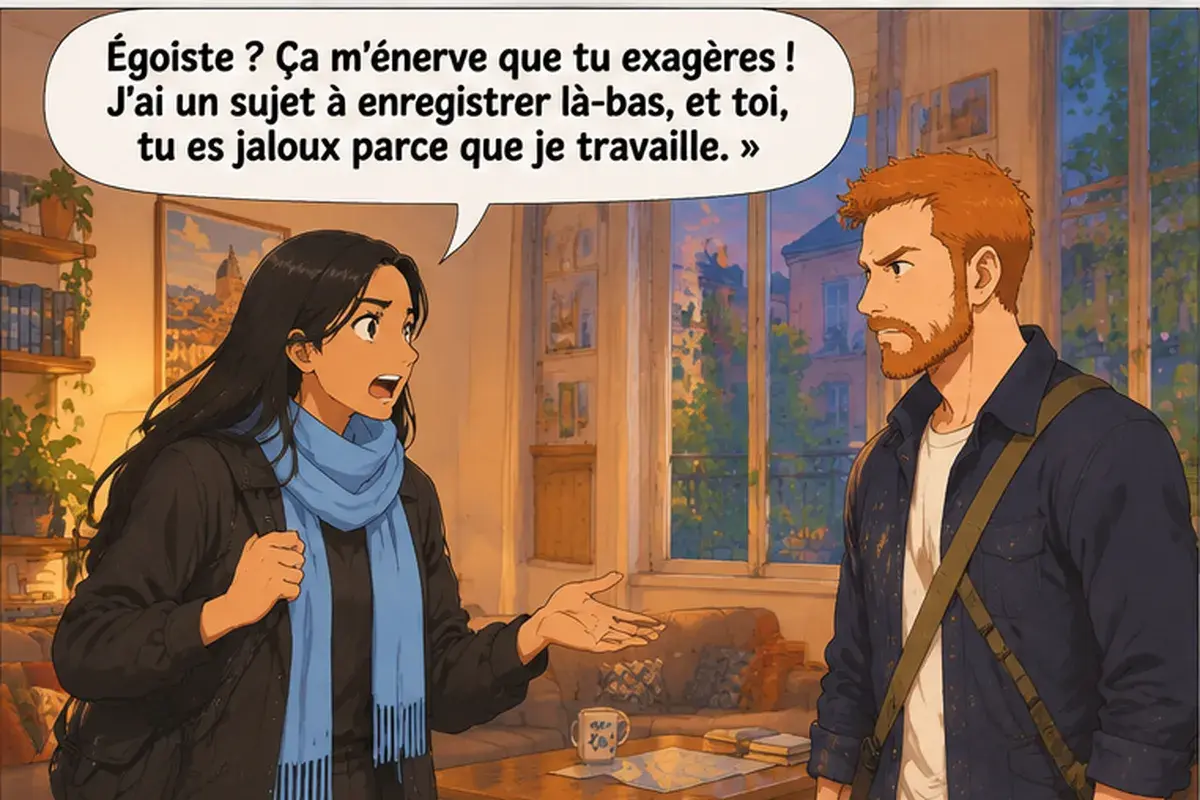
- Inès
Égoïste ? Ça m'énerve que tu exagères ! J'ai un sujet à enregistrer là-bas, et toi, tu es jaloux parce que je travaille.
Selfish? It annoys me that you're exaggerating! I have a story to record there, and you, you're jealous because I'm working. (to a man)

- Hugo
Jaloux ? De ton avion ? Je tiens bon, Inès : pas d'avion, même pour toi.
Jealous? Of your plane? I'm holding firm, Inès: no planes, not even for you.

- Inès
Tu m'accuses comme si j'avais menti ! C'est cruel.
You're accusing me as if I had lied! That's cruel.

- Hugo
Je ne t'insulte pas : je te reproche de ne m'avoir rien dit. Une grève possible, ce n'est pas une excuse, c'est presque une trahison.
I'm not insulting you: I'm reproaching you for not telling me anything. A possible strike is not an excuse, it's almost a betrayal.

- Inès
Une trahison ! C'est blessant, ça ! J'aurais aimé t'expliquer mes raisons, mais tu hurles déjà !
A betrayal! That's hurtful! I would have liked to explain my reasons to you, but you're already yelling!

- Hugo
Je ne hurle pas, je parle fort. Et oui, je prends le train, seul s'il le faut.
I'm not yelling, I'm talking loudly. And yes, I'm taking the train, alone if I have to. (man speaking)

- Inès
Parfait. Alors prends ton train, et moi, je prends mon avion.
Perfect. Then take your train, and as for me, I'm taking my plane.

- Pacha
Elle a claqué la porte. Ma question sur les horaires n'a pas aidé : j'aurais dû me taire.
She slammed the door. My question about the schedule didn't help: I should have kept quiet.
Grammar for this text
- Tu aurais pu me prévenir ! — a reproach: "you could have warned me (but you didn't)!" It is the set phrase
tu aurais pu+ infinitive:auraisisavoirin the conditional,puis the past participle ofpouvoir. Learn it as one chunk (the details are a B2 topic). The -s ofauraisis silent. More in the grammar of the unit. - j'ai peur que — "I'm afraid that": it takes the subjunctive. In the text: j'ai peur que la grève bloque tous les trains — "I'm afraid the strike will shut down all the trains".
bloquelooks like the normal present becausebloqueris a regular -er verb. - Je te jure que non ! — "I swear I didn't!"
jurermeans "to swear". - tu étais au courant ? — "did you know about it?"
être au courantmeans "to know about something". - Si on le prenait, on arriverait trois fois plus vite — "If we took it, we'd get there three times faster." After
sicomes the imperfect (prenait), and the other half takes the conditional (arriverait). Herelemeans "it" (the train). - comme si j'avais menti — "as if I had lied":
comme si+j'avais menti(something already done by then, unit 8). - je te reproche de ne m'avoir rien dit — "I'm reproaching you for not telling me anything":
avoir+ past participle, as inaprès avoir fait(unit 8). - Je tiens bon — "I'm holding firm":
tenir bonmeans "to hold firm", andtiensis the je form oftenir. - seul s'il le faut — "alone if I have to":
il faut+le("it"). - J'aurais aimé t'expliquer — "I would have liked to explain to you" (but it didn't happen):
j'aurais aimé+ infinitive, liketu aurais pu.t'iste, "to you". - j'aurais dû me taire — "I should have kept quiet" (but I didn't):
j'aurais dû+ infinitive.me tairemeans "to keep quiet".
Words and grammar of the unit: Have it out.
Learn the words from the texts with flashcards
In the app, you can tap any word in a text to see its translation, forms and examples, and new words stick with flashcards. 15 minutes a day.
Start for freeEverything is open for free. No card needed to sign up.