

French dialogue with translation · B1 · 18 lines
Je n'ai pas de contrat I don't have a contract
Comic · 18 panels
- Pacha
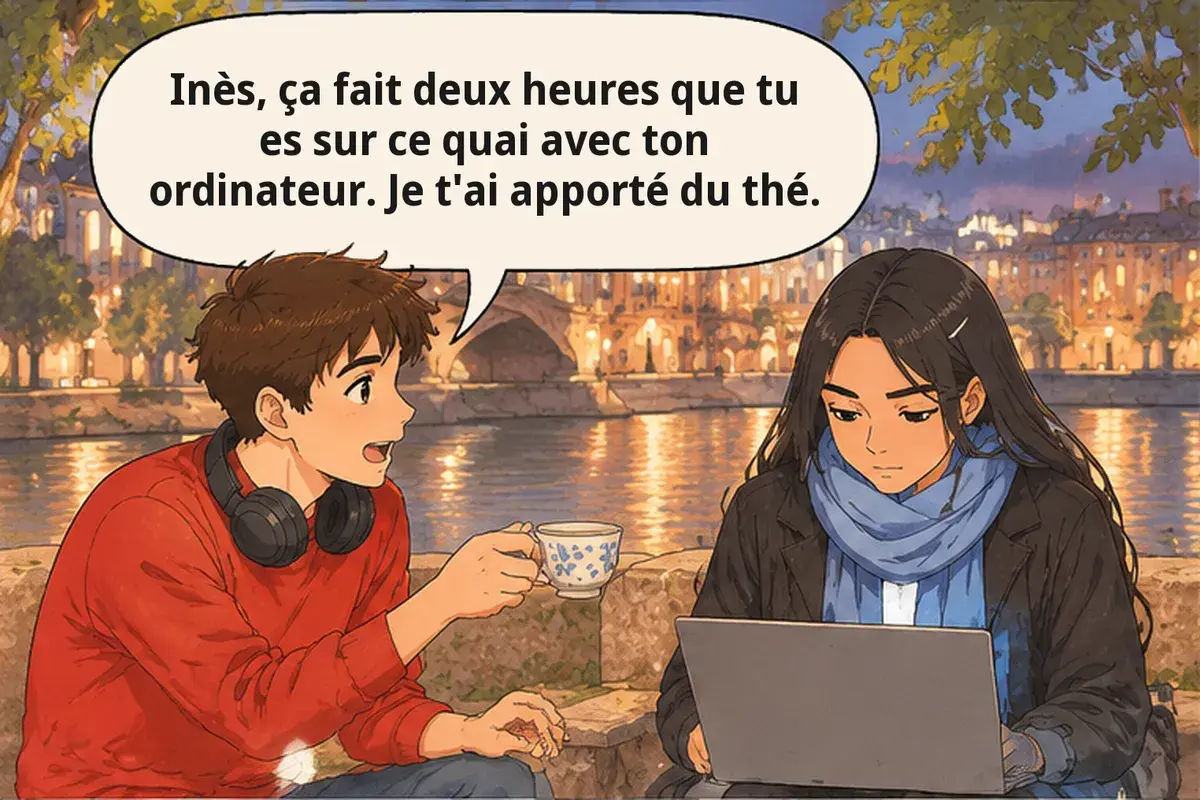
Inès, ça fait deux heures que tu es sur ce quai avec ton ordinateur. Je t'ai apporté du thé.
Inès, you've been on this quay with your computer for two hours. I brought you some tea.

- Inès
Merci. Il faut que j'envoie à la radio le plan de mon sujet sur Biarritz avant minuit, mais je n'arrive pas à me concentrer.
Thanks. I have to send the radio station the outline of my story on Biarritz before midnight, but I can't focus.
- Pacha
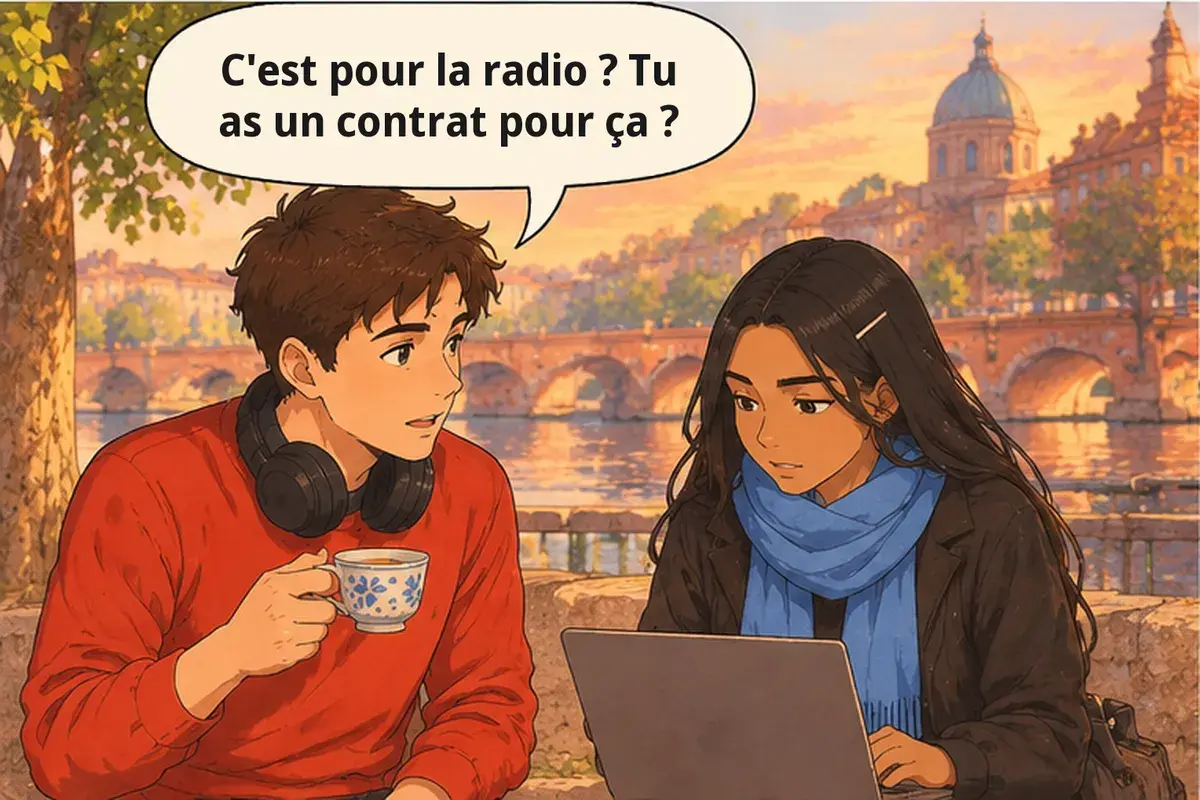
C'est pour la radio ? Tu as un contrat pour ça ?
Is it for the radio? Do you have a contract for that?
- Inès
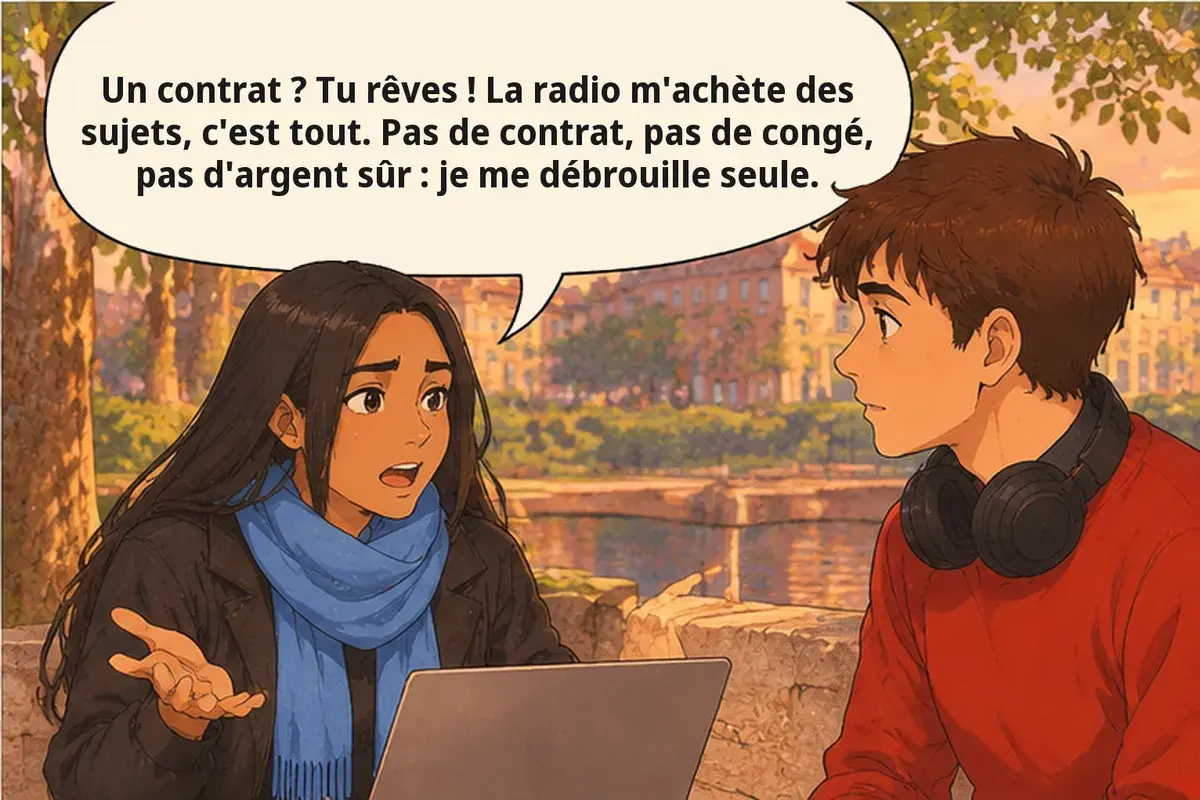
Un contrat ? Tu rêves ! La radio m'achète des sujets, c'est tout. Pas de contrat, pas de congé, pas d'argent sûr : je me débrouille seule.
A contract? You're dreaming! The radio station buys stories from me, that's all. No contract, no time off, no steady money: I manage on my own (woman speaking).
- Pacha
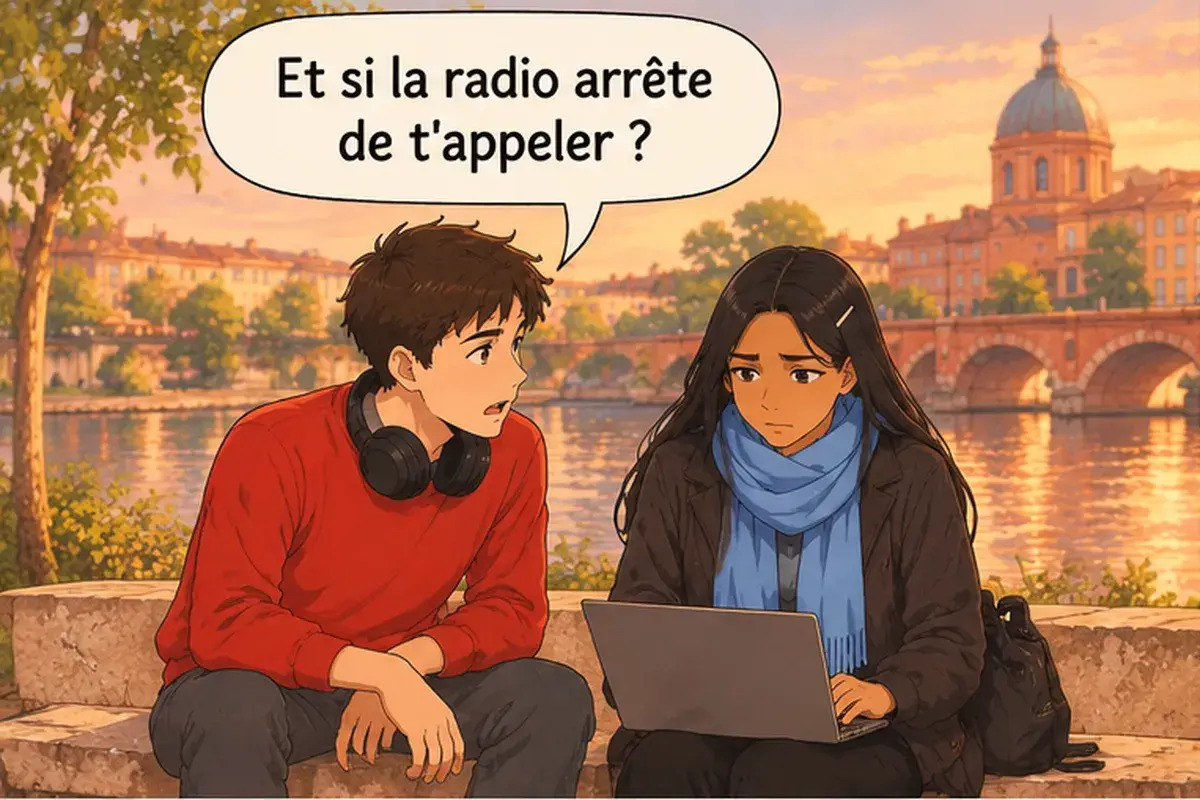
Et si la radio arrête de t'appeler ?
And what if the radio station stops calling you?
- Inès
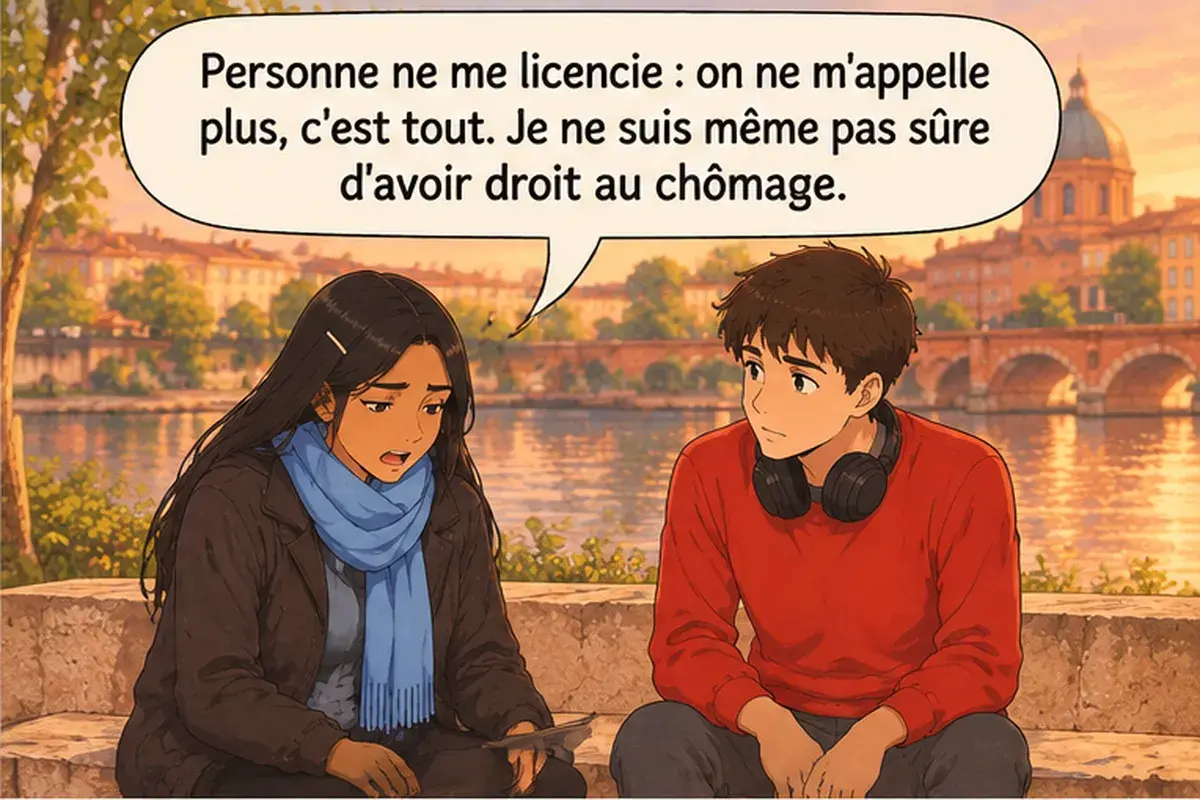
Personne ne me licencie : on ne m'appelle plus, c'est tout. Je ne suis même pas sûre d'avoir droit au chômage.
Nobody is firing me: they just don't call me anymore, that's all. I'm not even sure I'm entitled to unemployment (woman speaking).

- Pacha
Ce n'est pas du travail au noir, au moins ?
It's not working off the books, at least?
- Inès
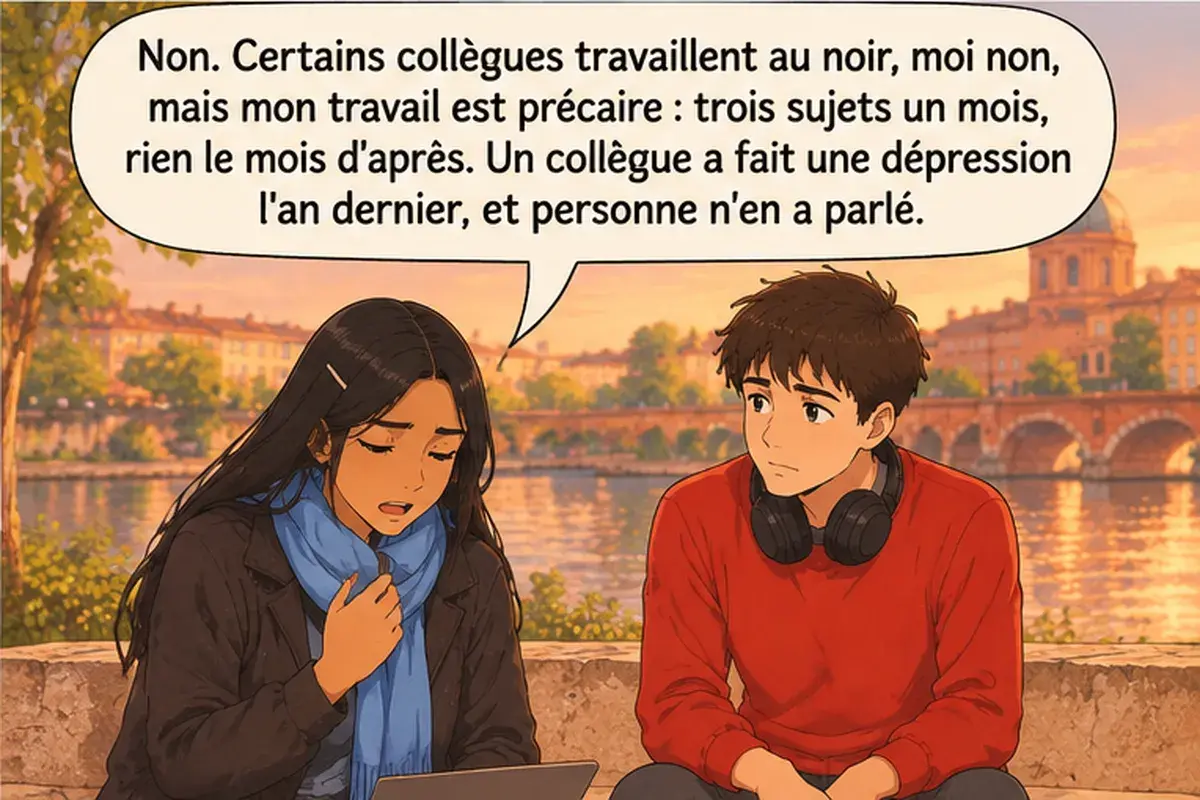
Non. Certains collègues travaillent au noir, moi non, mais mon travail est précaire : trois sujets un mois, rien le mois d'après. Un collègue a fait une dépression l'an dernier, et personne n'en a parlé.
No. Some colleagues work off the books, I don't, but my work is precarious: three stories one month, nothing the next. A colleague went through depression last year, and no one talked about it.

- Pacha
Et ton père, qu'est-ce qu'il dit ?
And your father, what does he say?
- Inès
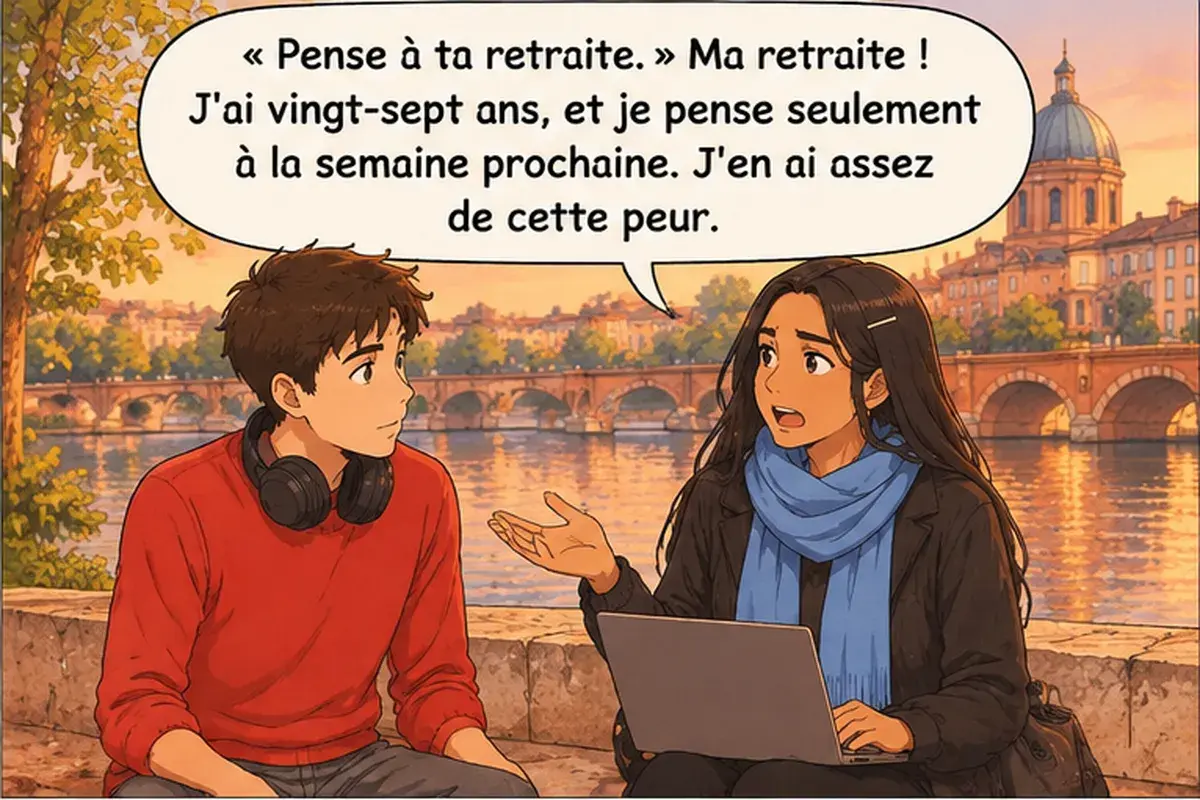
« Pense à ta retraite. » Ma retraite ! J'ai vingt-sept ans, et je pense seulement à la semaine prochaine. J'en ai assez de cette peur.
"Think about your retirement." My retirement! I'm twenty-seven, and I only think about next week. I've had enough of this fear.

- Pacha
C'est pour ça que tu as acheté des billets d'avion ?
Is that why you bought plane tickets?
- Inès
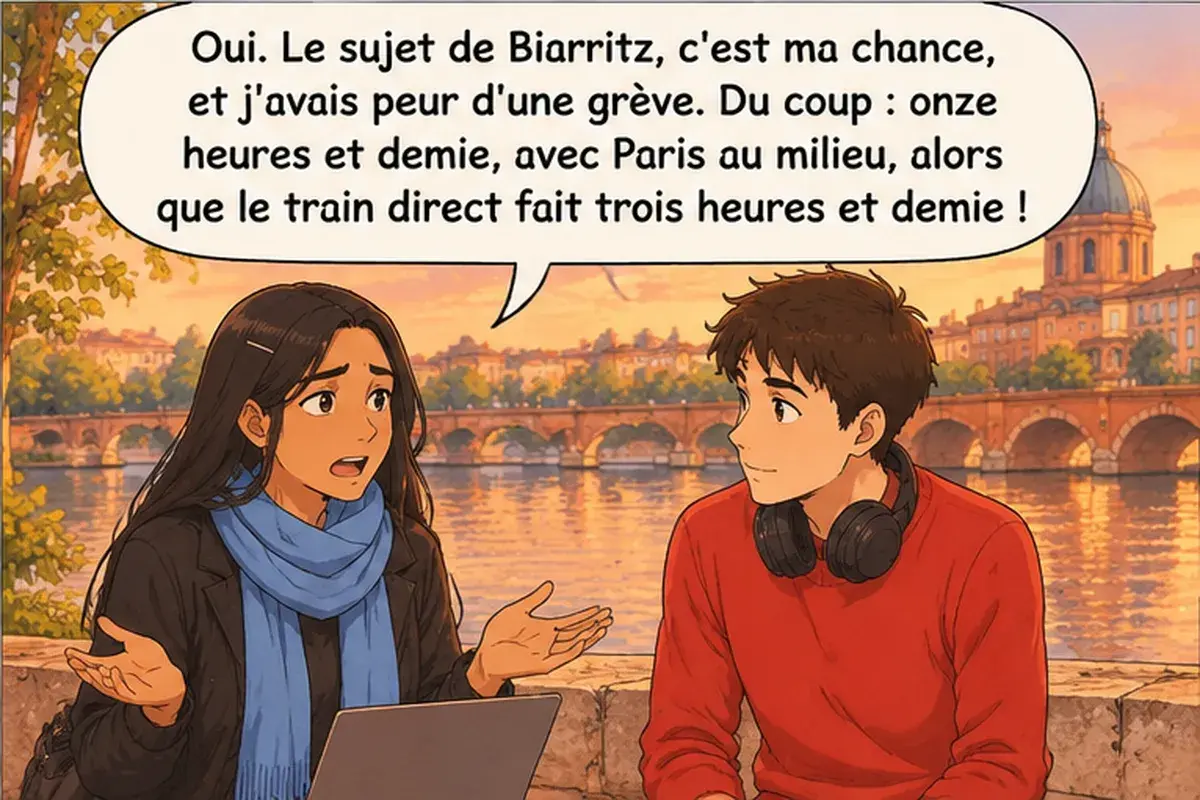
Oui. Le sujet de Biarritz, c'est ma chance, et j'avais peur d'une grève. Du coup : onze heures et demie, avec Paris au milieu, alors que le train direct fait trois heures et demie !
Yes. The Biarritz story is my chance, and I was afraid of a strike. So: eleven and a half hours, with Paris in the middle, when the direct train takes three and a half hours!

- Pacha
Tu as peur de ne pas finir à temps, c'est ça ?
You're afraid you won't finish on time, is that it?
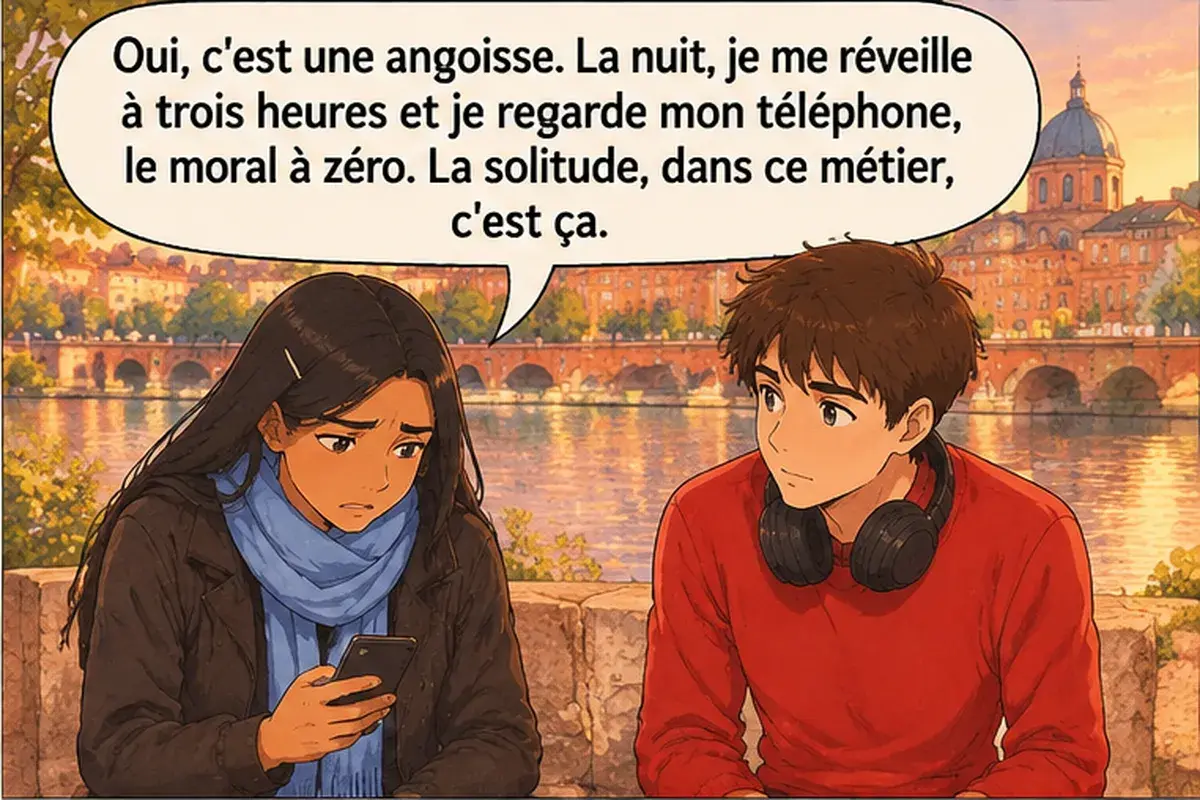
- Inès
Oui, c'est une angoisse. La nuit, je me réveille à trois heures et je regarde mon téléphone, le moral à zéro. La solitude, dans ce métier, c'est ça.
Yes, it's anxiety. At night, I wake up at three and look at my phone, my spirits at zero. Loneliness, in this line of work, is exactly that.

- Pacha
Hugo aussi a de l'insomnie. Il m'a parlé cette nuit, mais je ne dirai rien : c'était une conversation intime.
Hugo has insomnia too. He talked to me last night, but I won't say anything: it was a private conversation.

- Inès
Lui aussi ? D'habitude, il se moque de mes angoisses. Mais la culpabilité est là quand même : j'aurais dû lui parler avant d'acheter les billets.
Him too? Usually, he makes fun of my anxieties. But the guilt is there anyway: I should have talked to him before buying the tickets.
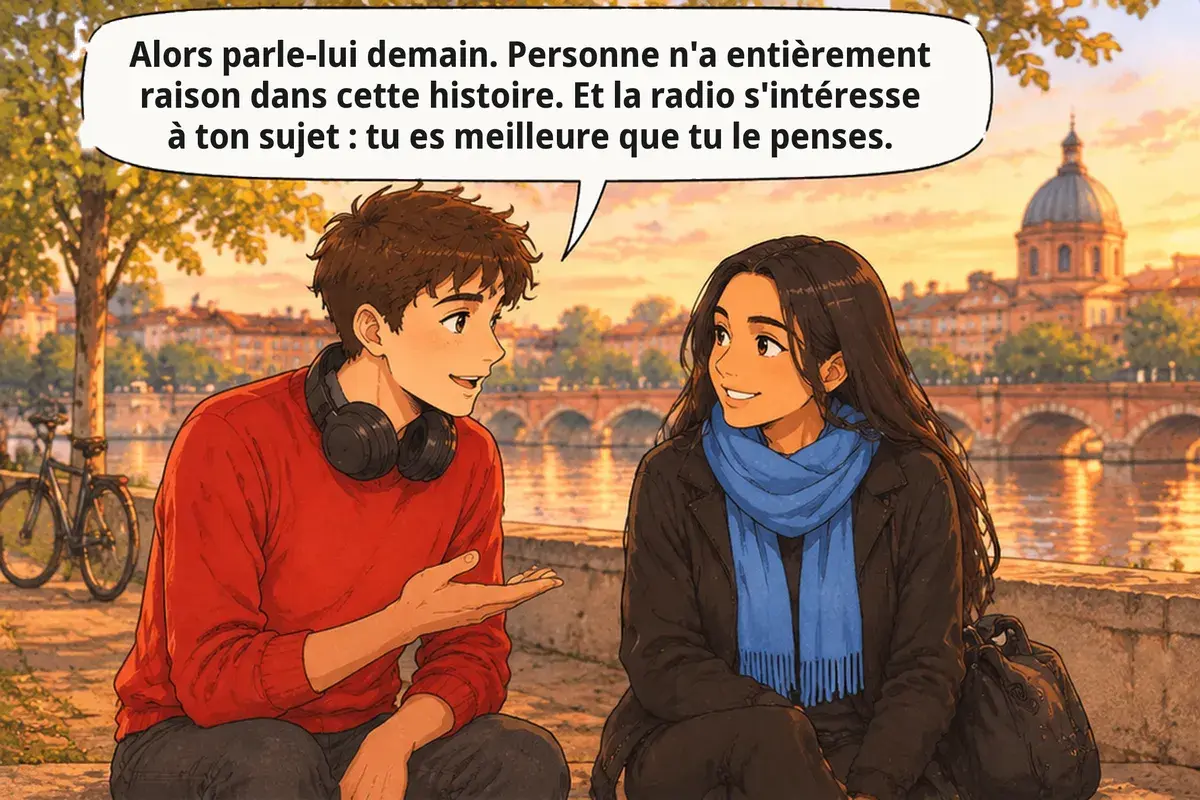
- Pacha
Alors parle-lui demain. Personne n'a entièrement raison dans cette histoire. Et la radio s'intéresse à ton sujet : tu es meilleure que tu le penses.
Then talk to him tomorrow. No one is entirely right in this story. And the radio station is interested in your story: you're better than you think (to a woman).

- Inès
Demain, promis. Ce soir, j'envoie mon plan. Je m'habitue à ton thé, c'est dangereux.
Tomorrow, I promise. Tonight, I'm sending my outline. I'm getting used to your tea, it's dangerous.
Grammar for this text
- il faut que — "it is necessary that"; it is followed by the subjunctive (unit 10).
- Il faut que j'envoie à la radio — I have to send the radio station.
envoyerhas the same form as in the present. - Tu rêves ! — You're dreaming! It's what you say to an unrealistic suggestion, like "in your dreams!" Literally: "you are dreaming."
- Personne ne me licencie — Nobody is firing me.
personneis the subject: "no one" +ne.licenciermeans the employer fires you; leaving on your own isdémissionner. Nobody is firing Inès: they just stop calling her. - Je ne suis même pas sûre d'avoir droit au chômage — I'm not even sure I'm entitled to unemployment.
avoir droit àmeans "to be entitled to";au = à + le.sûreis feminine: Inès is speaking. - J'en ai assez de cette peur — I've had enough of this fear.
en avoir assez demeans "to be fed up with";enis part of the expression here and doesn't replace anything. - Du coup — so, as a result (A2, unit 17). alors que le train direct fait trois heures et demie — whereas the direct train takes three and a half hours.
alors quemeans "whereas" (unit 11). - j'aurais dû lui parler — I should have talked to him. It's a ready-made phrase for "I should have":
dûcomes fromdevoir, a reproach to herself. The whole form is taught at B2. - tu es meilleure que tu le penses — you're better than you think.
meilleuremeans "better"; it's the feminine ofmeilleur(A2, unit 8).lehere means "so," not "the."
Words and grammar of the unit: Open up about your feelings.
Learn the words from the texts with flashcards
In the app, you can tap any word in a text to see its translation, forms and examples, and new words stick with flashcards. 15 minutes a day.
Start for freeEverything is open for free. No card needed to sign up.