

Spanish dialogue with translation · A1 · 14 lines
¿En qué trabajas? What do you do for work?
Comic · 13 panels

- Carmen
Hola, soy Carmen. ¿Tú eres amigo de Ana?
Hi, I'm Carmen. Are you a friend of Ana's? (to a man)
- Pablo
Sí, soy Pablo. Mucho gusto. ¿En qué trabajas?
Yes, I'm Pablo. Nice to meet you. What do you do for work?

- Carmen
Soy abogada. Trabajo en una empresa grande del centro.
I'm a lawyer. I work at a big company downtown (woman speaking).

- Pablo
¡Muy bien! Yo soy ingeniero, pero trabajo en una oficina pequeña.
Very good! I'm an engineer, but I work in a small office (man speaking).

- Carmen
¿Te gusta tu trabajo? ¿Tienes un buen jefe?
Do you like your job? Do you have a good boss?

- Pablo
Sí, mi jefe es muy bueno, y mis compañeros también. Tenemos una reunión cada lunes.
Yes, my boss is very good, and my coworkers are too. We have a meeting every Monday.
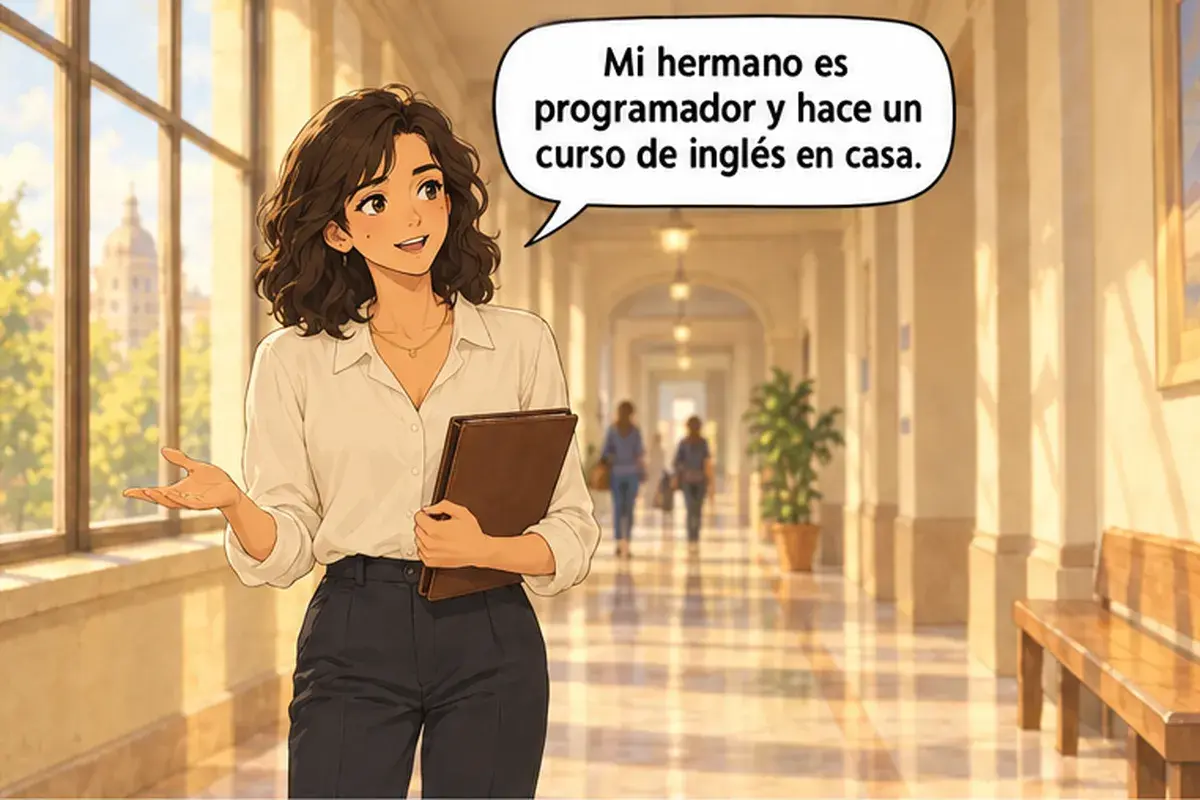
- Carmen
Mi hermano es programador y hace un curso de inglés en casa.
My brother is a programmer, and he's taking an English course at home.

- Pablo
¿Y tú? ¿Estudias algo ahora?
And you? Are you studying anything now?

- Carmen
Sí, aprendo inglés en la universidad. Tengo clase los martes y los jueves.
Yes, I'm learning English at the university. I have class on Tuesdays and Thursdays.

- Pablo
¿Es difícil? Yo leo y escribo en inglés, pero no hablo bien.
Is it difficult? I read and write in English, but I don't speak it well.

- Carmen
Leer es fácil, pero hablar es difícil. Tengo un examen el viernes.
Reading is easy, but speaking is hard. I have an exam on Friday.

- Pablo
Mucha suerte. ¿Repites las palabras nuevas todos los días?
Good luck. Do you repeat the new words every day?

- Carmen
Sí, y escribo cada palabra en mi libro con mi bolígrafo favorito.
Yes, and I write each word in my book with my favorite pen.

- Pablo
¡Qué bien! Yo también quiero aprender más.
Great! I want to learn more too.
Grammar for this text
Jobs without an article. After ser, Spanish names a job with no un / una, unlike English "a": soy abogada — I'm a lawyer; yo soy ingeniero — I'm an engineer; mi hermano es programador — my brother is a programmer. Carmen is a woman, so she says abogada, with -a at the end.
¿En qué trabajas? Word for word "in what do you work?" This is how Spanish asks "What do you do for work?" The answer is a job or a place: trabajo en una empresa grande del centro.
The yo and tú endings. trabajo, aprendo, yo leo y escribo: the yo form of most verbs ends in -o, whether they end in -ar, -er or -ir (a few common verbs break this rule: soy, estoy, voy). The tú form ends in -as for -ar verbs (trabajas, ¿estudias algo ahora?) and in -es for -er and -ir verbs (¿repites las palabras nuevas…?). Repites (from repetir) also changes its stem: e → i.
Hace un curso. Word for word "does a course", meaning "is taking a course". Hace is a form of the irregular verb hacer (to do, to make).
The infinitive as a subject. leer es fácil, pero hablar es difícil — "reading is easy, but speaking is hard". Where English often uses -ing, Spanish uses the infinitive. After quiero, the infinitive follows too, like English "want to": quiero aprender más — I want to learn more.
Un buen jefe. Bueno drops its -o before a masculine noun: un buen jefe. After the noun or after ser, it's the full word: mi jefe es muy bueno.
When. cada lunes — every Monday; los martes y los jueves — on Tuesdays and Thursdays; el viernes — on Friday. Spanish needs no word for "on" here: the article does the job.
Words and grammar of the unit: Talk about your work and studies.
Learn the words from the texts with flashcards
In the app, you can tap any word in a text to see its translation, forms and examples, and new words stick with flashcards. 15 minutes a day.
Start for freeEverything is open for free. No card needed to sign up.