

Spanish story with translation · A1 · 11 lines
En mi familia todos trabajan Everyone in my family works
Comic · 11 panels

Me llamo Sara y soy médica. Trabajo en el centro de la ciudad.
My name is Sara and I'm a doctor. I work downtown.

Mi marido, Miguel, es ingeniero. Trabaja todo el día con el ordenador.
My husband, Miguel, is an engineer. He works on the computer all day.
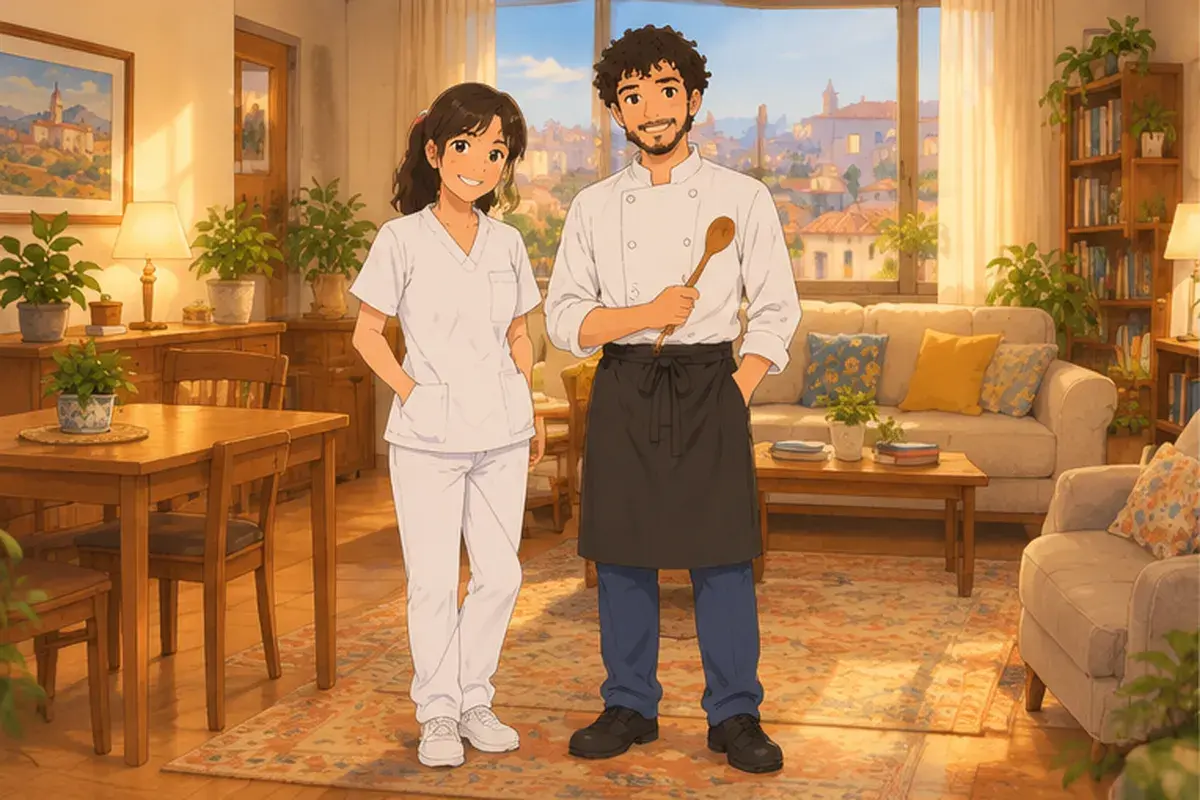
Mi hermana Rosa es enfermera, y mi hermano Luis es cocinero en un restaurante pequeño.
My sister Rosa is a nurse, and my brother Luis is a cook in a small restaurant.

Mi madre es dependienta en una tienda de ropa y mi padre es profesor en una escuela.
My mother is a salesclerk in a clothing store, and my father is a teacher at a school.

En nuestra familia no trabajamos los domingos.
In our family, we don't work on Sundays.

Ahora estudio inglés en la escuela de idiomas, dos días por semana.
Now I'm studying English at the language school, two days a week.

Es un curso difícil: hago muchas preguntas y escribo cada respuesta.
It's a difficult course: I ask a lot of questions and write down every answer.

Mi profesor siempre dice: «Repite, repite, repite».
My teacher always says, "Repeat, repeat, repeat."

A veces no entiendo una palabra y pregunto: «¿Qué significa?»
Sometimes I don't understand a word, and I ask, "What does it mean?"

Quiero leer libros en inglés y hablar con mis compañeros de trabajo.
I want to read books in English and talk with my coworkers.

Mi jefe dice que está muy bien, porque en la ciudad muchas personas hablan inglés.
My boss says that's very good, because many people in the city speak English.
Grammar for this text
Jobs with ser. soy médica, es ingeniero, Rosa es enfermera: no article. Job words for women end in -a: médica, enfermera, dependienta; for men: ingeniero, cocinero, profesor.
Trabajo: "I work" and "work". In trabajo en el centro de la ciudad it's the verb: "I work". In mis compañeros de trabajo it's the noun: "my coworkers", word for word "my companions of work".
Hacer and decir. Both are irregular. hago muchas preguntas — "I ask a lot of questions", word for word "I make questions". mi profesor siempre dice — "my teacher always says". mi jefe dice que está muy bien — que after dice means "that": "says that it's very good". English can drop "that" here; Spanish always keeps que.
Stem changes. no entiendo una palabra — from entender: e → ie. repite, repite, repite — from repetir: a tú command, "repeat!". The tú command looks like the él / ella form, so it has the same e → i change. Pregunto comes from the regular verb preguntar.
Quiero leer… y hablar. After quiero, the verbs stay in the infinitive: "I want to read and talk".
How often. no trabajamos los domingos — "we don't work on Sundays". dos días por semana — "two days a week": here por means "a" or "per". todo el día — "all day". a veces — "sometimes".
¿Qué significa? "What does it mean?" is a set question; Spanish needs no word for "it".
Words and grammar of the unit: Talk about your work and studies.
Learn the words from the texts with flashcards
In the app, you can tap any word in a text to see its translation, forms and examples, and new words stick with flashcards. 15 minutes a day.
Start for freeEverything is open for free. No card needed to sign up.