

Spanish story with translation · A1 · 13 lines
Entre semana tengo poco tiempo During the week I have little time
Comic · 9 panels

Mi semana empieza el lunes a las siete de la mañana.
My week starts on Monday at seven in the morning.
Todos los días me despierto, me levanto y me ducho. Por la mañana desayuno café con pan y queso.
Every day I wake up, get up and take a shower. In the morning I have coffee with bread and cheese for breakfast.

Salgo de casa a las ocho y media.
I leave home at eight thirty.
Desde el lunes hasta el viernes vuelvo a casa a las seis de la tarde.
From Monday to Friday I come back home at six in the evening.

Entre semana tengo poco tiempo. No me gusta la mañana, pero me gusta la tarde.
During the week I have little time. I don't like the morning, but I like the afternoon.

Los martes y los jueves cenamos con mis padres.
On Tuesdays and Thursdays we have dinner with my parents.

El miércoles ceno en casa y hablo con Ana por teléfono. Ella se acuesta a las diez.
On Wednesday I have dinner at home and talk to Ana on the phone. She goes to bed at ten.

Me acuesto a las once, pero el viernes me acuesto a las doce.
I go to bed at eleven, but on Friday I go to bed at twelve.
¿Cuándo duermo más? El sábado y el domingo.
When do I sleep more? On Saturday and Sunday.

El fin de semana duermo hasta las diez.
On the weekend I sleep until ten.

La noche del sábado salgo con mis amigos.
On Saturday night I go out with my friends.
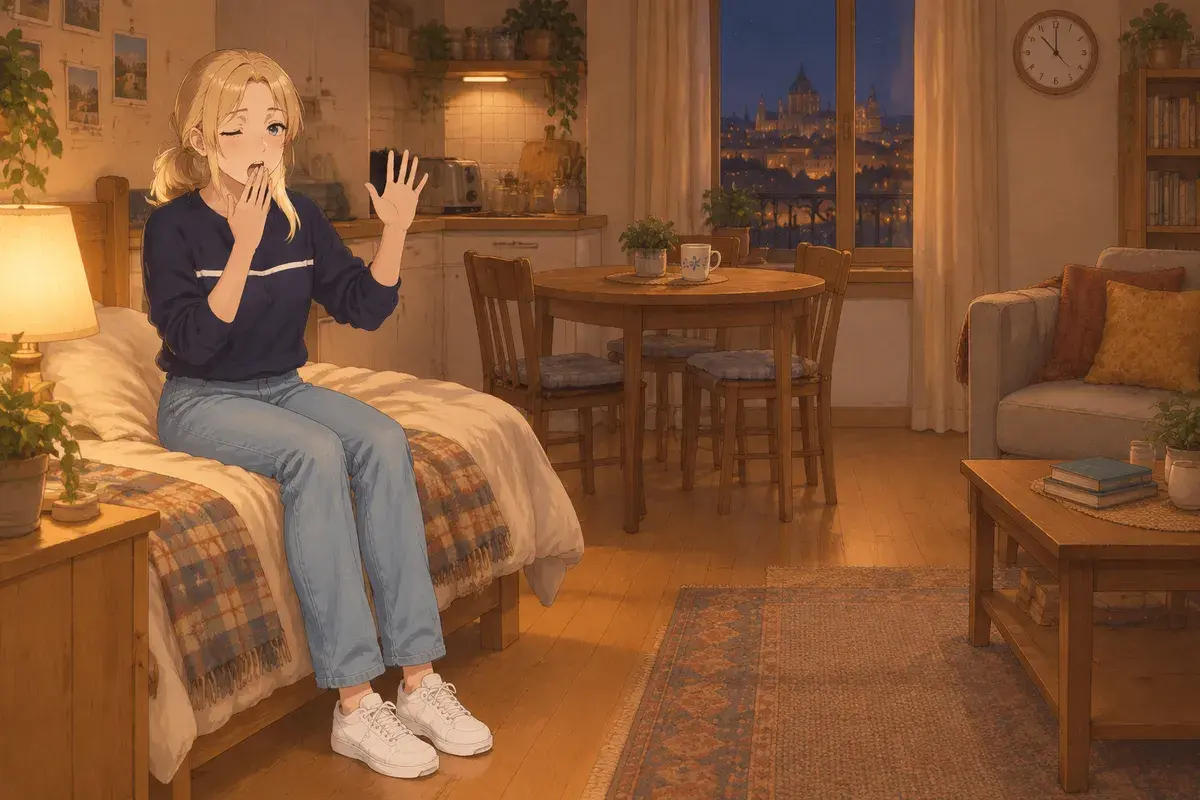
Ahora son las once y cuarto de la noche. ¡Tengo que dormir!
Now it's a quarter past eleven at night. I have to sleep!
¡Hasta mañana!
See you tomorrow!
Grammar for this text
el lunes and los martes: when. A day with el means "on that day": El miércoles ceno en casa, el viernes me acuesto a las doce. With los it means "every such day": Los martes y los jueves cenamos con mis padres — "on Tuesdays and Thursdays". Spanish needs no word for "on": the article does that job. The same goes for el fin de semana — "on the weekend".
Clock time and part of the day. A las siete de la mañana — "at seven in the morning", a las seis de la tarde — "at six in the evening": after a clock time, the part of the day comes with de la. Without a clock time, use por la: Por la mañana desayuno — "In the morning I have breakfast". Desde el lunes hasta el viernes — "from Monday to Friday". La noche del sábado — word for word "the night of Saturday", that is, "on Saturday night".
salgo, vuelvo, duermo. Salgo de casa comes from salir (to leave): the yo form is irregular, so just learn it. Vuelvo a casa (from volver, to come back) and duermo (from dormir, to sleep): when the stress falls on the stem, o becomes ue. Casa meaning "your own home" has no article: de casa — from home, a casa — home, en casa — at home. And in salgo con mis amigos, salir means "to go out" for fun.
me acuesto, se acuesta. About yourself, use me; about someone else, use se: Ella se acuesta a las diez.
empieza. Mi semana empieza comes from empezar (to start): the stem changes e → ie, like quiere (unit 6).
la mañana and mañana. With the article, la mañana is "morning" (No me gusta la mañana); without it, mañana means "tomorrow" (¡Hasta mañana!).
Words and grammar of the unit: Ask the time and describe your day.
Learn the words from the texts with flashcards
In the app, you can tap any word in a text to see its translation, forms and examples, and new words stick with flashcards. 15 minutes a day.
Start for freeEverything is open for free. No card needed to sign up.