

German story with translation · B1 · 12 lines
Es regnet? Umso besser! It's raining? All the better!
Comic · 12 panels

Am Samstag regnete es schon früh. Schietwetter!
On Saturday it was already raining early. Lousy weather!

Normalerweise bin ich sportlich, aber an dem Morgen war ich faul und hatte keine Motivation.
Normally I'm sporty, but that morning I was lazy and had no motivation.

Aber meine Mitgliedschaft im Lauftreff war ganz neu, und ich wollte regelmäßig trainieren.
But my membership in the running club was brand new, and I wanted to train regularly.

Also zog ich die Regenjacke an und fuhr zur Alster.
So I put on my rain jacket and went to the Alster.
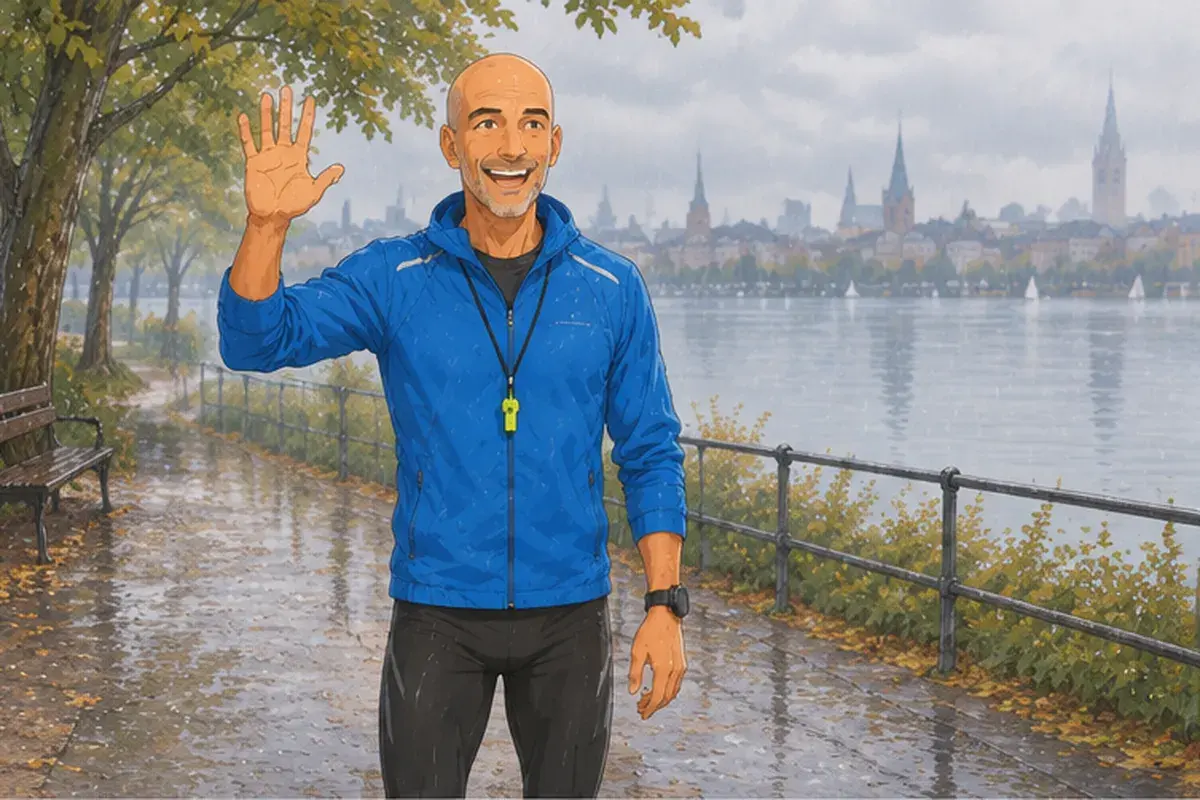
Jörg stand am Start und lachte: „Es regnet? Umso besser!“
Jörg stood at the start and laughed: "It's raining? All the better!"

Von wegen besser! Nach fünf Minuten war ich völlig nass.
Better? No way! After five minutes I was completely wet.

Je länger wir liefen, desto weniger störte mich der Regen, nur den Muskelkater spürte ich.
The longer we ran, the less the rain bothered me; I only felt my sore muscles.

Für das Tempo in der Gruppe fehlte mir nach wie vor die Ausdauer, aber ich hielt durch.
I still lacked the stamina for the pace in the group, but I kept going.

Ab und zu gingen wir ein Stück, aber das Training war hart.
Now and then we walked a bit, but the workout was hard.

Am Ende hatte ich fast keine Kraft mehr, aber richtig gute Laune.
At the end I had almost no strength left, but I was in a really good mood.

Danach gab es Tee im Café am Ufer, und Jörg erzählte vom Picknick im Sommer.
Afterward there was tea at the café on the shore, and Jörg talked about the picnic in the summer.

Zum Glück gab es keine Verletzung, und die Bewegung gab mir Energie.
Luckily there was no injury, and the exercise gave me energy.
Grammar for this text
- Am Samstag regnete es schon früh —
regneteis the Präteritum (narrative past) ofregnen: add-ete("it was raining"). Stories about the past are told in the Präteritum (unit 1). - Also zog ich die Regenjacke an und fuhr zur Alster —
zogis the Präteritum ofanziehen(to put on), the ich form. The stem changes:ziehen — zog. The prefixanwent to the end.fuhris the Präteritum offahren(to go, to drive):abecomesu, also the ich form.alsohere means "so", not "also". - Jörg stand am Start und lachte —
standcomes fromstehen(to stand),lachtefromlachen(to laugh); both are er forms. Ich wollte regelmäßig trainieren —wollteis the Präteritum ofwollen("wanted"), the ich form. - Von wegen besser! — a casual way to disagree: "no way, as if". Katja doesn't agree with Jörg. The word
wegen(because of) has nothing to do with it here. - Je länger wir liefen, desto weniger störte mich der Regen —
je … desto— "the …, the …" (this unit): afterjethe verb goes to the end (liefenis the Präteritum oflaufen:aubecomesie), afterdestothe verb comes right away (störte). Ab und zu gingen wir ein Stück —gingenis the Präteritum ofgehen(to go, to walk), the wir form;ab und zu— "now and then". - Für das Tempo in der Gruppe fehlte mir nach wie vor die Ausdauer, aber ich hielt durch —
fehlteis the Präteritum offehlen(to be missing). The person who lacks something is in the dative:mir— "(to) me", literally "the stamina was missing to me".nach wie vor— "still".durchhalten(to keep going) is separable:hieltis the Präteritum ofhalten, anddurchstands at the end. - Zum Glück gab es keine Verletzung —
gab esis the Präteritum ofes gibt("there was");zum Glück— "luckily".
Words and grammar of the unit: Join a running club.
Learn the words from the texts with flashcards
In the app, you can tap any word in a text to see its translation, forms and examples, and new words stick with flashcards. 15 minutes a day.
Start for freeEverything is open for free. No card needed to sign up.