

German story with translation · A2 · 12 lines
Er steckt in der Tasche It's in the pocket
Comic · 12 panels

Meine Unterkunft ist eine Ferienwohnung: klein, aber sauber und praktisch.
My place to stay is a vacation rental: small, but clean and practical.

Sie ist zentral und im Erdgeschoss. Ein Café ist um die Ecke.
It's central and on the ground floor. There's a café around the corner.
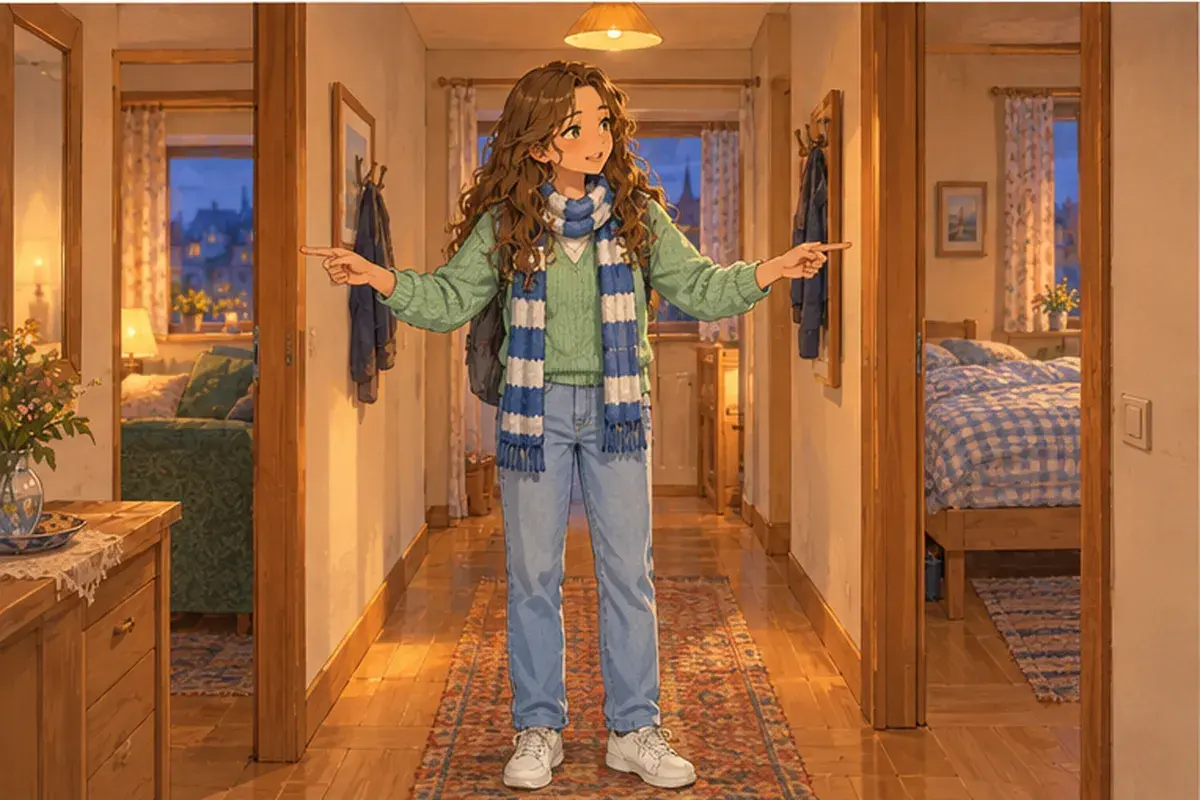
Der Flur ist zwischen dem Wohnzimmer und dem Schlafzimmer.
The hallway is between the living room and the bedroom.

Den Koffer stelle ich unter das Bett, den Stuhl an den Tisch.
I put the suitcase under the bed and the chair at the table.

Im Flur hängt ein Spiegel, im Wohnzimmer an der Wand eine Kuckucksuhr.
A mirror hangs in the hallway, and a cuckoo clock on the wall in the living room.

Ich hänge die Jacke an den Haken und lege alles ins Regal.
I hang the jacket on the hook and put everything on the shelf.

Auf dem Zettel von der Gastgeberin steht: Supermarkt in der Nähe.
The note from the host says: supermarket nearby.

Ich will einkaufen, aber wo ist der Schlüssel? Er muss irgendwo sein!
I want to go shopping, but where's the key? It has to be somewhere!

Ich suche in der Schublade, unter der Decke, hinter dem Stuhl.
I search in the drawer, under the blanket, behind the chair.

Alle Dinge liegen auf dem Boden, aber der Schlüssel ist nicht da.
All the things are lying on the floor, but the key isn't there.

Ich nehme die Jacke vom Haken: Er steckt in der Tasche!
I take the jacket off the hook: it's in the pocket!

Zuerst räume ich auf, dann gehe ich einkaufen.
First I tidy up, then I go shopping.
Grammar for this text
- Den Koffer stelle ich unter das Bett — "where to?", so the accusative: das Bett (neuter das doesn't change), den Koffer (der becomes den). stelle is the ich form of stellen (to put, set upright). If the suitcase were already there, it would be steht unter dem Bett. Den Koffer comes first, so the verb stays second and ich moves after it.
- Im Flur hängt ein Spiegel, im Wohnzimmer an der Wand eine Kuckucksuhr — im = in dem: "where?", so the dative; an der Wand is "where?" too (die Wand becomes der Wand). The second time, hängt isn't repeated.
- Ich hänge die Jacke an den Haken und lege alles ins Regal — here hänge means "hang up" (where to? — accusative: der Haken becomes den Haken); lege is from legen (to lay, put flat); ins = in das. One ich for two verbs, as in English.
- Er muss irgendwo sein! — muss is the er / sie / es form of müssen (must, have to); sein goes to the end. irgendwo means "somewhere"; er here is der Schlüssel, so English says "it".
- Ich suche in der Schublade, unter der Decke, hinter dem Stuhl — "where?" three times, so der Schublade, der Decke, dem Stuhl. die Decke is a blanket here (it can also mean a ceiling). Alle Dinge liegen auf dem Boden — liegen (to lie) in the sie form (they); Dinge is the plural of das Ding.
- Ich nehme die Jacke vom Haken — vom = von dem: von always takes the dative. Er steckt in der Tasche! — steckt is the er form of stecken (to be inside); er is der Schlüssel; die Tasche means "pocket" here.
- Zuerst räume ich auf — aufräumen (to tidy up) splits: räume is in second place, auf at the end, like "tidy up". Zuerst comes first, so ich moves after the verb.
Words and grammar of the unit: Stay in a vacation rental.
Learn the words from the texts with flashcards
In the app, you can tap any word in a text to see its translation, forms and examples, and new words stick with flashcards. 15 minutes a day.
Start for freeEverything is open for free. No card needed to sign up.