

German dialogue with translation · A1 · 11 lines
Wie war der Flug? How was the flight?
Comic · 7 panels

- Lukas
Katja! Hallo! Herzlich willkommen in Berlin!
Katja! Hi! Welcome to Berlin!
- Katja
Hallo, Lukas! Freut mich!
Hi, Lukas! Nice to meet you!

- Lukas
Freut mich auch! Wie war der Flug?
Nice to meet you too! How was the flight?

- Katja
Der Flug war sehr gut, aber die Ankunft: „Wie bitte? Wie bitte?“
The flight was very good, but the arrival: "Pardon? Pardon?"
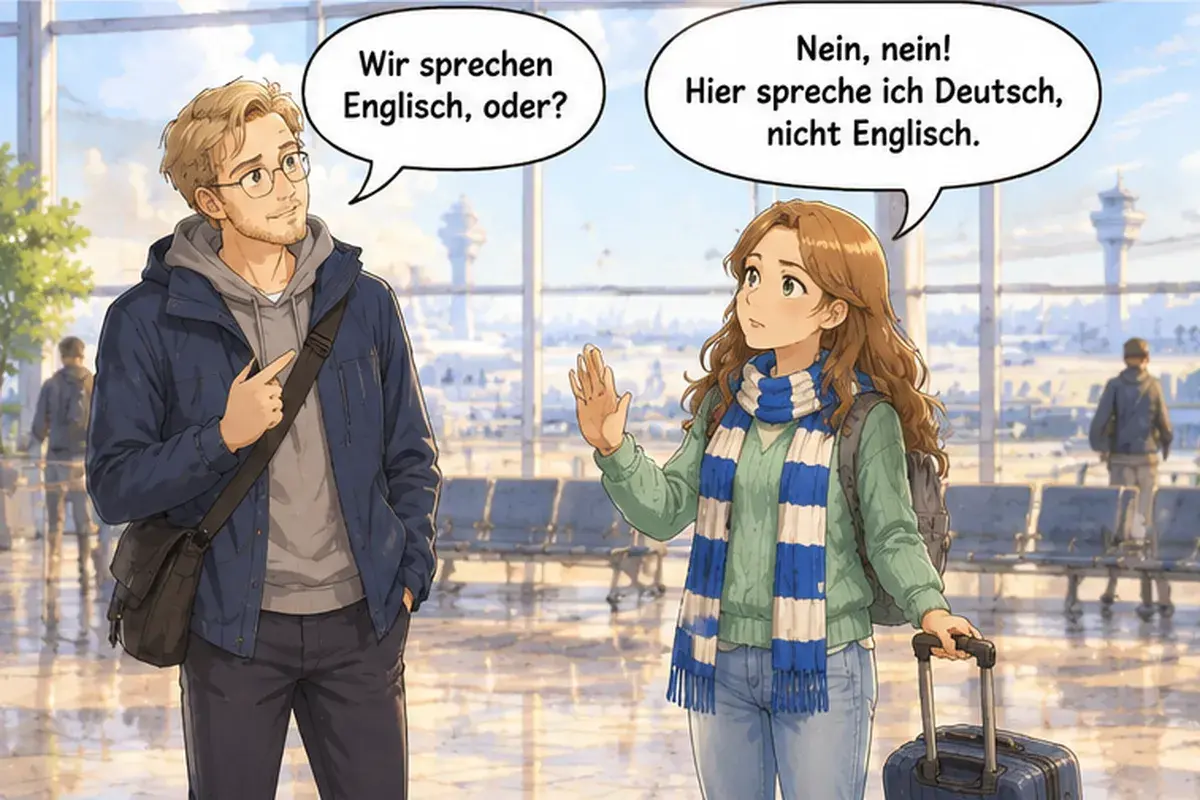
- Lukas
Wir sprechen Englisch, oder?
We're speaking English, right?
- Katja
Nein, nein! Hier spreche ich Deutsch, nicht Englisch.
No, no! Here I speak German, not English.

- Lukas
Gut! Ich spreche langsam, ja?
Good! I'll speak slowly, okay?
- Katja
Ja, bitte! Ich verstehe ein bisschen.
Yes, please! I understand a little.

- Lukas
Sehr gut! Und wie geht's dir?
Very good! And how are you?
- Katja
Gut, danke. Und du?
Good, thanks. And you?

- Lukas
Auch gut, danke! Zwei Wochen Berlin — sehr gut!
Good too, thanks! Two weeks of Berlin — very good!
Grammar for this text
Freut mich: a set phrase, "nice to meet you"; word for word "pleases me" (mich means "me"). The answer:Freut mich auch— nice to meet you too.Wie war der Flug?: war is "was", the past of sein (ist → war). The past tense comes later; for now learn the question as a whole: it's what people ask after a trip. der Flug is masculine.Der Flug war sehr gut: the answer uses the same form; sehr (very) goes before gut, as in English.aber die Ankunft: „Wie bitte? Wie bitte?“: Katja is joking: at passport control she kept asking people to repeat. Wie bitte? is the polite "pardon?". There's no verb after die Ankunft: that's how people keep it short when they talk.Wir sprechen Englisch, oder?: sprechen is the wir form (the same as the dictionary form). oder? at the end means "right?".Ich spreche langsam, ja?: spreche is the ich form. ja? at the end asks for agreement: "okay?".Und wie geht's dir?: a set phrase, "how are you?": geht's is short for geht es, and dir is "you" for a friend (to an adult stranger you say Wie geht es Ihnen?). For now learn it as a whole.
Words and grammar of the unit: Say hello and introduce yourself.
Learn the words from the texts with flashcards
In the app, you can tap any word in a text to see its translation, forms and examples, and new words stick with flashcards. 15 minutes a day.
Start for freeEverything is open for free. No card needed to sign up.