

Portuguese story with translation · A2 · 14 lines
É melhor reservar cedo It's better to book early
Comic · 11 panels

Escrevo no caderno o capítulo do carnaval, e a Bia lê cada linha.
I'm writing the Carnival chapter in my notebook, and Bia reads every line.

Em fevereiro o turismo muda a cidade: o público do carnaval vem do mundo inteiro.
In February tourism changes the city: the Carnival crowd comes from all over the world.

Primeiro, a reserva: os quartos acabam rapidamente, e quem chega sem reserva não acha nada.
First, the reservation: rooms run out quickly, and anyone who arrives without a reservation can't find anything.
É melhor reservar cedo.
It's better to book early.

Quarto, mesa no restaurante, tudo.
A room, a table at a restaurant, everything.
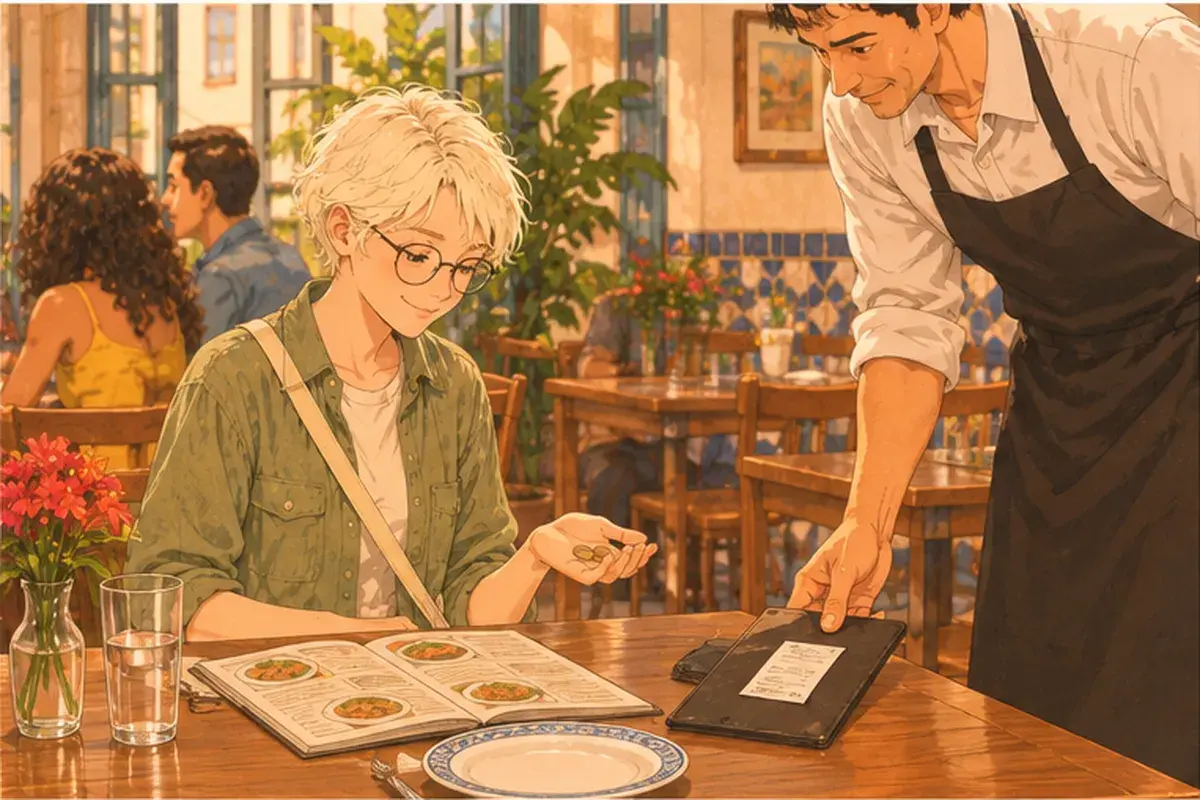
No restaurante, o menu mostra os preços, mas a conta vem com dez por cento a mais.
At the restaurant, the menu shows the prices, but the check comes with ten percent extra.
Esses dez por cento são a gorjeta do garçom, e a maioria das pessoas paga. Se o serviço é excelente, a gente dá um pouco mais.
That ten percent is the waiter's tip, and most people pay it. If the service is excellent, we give a little more.

Dinheiro? Só real. O turista chega com dólar, e o quiosque responde: “Aqui é só real, amigo”.
Money? Only reais. The tourist arrives with dollars, and the kiosk answers: "Only reais here, friend."

Pedir comida em casa? A entrega demora, porque a rua está cheia de gente.
Ordering food at home? Delivery takes a while, because the street is full of people.

Leve a própria água. E respeite o vizinho: ele também quer dormir.
Take your own water. And respect your neighbor: he wants to sleep too.

A dica principal: leve chinelo velho, porque chinelo novo some. A Bia lê e diz: “De fato. Eu já perdi três”.
The main tip: take old flip-flops, because new flip-flops disappear. Bia reads it and says: "In fact. I've already lost three."

O Léo comprou um cabelo azul e não diz por quê.
Léo bought blue hair and won't say why.
Para ele, o porquê é segredo.
For him, the reason is a secret.

A Bia pergunta: “Por que tantas regras?” E eu respondo: “Porque quero chegar em casa inteira.”
Bia asks: "Why so many rules?" And I answer: "Because I want to get home in one piece." (woman speaking)
Grammar for this text
- os quartos acabam rapidamente —
rapidamente=rápida+-mente: "quickly". It is used in books and articles; in conversation people just sayrápido. Hereacabarmeans "to run out". - quem chega sem reserva —
a reservais a noun, "reservation" (it comes with an article), not a form of the verbreservar.quemmeans "whoever, the one who". - É melhor reservar cedo —
é melhor+ infinitive is gentle advice (A2, unit 21).cedomeans "early", here "ahead of time". - a conta vem com dez por cento a mais — restaurant checks usually already include ten percent for service. This is
a gorjeta, the tip. You don't have to pay it, but most people do. - a maioria das pessoas paga —
a maioria das+ plural noun means "most of the";das=de+as. The verb is usually singular:paga. - Dinheiro? Só real. — there is no verb: "Only reais."
realis one word; the plural isreais. - A entrega demora —
a entregameans "delivery";demorameans "takes a while". - Leve a própria água. E respeite o vizinho —
leveandrespeiteare polite commands fromlevarandrespeitar, likefale: this is how tips are written in books.a própria águameans "your own water". - De fato — "that's right, indeed": it confirms what was said.
- chinelo novo some —
somemeans "disappears", fromsumir. - não diz por quê —
por quêhas an accent because it comes at the end of the sentence. All four spellings are in the unit grammar.
Words and grammar of the unit: Put together a Carnival costume.
Learn the words from the texts with flashcards
In the app, you can tap any word in a text to see its translation, forms and examples, and new words stick with flashcards. 15 minutes a day.
Start for freeEverything is open for free. No card needed to sign up.