

Portuguese dialogue with translation · A1 · 12 lines
Como a gente vai para a rodoviária? How are we getting to the bus station?
Comic · 7 panels

- Nina
Léo, como a gente vai para a rodoviária? De carro?
Léo, how are we getting to the bus station? By car?
- Léo
Eu dirijo, mas não tenho carro.
I drive, but I don't have a car.

- Bia
Então vamos de avião!
Then let's go by plane!
- Léo
Para Ubatuba?! E o aeroporto fica longe.
To Ubatuba?! And the airport is far away.
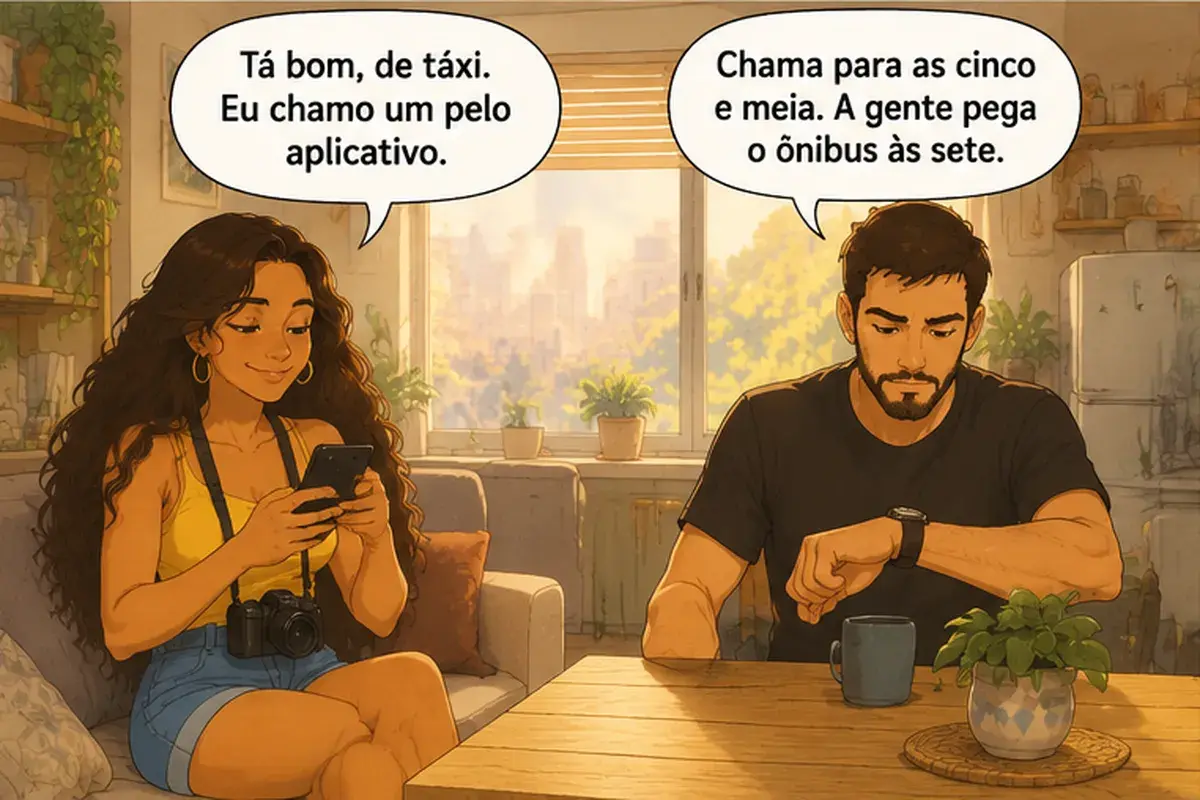
- Bia
Tá bom, de táxi. Eu chamo um pelo aplicativo.
OK, by taxi. I'll call one through the app.
- Léo
Chama para as cinco e meia. A gente pega o ônibus às sete.
Call it for five thirty. We're taking the bus at seven.

- Nina
Às cinco e meia?! Por que às cinco e meia?
At five thirty?! Why at five thirty?
- Léo
Porque a Bia.
Because Bia.

- Nina
E eu levo mala ou mochila?
And do I take a suitcase or a backpack?
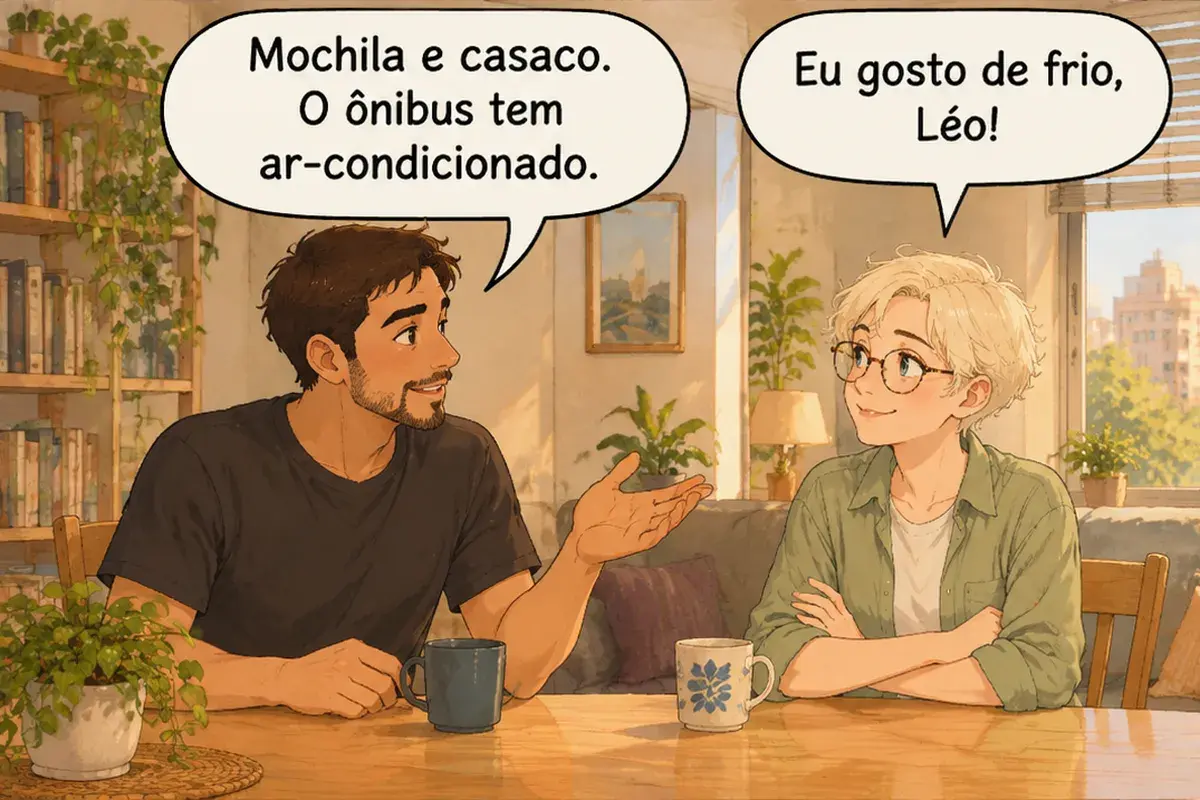
- Léo
Mochila e casaco. O ônibus tem ar-condicionado.
A backpack and a coat. The bus has air conditioning.
- Nina
Eu gosto de frio, Léo!
I like the cold, Léo!

- Léo
Eu sei. Mas o ar-condicionado é brasileiro.
I know. But the air conditioning is Brazilian.
Grammar for this text
- Por que às cinco e meia? and Porque a Bia. — por que as two words is the question "why?"; porque as one word is the answer "because". Léo answers briefly: "Because Bia" (who is always late).
- Eu dirijo, mas não tenho carro. — dirijo is the eu form of dirigir (to drive). Before o, the letter g becomes j so the sound stays the same; the other forms are regular: você dirige.
- Então vamos de avião! — vamos is the nós form of ir. de avião — "by plane": a means of transport takes de and no article, like English "by plane".
- Eu chamo um pelo aplicativo. — um stands for um táxi: the word táxi was already said, so it's dropped. pelo = por + o — "through the app".
- Chama para as cinco e meia. — chama is the você / ele / ela form of chamar, but here it's a request: "call (one)". This is how friends ask for something casually (commands come in A2). cinco e meia — "five thirty", literally "five and a half".
- A gente pega o ônibus às sete. — pega is from pegar (to take).
- pegar o ônibus — "to take the bus".
Words and grammar of the unit: Buy a bus ticket.
Learn the words from the texts with flashcards
In the app, you can tap any word in a text to see its translation, forms and examples, and new words stick with flashcards. 15 minutes a day.
Start for freeEverything is open for free. No card needed to sign up.