

Portuguese story with translation · A1 · 14 lines
Amanhã a gente vai ficar na praia o dia todo Tomorrow we're going to stay at the beach all day
Comic · 8 panels

Oi, Dima! Estamos em Ubatuba, na praia!
Hi, Dima! We're in Ubatuba, at the beach!
Não é um hotel, é uma pousada pequena: do mar são dois minutos a pé.
It's not a hotel, it's a small guesthouse: the sea is two minutes away on foot.

É feriado, é como férias: aqui a gente não tem pressa.
It's a holiday, it's like a vacation: here we're in no hurry.
Amanhã a gente vai ficar na praia o dia todo!
Tomorrow we're going to stay at the beach all day!
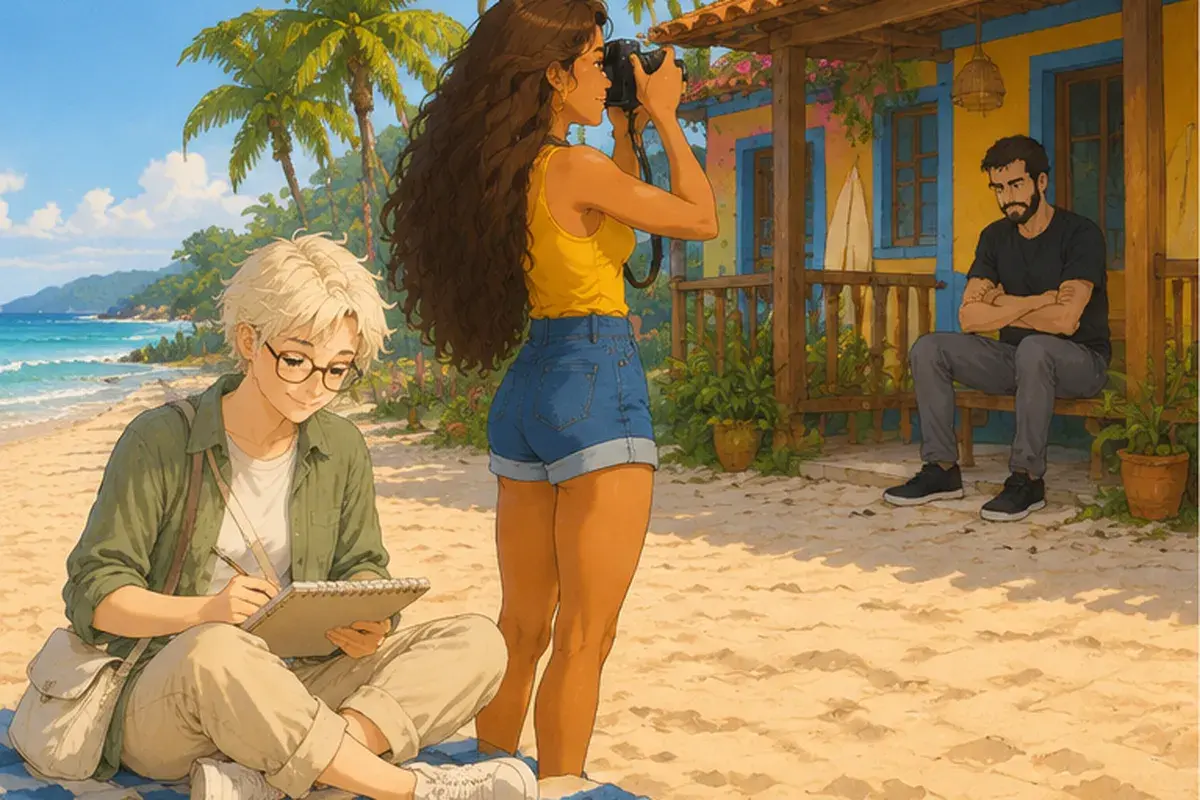
Eu vou desenhar o mar, e a Bia vai tirar mil fotos.
I'm going to draw the sea, and Bia is going to take a thousand photos.
O Léo vai ficar na pousada: ele não gosta de areia.
Léo is going to stay at the guesthouse: he doesn't like sand.

A Bia fala: «Agora sim! Praia!» Em São Paulo ela sempre fala: «Cadê o mar?»
Bia says: "Now we're talking! The beach!" In São Paulo she always says: "Where's the sea?"

Os vendedores falam: «Oi, gringa! Água de coco?»
The vendors say: "Hi, gringa! Coconut water?"
Para eles eu sou turista e gringa. Não é ruim!
To them I'm a tourist and a gringa. It's not bad!

Eu tomo uma água de coco, a Bia pede açaí e todo mundo quer sorvete.
I have a coconut water, Bia orders açaí, and everyone wants ice cream.

No domingo a gente vai visitar o centro de ônibus: o ponto fica em frente à pousada.
On Sunday we're going to visit downtown by bus: the stop is in front of the guesthouse.
O ônibus para, a gente sobe. A Bia vai descer no ponto errado, eu sei!
The bus stops, we get on. Bia is going to get off at the wrong stop, I know it!
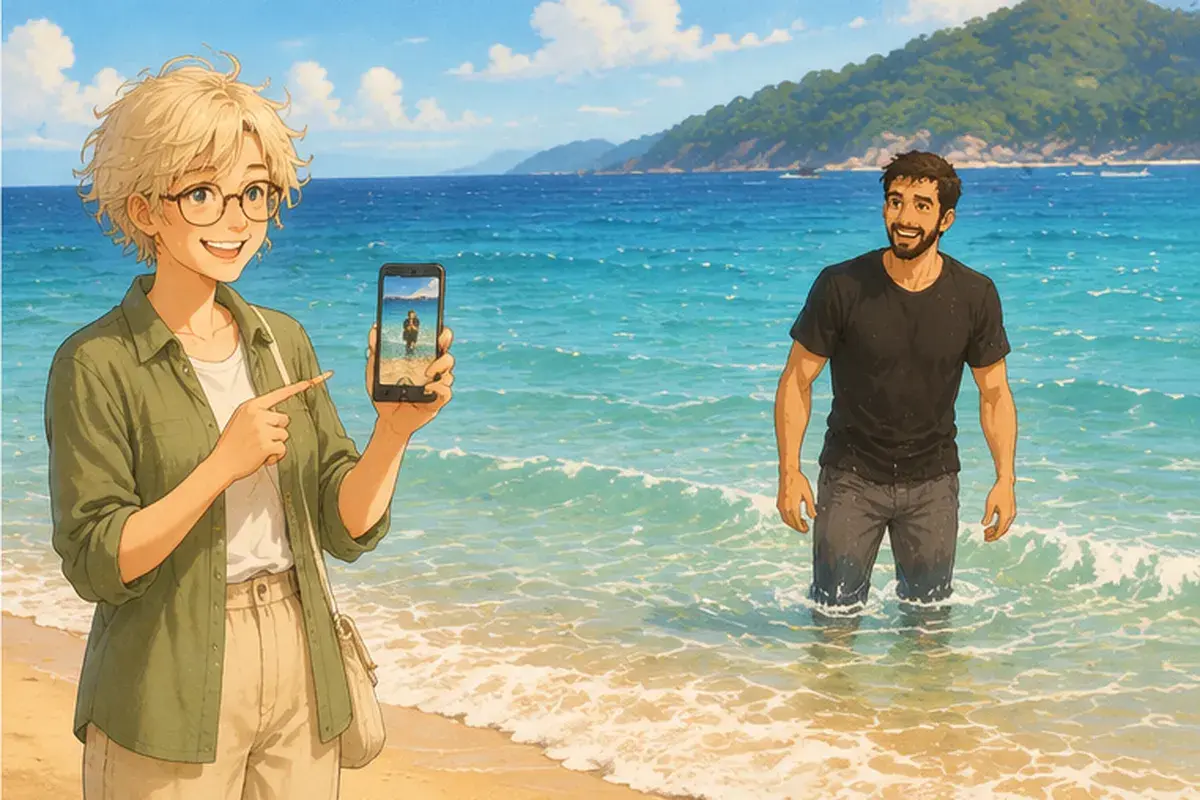
Mas olha a foto, Dima: o Léo é o primeiro no mar!
But look at the photo, Dima: Léo is the first one in the sea!
Ele anda devagar na areia, mas anda. Ele diz: «É só um minuto», mas fica duas horas!
He walks slowly on the sand, but he walks. He says: "It's just one minute," but he stays two hours!
Grammar for this text
- Amanhã a gente vai ficar na praia o dia todo! — vai ficar is ir + infinitive. With a gente the verb takes the você / ele / ela form: a gente vai. o dia todo — "all day": the word todo comes after dia.
- Eu vou desenhar o mar, e a Bia vai tirar mil fotos. — vou is the eu form of ir: it's irregular, so learn it by heart. tirar foto — "to take a photo", with the same "take" as in English.
- Estamos em Ubatuba — estamos is the nós form of estar: "we are (somewhere)". É feriado, é como férias — "it's a holiday, it's like a vacation"; férias is always plural.
- Oi, gringa! Água de coco? — gringa is a casual word for any foreign woman. It isn't rude: people say it as a joke or in a friendly way. The masculine is gringo. People drink água de coco straight from a green coconut.
- O ônibus para, a gente sobe. — para here isn't the preposition: it's the você / ele / ela form of parar (to stop). sobe is from subir: the u in the stem became o (eu subo, but ele sobe).
- A Bia vai descer no ponto errado — descer — "to get off" (a bus). no ponto = em + o ponto.
- Ele anda devagar na areia — anda is the você / ele / ela form of andar in the sense "to walk" (not the noun "floor"). devagar never changes.
- mas fica duas horas — fica is the ele form of ficar: here "stays, spends time". The joke: "one minute" turned into two hours.
Words and grammar of the unit: Buy a bus ticket.
Learn the words from the texts with flashcards
In the app, you can tap any word in a text to see its translation, forms and examples, and new words stick with flashcards. 15 minutes a day.
Start for freeEverything is open for free. No card needed to sign up.