

Chinese dialogue with translation · A2 · 16 lines
结果怎么样? So how did it end?
Comic · 16 panels

- 张磊
方便面来了!你家也没电了?
The instant noodles are here! Is the power out at your place too?

- 伊利亚
对,热水也没有。怎么吃?
Yes, and there's no hot water either. How do we eat them?

- 张磊
没事,我们先看个电影,来电了再吃。
It's fine — let's watch a movie first and eat when the power comes back.

- 伊利亚
好,用我的手机看吧。你想看什么?
OK, let's watch on my phone. What do you want to watch?

- 张磊
看这个,讲一个台风的故事。
Let's watch this one — it tells a story about a typhoon.

- 伊利亚
外边有台风,你还要看台风?
There's a typhoon outside, and you still want to watch a typhoon?

- 张磊
对啊!外边有台风,所以看这个最有意思!
Sure! There's a typhoon outside, so this one is the most interesting to watch!

- 伊利亚
这是电影里的风,还是外边的风?
Is this the wind in the movie or the wind outside?
- 张磊
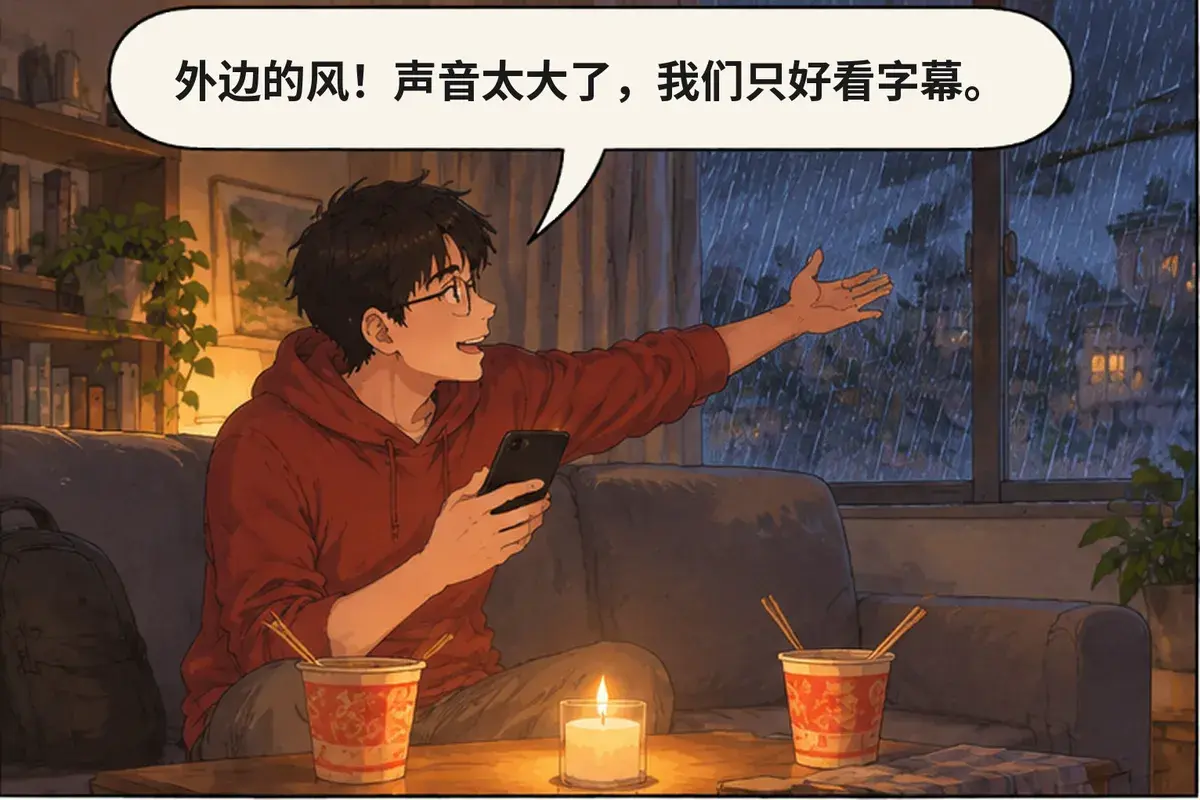
外边的风!声音太大了,我们只好看字幕。
The wind outside! The sound is too loud — we have no choice but to read the subtitles.

- 伊利亚
这个演员是谁?很有名吗?
Who's this actor? Is he very famous?

- 张磊
很有名,是大明星。但是电影一般。
Very famous — he's a big star. But the movie is so-so.

- 伊利亚
哎,我的手机没电了!结果怎么样?
Oh no, my phone's battery died! So how did it end?

- 张磊
我看过,我给你讲吧。
I've seen it — let me tell you.
- 张磊
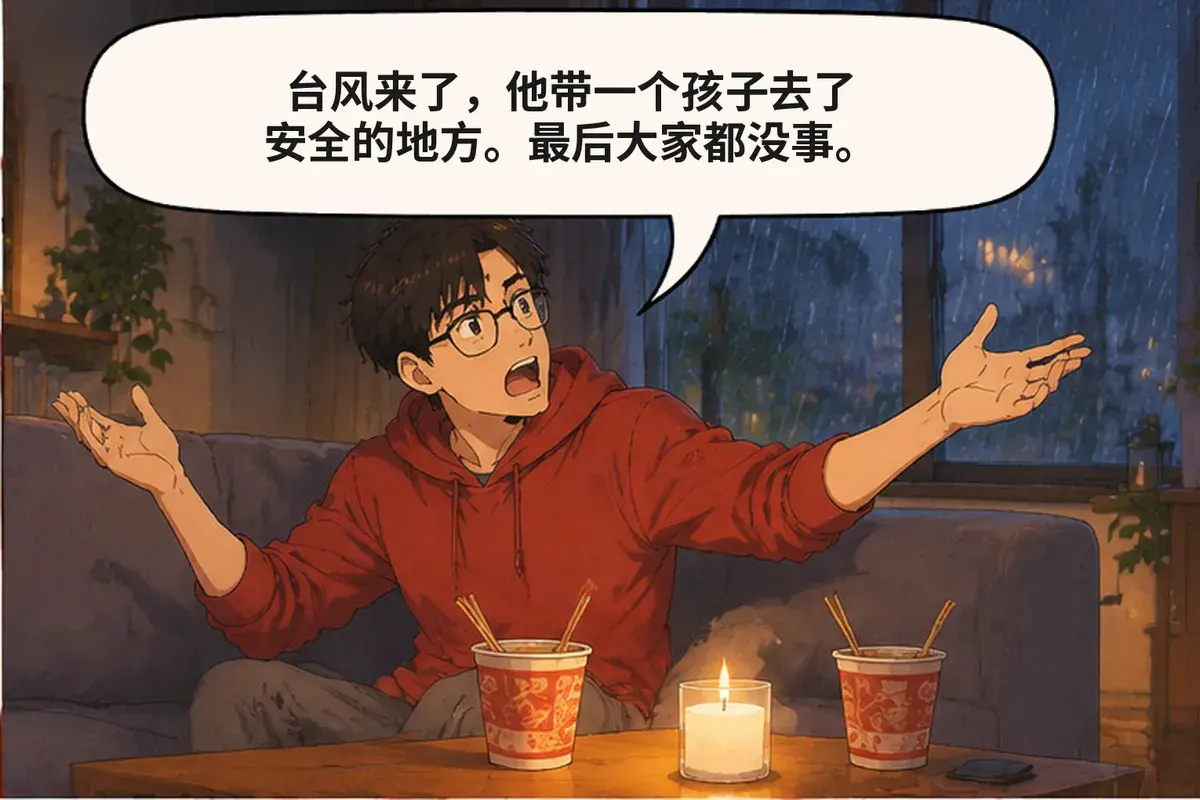
台风来了,他带一个孩子去了安全的地方。最后大家都没事。
The typhoon came, and he took a child to a safe place. Finally, everyone was fine.

- 伊利亚
这个故事真一般!
This story is really so-so!

- 张磊
哎,来电了!先吃方便面,再看电视剧!
Oh, the power's back! Let's eat the instant noodles first, then watch a TV series!
Grammar for this text
结果 怎么样? — "so how did it end?": 结果 means "result, how it ended". Ilya's phone dies in the middle of the movie, and he asks Zhang Lei to tell him the ending.
来 电 了 再 吃。 — 来 电 了 means "the power is back", literally "electricity has come"; 再 here means "and only then": first the power, then the food.
我们 先 看 个 电影 — colloquial 看 个 电影 without 一: "let's watch some movie".
讲 一 个 台风 的 故事 — 讲 means "to tell": the movie tells a story about a typhoon.
外边 有 台风, 所以 看 这 个 最 有 意思! — Zhang Lei is joking: there's a typhoon outside, so of course you should watch a typhoon movie. In conversation "because" is often dropped, and only 所以 is left.
这 是 电影 里 的 风, 还是 外边 的 风? — 还是 means "or" in a question (A1, unit 3). You can't tell the wind in the movie from the wind outside.
我们 只好 看 字幕。 — 只好 means "to have no choice but to": the wind is loud, so they have to read the subtitles.
很 有名, 是 大 明星。 但是 电影 一般。 — 明星 means "star"; 一般 means "so-so".
我 看 过, 我 给 你 讲 吧。 — 过 means "have done before" (A1, unit 17): Zhang Lei has already seen this movie; 吧 here means "let me …".
他 带 一 个 孩子 去 了 安全 的 地方 — 安全 的 地方 means "a safe place": 的 stands between the describing word and the thing, as in 好吃 的 菜 (A1, unit 8).
先 吃 方便面, 再 看 电视剧! — 先 … 再 … means "first …, then …" (A1, unit 17).
Words and grammar of the unit: Get ready for a typhoon.
Learn the words from the texts with flashcards
In the app, you can tap any word in a text to see its translation, forms and examples, and new words stick with flashcards. 15 minutes a day.
Start for freeEverything is open for free. No card needed to sign up.