

Chinese dialogue with translation · A1 · 12 lines
大家在睡觉呢! Everyone's sleeping!
Comic · 10 panels

- 张磊
喂,伊利亚!你在干什么呢?
Hello? Ilya! What are you doing?

- 伊利亚
我在公司呢!我正在吃午饭。
I'm at the office! I'm having lunch right now.

- 张磊
中午你不午睡吗?
Don't you take a nap at noon?
- 伊利亚
什么?“午睡”是什么意思?
What? What does "wǔshuì" mean?

- 张磊
你看看你的同事。他们在干什么呢?
Take a look at your coworkers. What are they doing?

- 伊利亚
他们……在睡觉。这是“午睡”吗?
They're... sleeping. So this is "wǔshuì"?

- 周经理
伊利亚!大家在睡觉呢!
Ilya! Everyone's sleeping!

- 伊利亚
啊,不好意思,周经理!张磊,我一会给你打电话。
Oh, sorry, Manager Zhou! Zhang Lei, I'll call you later.
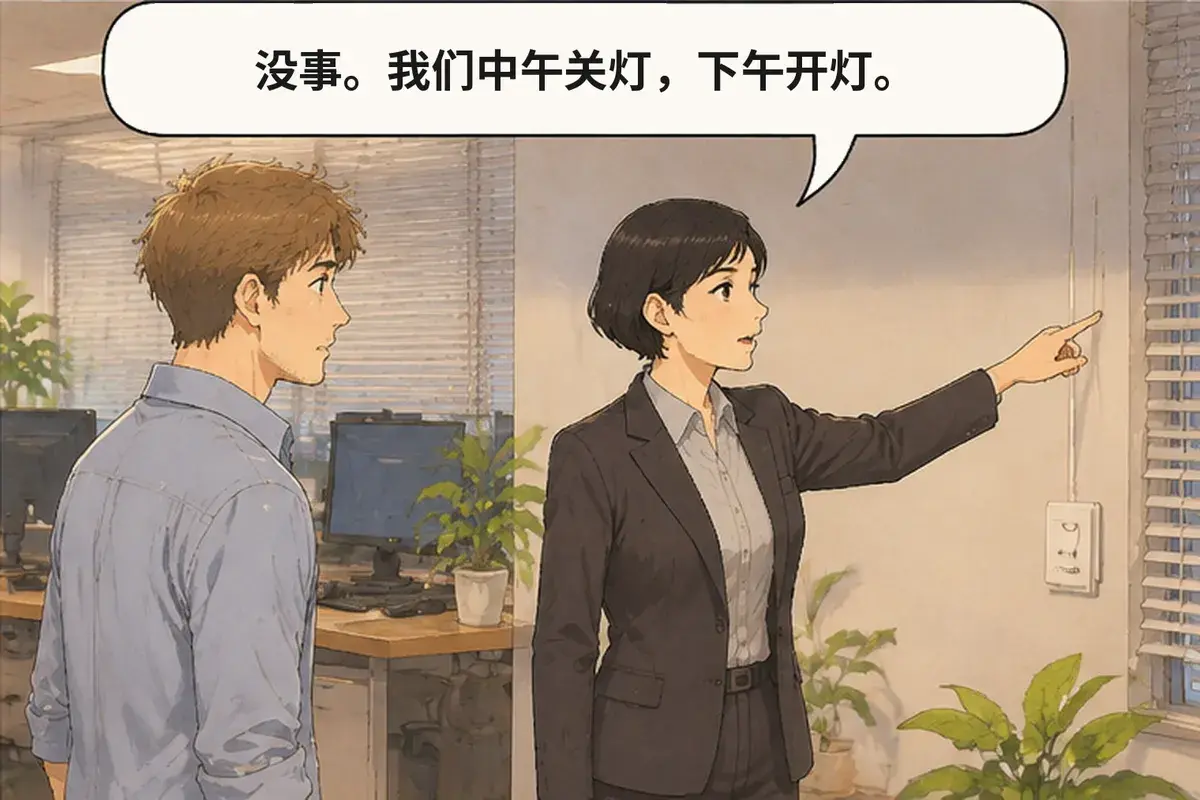
- 周经理
没事。我们中午关灯,下午开灯。
It's fine. We turn off the lights at noon and turn them on in the afternoon.

- 伊利亚
我白天不睡觉……我现在做什么?
I don't sleep during the day... What do I do now?
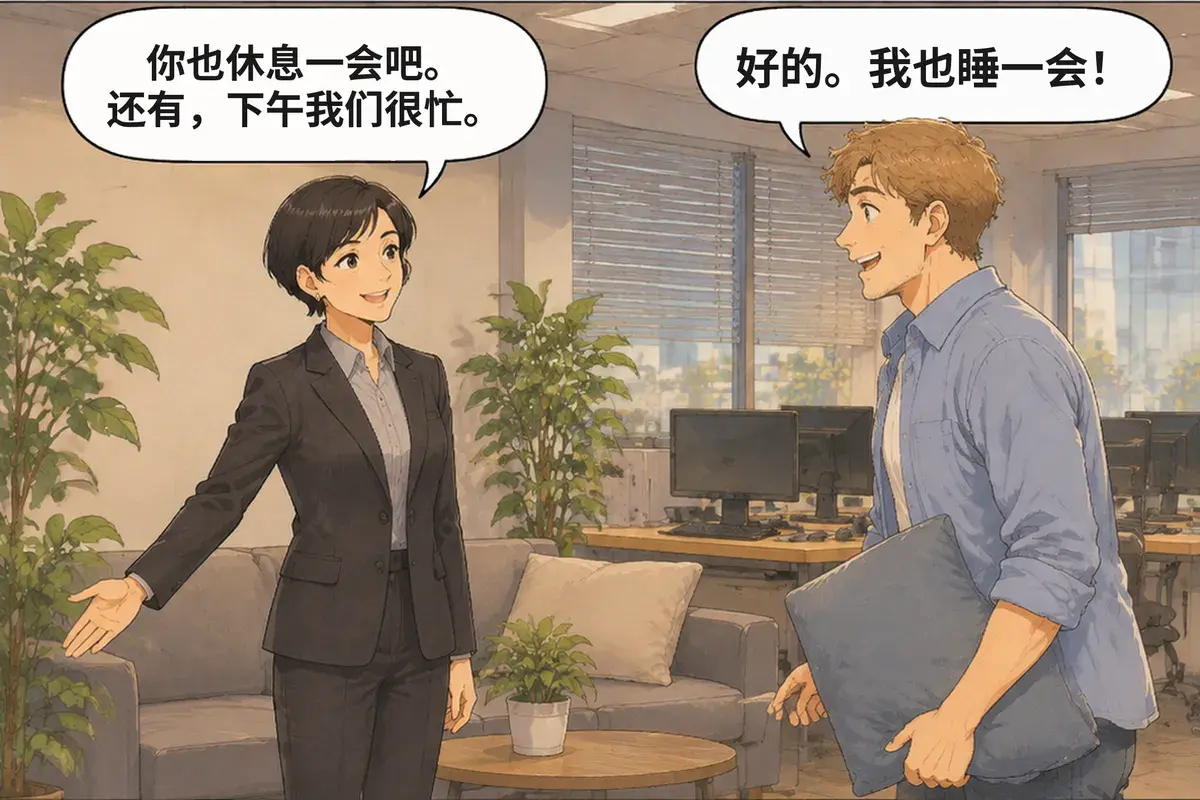
- 周经理
你也休息一会吧。还有,下午我们很忙。
You rest for a bit too. Besides, we're very busy in the afternoon.
- 伊利亚
好的。我也睡一会!
OK. I'll sleep for a bit too!
Grammar for this text
你 在 干 什么 呢? — the key phrase of the unit: 在 before the verb and 呢 at the end, "what are you doing (right now)?". 干 (gàn) is a casual "to do": that's how you ask a friend. Ilya would ask his boss with 做.
我 在 公司 呢! — here 在 means "to be at" (unit 4), and 呢 adds "right now": "I'm at the office!".
我 正在 吃 午饭。 — 正在 is "right now, at this very minute".
“午睡” 是 什么 意思? — 午睡 is the nap after lunch. In Chinese offices it's a custom: from about twelve to one thirty they turn off the lights, and people sleep right at their desks. Ilya hears the word for the first time and asks about it out loud in the silence. The follow-up 这 是 “午睡” 吗? — "so this is "wǔshuì"?" — is how you check a guess.
你 看看 你 的 同事。 — 看看 is "take a look": a doubled verb sounds soft (a ready-made form, unit 7).
我 一会 给 你 打 电话。 — 一会 before the verb is "later, in a minute". After the verb (你 也 休息 一会 吧) it's "for a bit, for a little while". In the North people say 一会儿.
我们 中午 关 灯, 下午 开 灯。 — 关 is "to turn off, to close", 开 is "to turn on, to open". The time words (中午, 下午) come before the verb.
你 也 休息 一会 吧。 — 吧 makes the advice softer. Manager Zhou, the head of the department, uses the plain 你 with Ilya, not the polite 您. 还有, 下午 我们 很 忙。 — 还有 (háiyǒu) is "besides, and also": it adds one more reason or point.
Words and grammar of the unit: Say what you're doing right now.
Learn the words from the texts with flashcards
In the app, you can tap any word in a text to see its translation, forms and examples, and new words stick with flashcards. 15 minutes a day.
Start for freeEverything is open for free. No card needed to sign up.