

Chinese dialogue with translation · A1 · 13 lines
半糖,去冰! Half sugar, no ice!
Comic · 8 panels
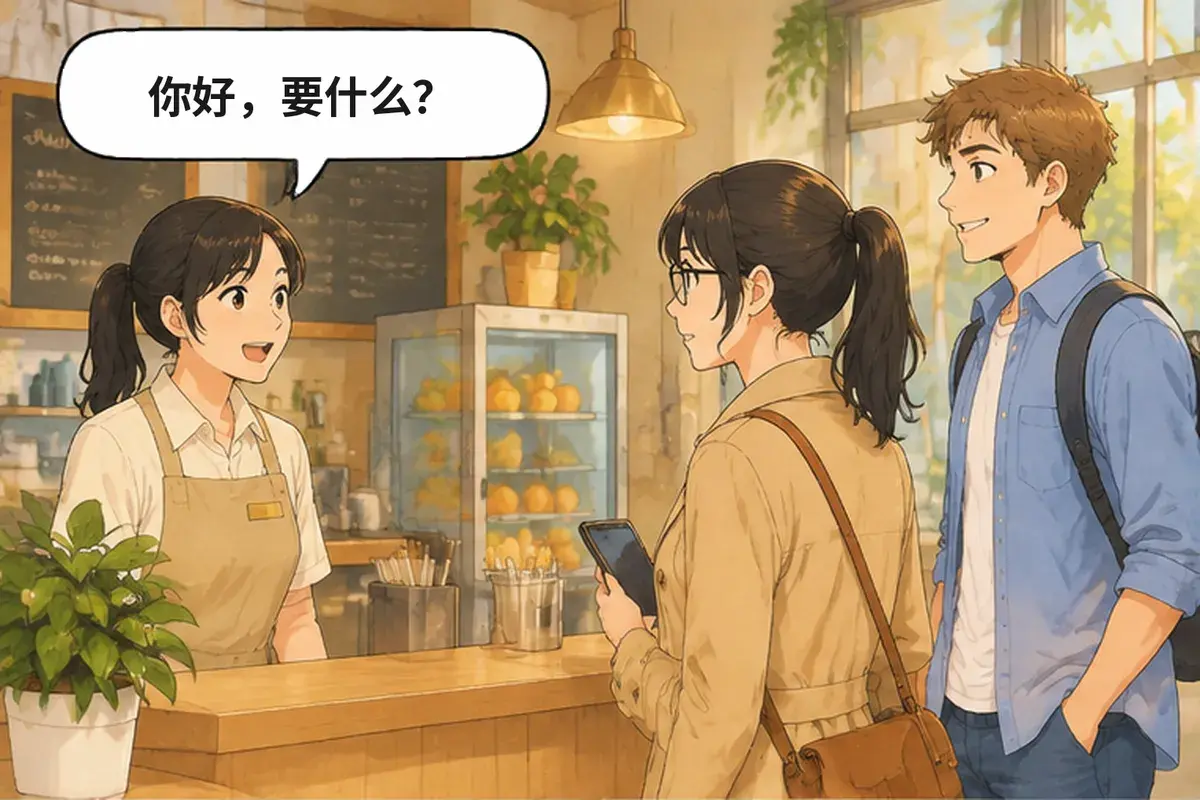
- 店员
你好,要什么?
Hi, what will you have?

- 晓雨
一杯奶茶,半糖,去冰!
A cup of milk tea, half sugar, no ice!

- 店员
好。你呢?想喝什么?
OK. And you? What would you like to drink?
- 伊利亚
我要一杯奶茶。
I'll have a cup of milk tea.

- 店员
糖呢?半糖?
What about sugar? Half sugar?
- 伊利亚
啊?你说什么?
Huh? What did you say?

- 店员
糖。你要半糖吗?
Sugar. Do you want half sugar?
- 伊利亚
要,半糖。
I do, half sugar.

- 店员
去冰还是热的?
No ice, or hot?
- 伊利亚
去?我不去!我要奶茶。
Go? I'm not going! I want milk tea.

- 晓雨
不是“去”!“去冰”是不要冰。
Not "go"! "Qùbīng" means "no ice."

- 伊利亚
啊!我要冰的,大杯。
Oh! I'll have it iced, a large cup.
- 店员
好,两杯奶茶。
OK, two cups of milk tea.
Grammar for this text
去? 我 不 去! — Ilya knows 去 (qù) as "to go" and panics: go where? But at a milk tea shop 去 means "to remove": 去冰 (qùbīng) — "remove the ice", that is, "no ice". That's just what Xiaoyu says: “去冰” 是 不 要 冰。 — 不 要 here means "don't want, no".
一 杯 奶茶, 半糖, 去冰! — this is how people order, short and simple: the drink, the sugar, the ice. 半糖 — "half sugar": the drink is half as sweet. 一 杯 (yì bēi): 杯 is the measure word for cups and glasses, and 一 before it is said in the 4th tone (see the unit grammar).
糖 呢? 半糖? — 呢 after a word means "what about…?": "What about sugar?" Just like in 你 呢?.
啊? 你 说 什么? — this is how you ask someone to repeat: "Huh? What did you say?" 啊? is said with a rising voice.
要, 半糖。 — there's no separate word for "yes": you repeat the verb from the question 你 要 半糖 吗?.
去冰 还是 热 的? — 还是 is "or" in a question; no 吗 is needed. 热 的 — "a hot one (drink)": 的 stands in for the noun, like "one" in English "a hot one". More about this 的 in unit 8; for now, learn 热 的 as a whole.
啊! 我 要 冰 的, 大 杯。 — Ilya picks a third option: 冰 的 — "iced, cold". He likes ice-cold drinks, and Chinese people like warm ones (you'll see in the next text).
好, 两 杯 奶茶。 — before a measure word, "two" is 两 (liǎng), not 二. Ilya and the salesclerk say 你 to each other: the plain "you" is normal in a shop.
Words and grammar of the unit: Order milk tea and coffee.
Learn the words from the texts with flashcards
In the app, you can tap any word in a text to see its translation, forms and examples, and new words stick with flashcards. 15 minutes a day.
Start for freeEverything is open for free. No card needed to sign up.