

Italian story with translation · A1 · 14 lines
Tranquillo! Non ti preoccupare, non è grave Relax! Don't worry, it's not serious
Comic · 14 panels

Oggi sto a letto: sono malato.
Today I'm staying in bed: I'm sick (man speaking).
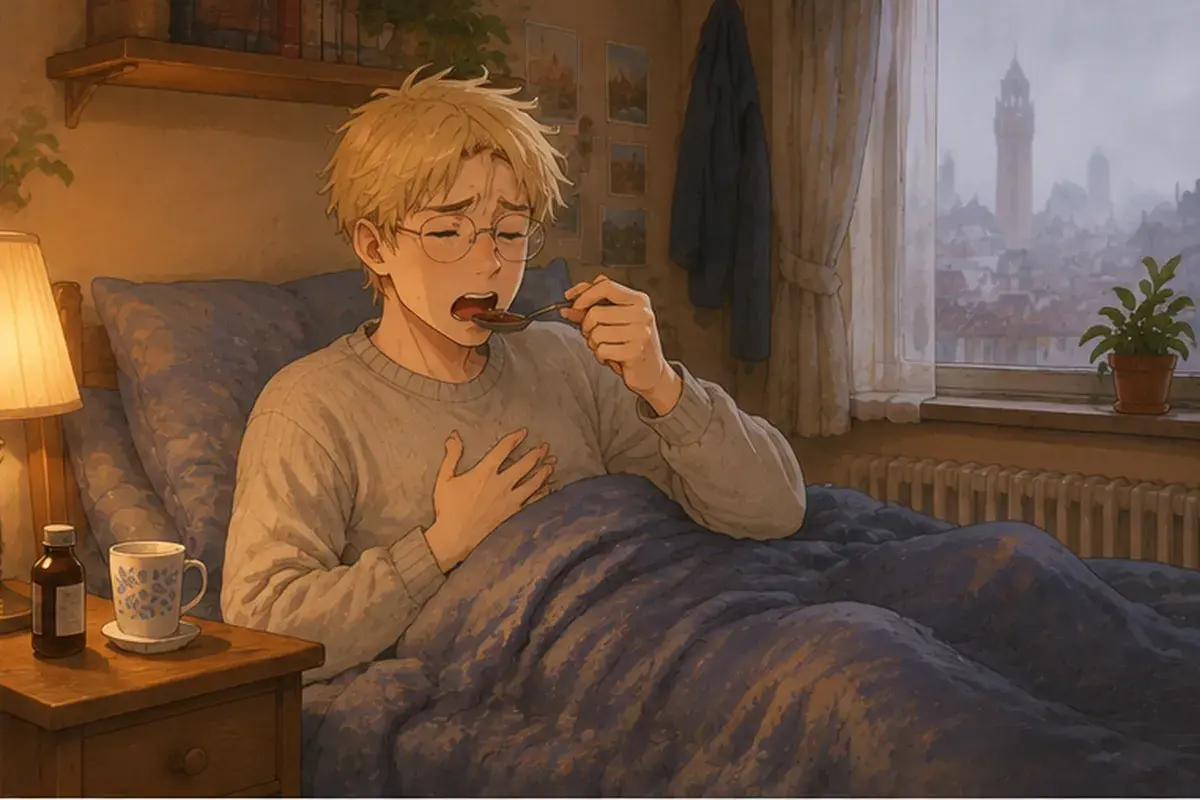
Prendo lo sciroppo della farmacia, ma la tosse è ancora forte.
I'm taking the syrup from the pharmacy, but the cough is still bad.

Ho mal di testa, mal di schiena e le gambe pesanti.
I have a headache, a backache, and heavy legs.

Ragù dorme sui miei piedi, con la bocca aperta: vedo tutti i denti!
Ragù is sleeping on my feet with his mouth open: I can see all his teeth!

Giulia è alla porta: «Posso?»
Giulia is at the door: "May I?"

«Avanti!» Giulia ha una coperta in mano.
"Come in!" Giulia has a blanket in her hand.

«Povero Misha! Ecco la mia coperta, ma domani ho freddo anch'io!»
"Poor Misha! Here's my blanket, but tomorrow I'll be cold too!"

A mezzogiorno arriva la signora Paola con il brodo.
At noon Signora Paola arrives with the broth.

«Ha mangiato, Michele? Deve mangiare il brodo: la salute è importante!»
"Have you eaten, Michele? You need to eat the broth: health is important!" (formal)

Mangio tutto il brodo e sto meglio. Ma nel pomeriggio sto peggio: ho la febbre.
I eat all the broth and feel better. But in the afternoon I feel worse: I have a fever.

La sera torna Luca: «Tranquillo! Non ti preoccupare, non è grave.»
In the evening Luca comes back: "Relax! Don't worry, it's not serious." (to a man)

Poi dice: «Enzo manda un tè con il miele per il dottore!»
Then he says: "Enzo is sending tea with honey for the dottore!"

Bevo il tè con il miele e dopo dormo.
I drink the tea with honey and then I sleep.

Questa volta il tè è la cosa giusta: sto male!
This time tea is the right thing: I feel sick!
Grammar for this text
- Oggi sto a letto: sono malato. — sto is the io form of stare; sto a letto — I'm staying in bed. sono malato — I'm sick; "I feel sick" is sto male.
- Ragù dorme sui miei piedi, con la bocca aperta: vedo tutti i denti! — sui = su + i (on + the, plural); i miei piedi — my feet. Body parts take the article: la bocca, i denti, where English says "his mouth", "his teeth".
- Ho mal di testa, mal di schiena e le gambe pesanti. — one ho for all three complaints; mal di — pain in…; le gambe — the plural of la gamba.
- «Avanti!» Giulia ha una coperta in mano. — Avanti! — come in! — the answer to «Posso?» (may I?: posso — I can, from potere, unit 10).
- domani ho freddo anch'io! — ho freddo — I'm cold (word for word "I have cold"); anch'io = anche + io, me too. The present tense with domani means "tomorrow I'll be cold".
- Ha mangiato, Michele? Deve mangiare il brodo: la salute è importante! — Signora Paola uses Lei with Misha: ha mangiato — have you eaten? — a ready-made past form (ha is the Lei form of avere, mangiato comes from mangiare); the rule comes in unit 15. deve — you need to. Michele is what she calls Misha.
- Non ti preoccupare, non è grave. — don't worry (to a friend; with Lei — non si preoccupi). For now it's a set phrase; more at A2.
Words and grammar of the unit: Say what hurts at the pharmacy.
Learn the words from the texts with flashcards
In the app, you can tap any word in a text to see its translation, forms and examples, and new words stick with flashcards. 15 minutes a day.
Start for freeEverything is open for free. No card needed to sign up.