

Italian story with translation · A1 · 15 lines
Ragù, che stai facendo? Ragù, what are you doing?
Comic · 15 panels

Oggi è venerdì e, dopo pranzo, siamo tutti a casa.
Today is Friday, and after lunch we're all at home.

La mattina imparo l'italiano a scuola, il pomeriggio disegno per il mio ufficio.
In the mornings I learn Italian at school, and in the afternoons I draw for my office.

Alle tre ho una riunione con i colleghi. Anche Luca ha una riunione: il venerdì lavora da casa.
At three I have a meeting with my colleagues. Luca has a meeting too: on Fridays he works from home.

Giulia è giornalista e scrive articoli. Il martedì e il sabato lavora in libreria.
Giulia is a journalist and writes articles. On Tuesdays and Saturdays she works at a bookstore.

Oggi è a casa e ha una riunione per il podcast.
Today she's at home and has a meeting for the podcast.

Tre riunioni e un solo wi-fi.
Three meetings and only one Wi-Fi.

Giulia dice a Luca: «Il podcast è importante: silenzio!»
Giulia says to Luca: "The podcast is important: quiet!"

Ragù dorme sulla mia tastiera.
Ragù is sleeping on my keyboard.

Dico: «Ragù, che stai facendo?»
I say: "Ragù, what are you doing?"

Sul computer c'è una parola nuova. Non è italiano, non è inglese: è la lingua di Ragù!
There's a new word on the computer. It isn't Italian, it isn't English: it's Ragù's language!

Dico ai colleghi: «Scusate, il gatto non è un collega!» Loro ridono: Ragù è un vero attore!
I say to my colleagues: "Sorry, the cat isn't a colleague!" They laugh: Ragù is a real actor!
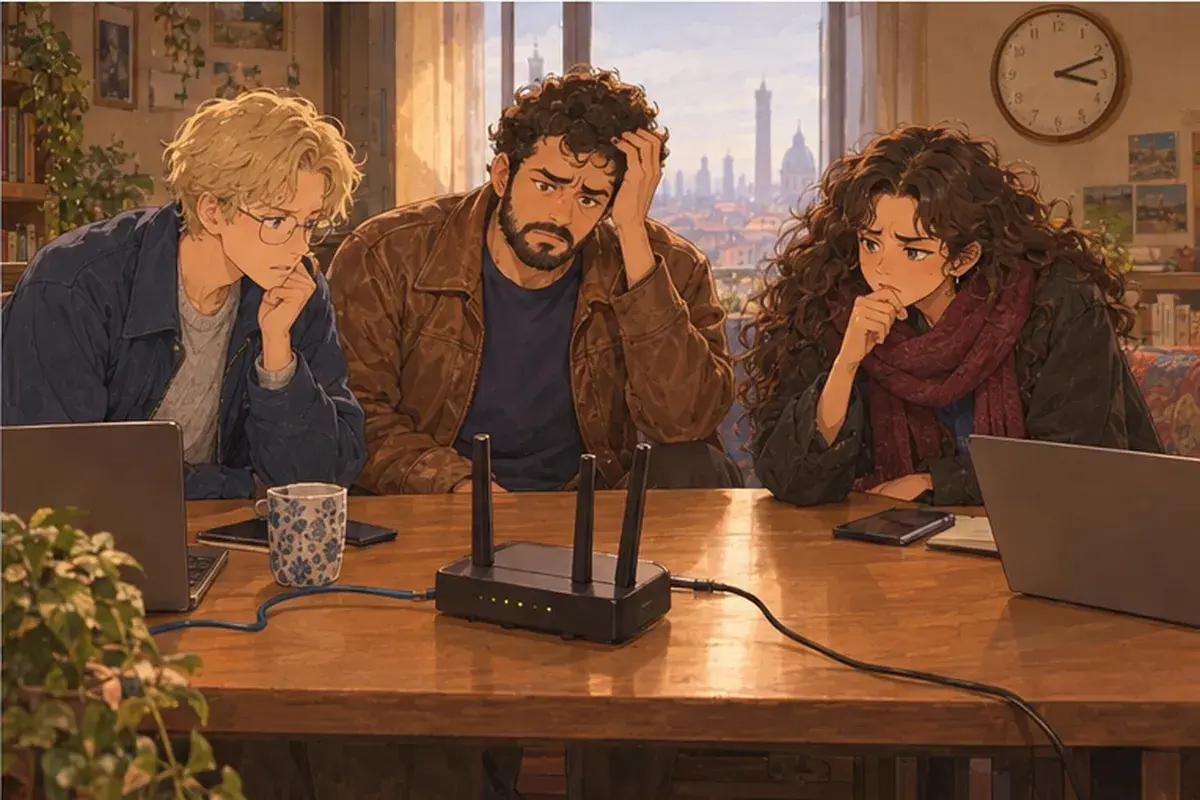
Alle tre e dieci il wi-fi non funziona!
At ten past three the Wi-Fi isn't working!

Luca è ingegnere, ma non sa niente di wi-fi. Dice: «Tranquillo!»
Luca is an engineer, but he doesn't know anything about Wi-Fi. He says: "Don't worry!"

Alle quattro il wi-fi funziona di nuovo e le riunioni finiscono.
At four the Wi-Fi is working again, and the meetings end.

Luca dice: «Vedi? Tranquillo!» Ragù dorme ancora: per lui il wi-fi non esiste.
Luca says: "See? Don't worry!" Ragù is still sleeping: for him, Wi-Fi doesn't exist.
Grammar for this text
- Ragù, che stai facendo? — a ready-made form: stai facendo — you're doing right now (stare + the ending -ndo, like English -ing). The rule comes at A2; for now learn it whole. For a plain "what are you doing?" Italians often just say cosa fai.
- Scusate — sorry, said to several people (voi). To one person on tu you say scusa, on Lei — scusi. A ready-made form; the rule comes at B1.
- Dico ai colleghi — dico — I say, from dire (see the unit grammar). ai = a + i: "to the colleagues". The same in Sul computer: sul = su + il, "on"; and sulla mia tastiera: sulla = su + la. The rule is in unit 9.
- non sa niente di wi-fi — sa — he knows, from sapere. non… niente is a double negative, and that's correct in Italian: "he doesn't know anything" (English uses one negative); di — about.
- La mattina imparo, il venerdì lavora da casa — an article before a part of the day or a day of the week means "every time": "in the mornings", "on Fridays". da casa — from home.
- Ragù è un vero attore! — vero before a noun means "real" (unit 1: vero? — right?). To work as an actor is fare l'attore, like fare il rider.
- Alle tre e dieci, Alle quattro — alle = a + le: "at ten past three", "at four". To say at what time: alle + the number; more in unit 8.
Words and grammar of the unit: Talk about your job and studies.
Learn the words from the texts with flashcards
In the app, you can tap any word in a text to see its translation, forms and examples, and new words stick with flashcards. 15 minutes a day.
Start for freeEverything is open for free. No card needed to sign up.