

French dialogue with translation · B2 · 17 lines
Je me permets de vous écrire I'm taking the liberty of writing to you
Comic · 17 panels
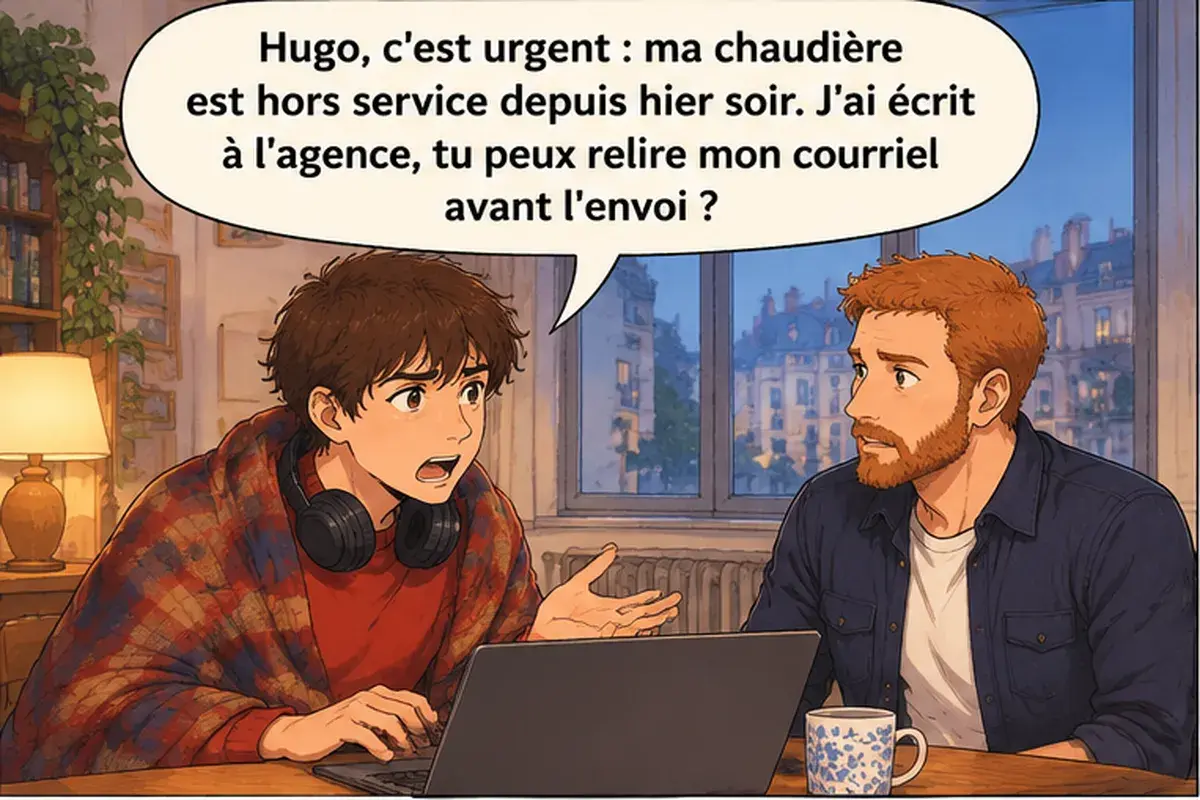
- Pacha
Hugo, c'est urgent : ma chaudière est hors service depuis hier soir. J'ai écrit à l'agence, tu peux relire mon courriel avant l'envoi ?
Hugo, it's urgent: my boiler has been out of service since last night. I've written to the agency, can you proofread my email before sending it?

- Pacha
Salut Monsieur Perrin ! Ma chaudière est cassée, c'est nul, faites quelque chose ! Amicalement, Pacha
Hi Monsieur Perrin! My boiler is broken, it sucks, do something! Warmly, Pacha (formal)
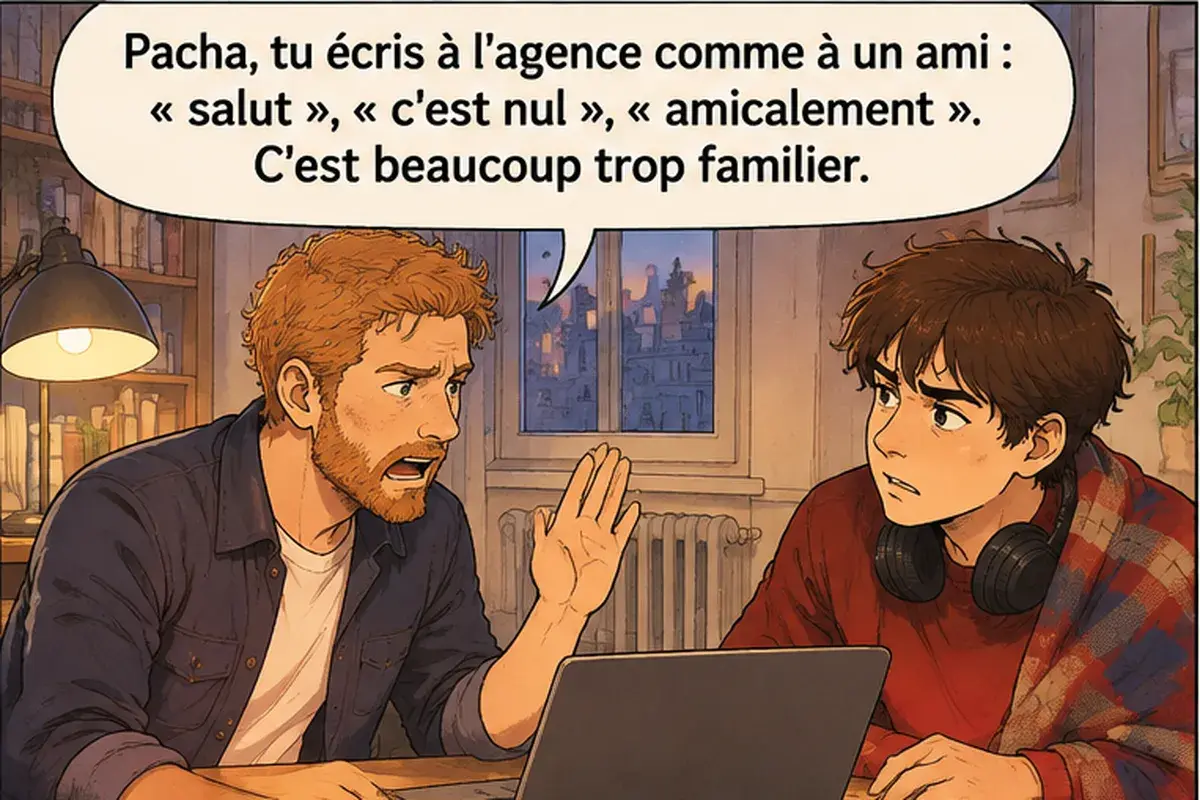
- Hugo
Pacha, tu écris à l'agence comme à un ami : « salut », « c'est nul », « amicalement ». C'est beaucoup trop familier.
Pacha, you're writing to the agency like you'd write to a friend: "hi," "it sucks," "warmly." That's way too casual.

- Hugo
Dans ce courriel, tu es l'expéditeur et l'agence est le destinataire. Signe de ton nom complet, sinon ça ressemble à un message anonyme.
In this email, you're the sender and the agency is the recipient. Sign with your full name, otherwise it looks like an anonymous message.

- Pacha
Mais je suis furieux ! Je dois cacher ça ?
But I'm furious! Do I have to hide that? (man speaking)
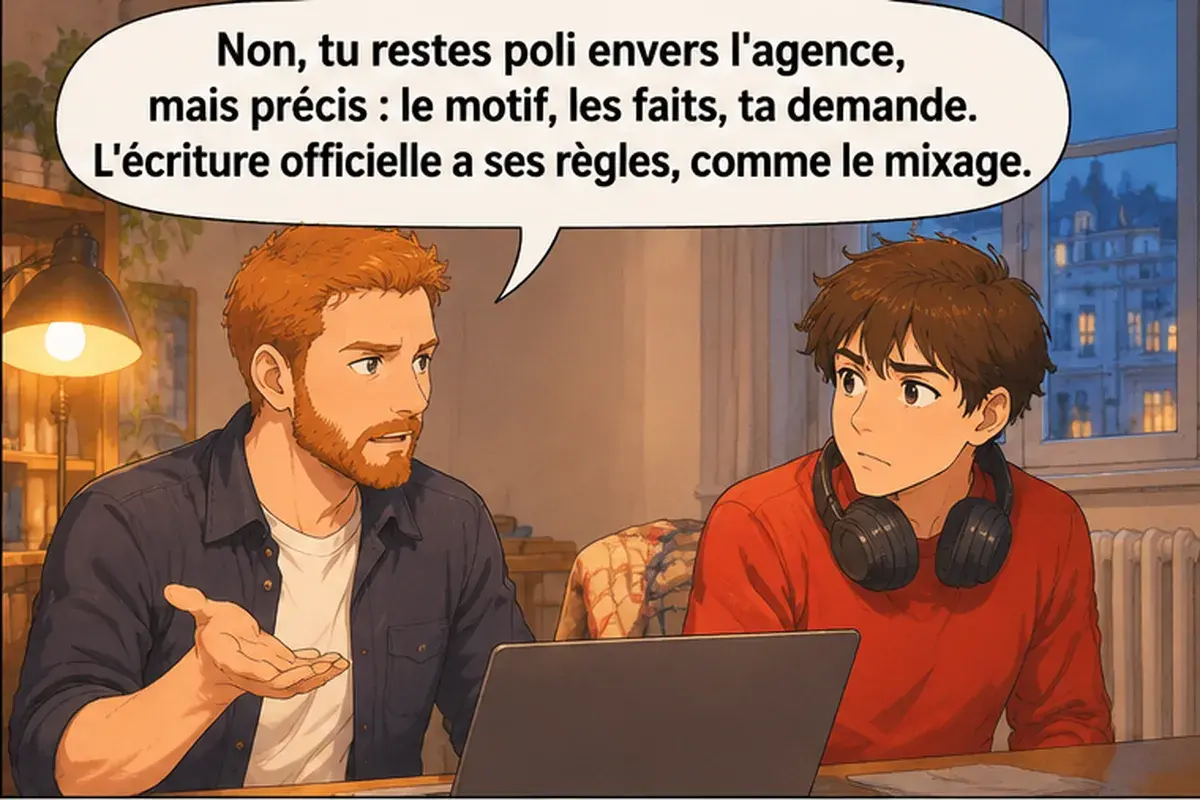
- Hugo
Non, tu restes poli envers l'agence, mais précis : le motif, les faits, ta demande. L'écriture officielle a ses règles, comme le mixage.
No, you stay polite toward the agency, but precise: the reason, the facts, your request. Official writing has its rules, just like sound mixing.
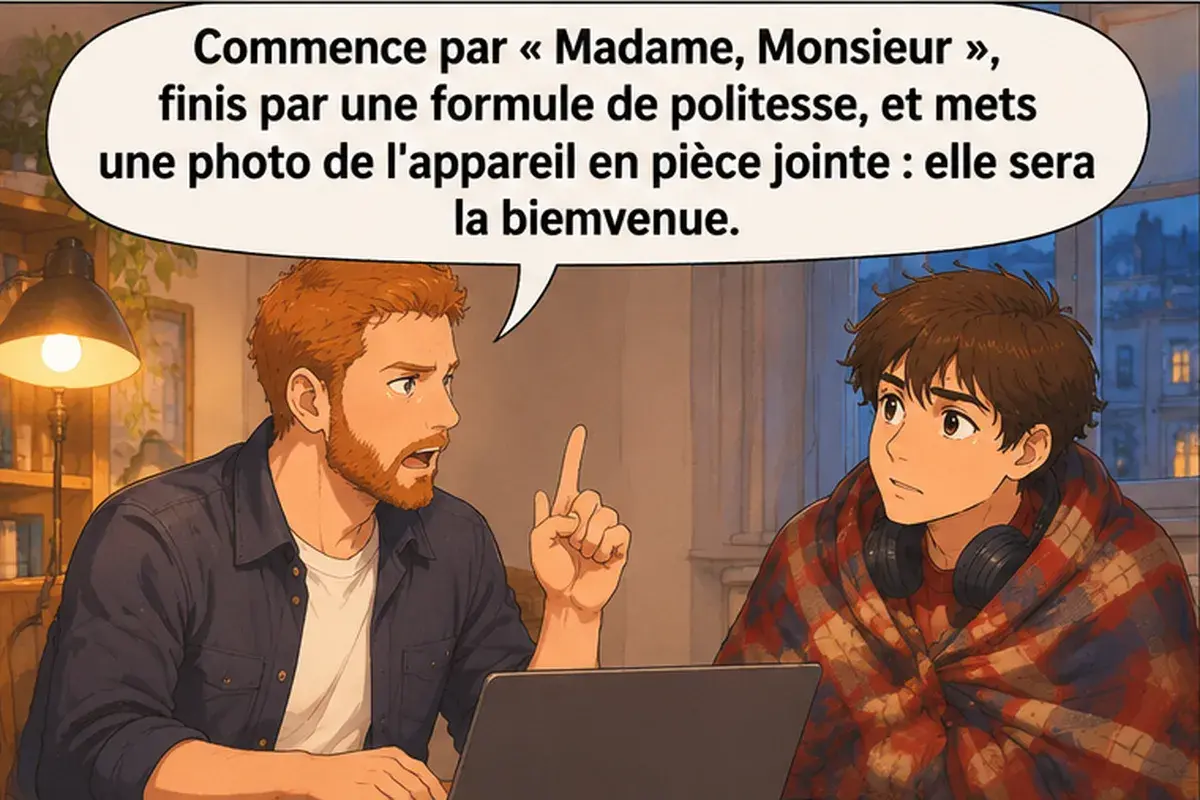
- Hugo
Commence par « Madame, Monsieur », finis par une formule de politesse, et mets une photo de l'appareil en pièce jointe : elle sera la bienvenue.
Start with "Madame, Monsieur," end with a polite closing, and add a photo of the unit as an attachment: it will be welcome.

- Pacha
Madame, Monsieur,
Dear Sir or Madam,

- Pacha
Je me permets de vous écrire suite à la panne de la chaudière de mon appartement, à la Croix-Rousse.
I'm taking the liberty of writing to you following the breakdown of the boiler in my apartment, in la Croix-Rousse. (formal)
- Pacha
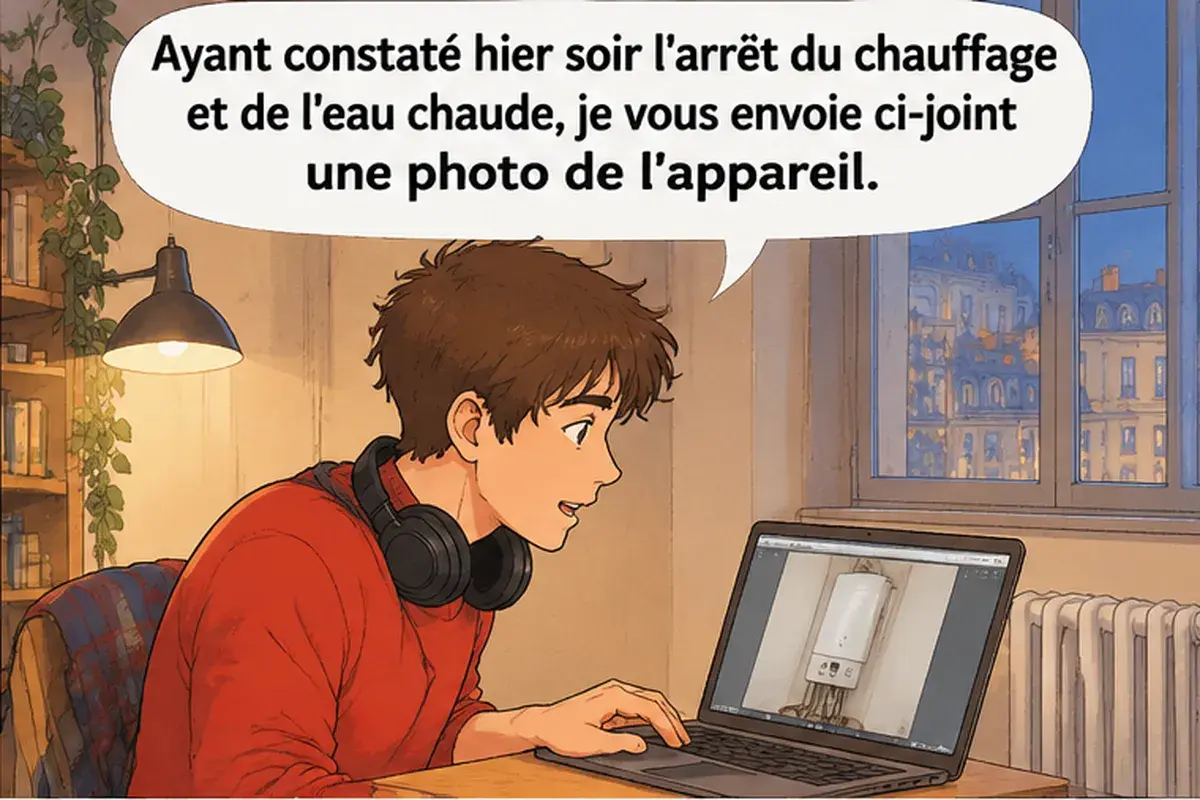
Ayant constaté hier soir l'arrêt du chauffage et de l'eau chaude, je vous envoie ci-joint une photo de l'appareil.
Having noticed last night that the heating and hot water had stopped, I'm sending you a photo of the unit attached. (formal)
- Pacha
Étant locataire de cet appartement depuis quelques semaines, je souhaite savoir qui doit organiser la réparation.
As I've been the tenant of this apartment for a few weeks, I'd like to know who has to arrange the repair.
- Pacha
Souhaitant une réponse rapide, je sollicite le passage d'un technicien afin de faire dépanner la chaudière.
Wishing for a quick reply, I'm requesting a technician visit in order to have the boiler repaired.

- Pacha
Je vous prie de bien vouloir m'indiquer une date de passage.
I kindly ask you to tell me a date for the visit. (formal)
- Pacha
Dans l'attente de votre réponse, je reste à votre disposition.
Looking forward to your reply, I remain at your disposal. (formal)

- Pacha
Je vous prie d'agréer, Madame, Monsieur, l'expression de mes salutations distinguées.
I ask you to accept, Sir or Madam, the expression of my distinguished regards. (formal)

- Pacha
Merci, Hugo ! Je l'envoie. Cordialement, Pacha.
Thanks, Hugo! I'm sending it. Best regards, Pacha.

- Hugo
Parfait. Mais « cordialement », entre nous, ça fait un peu froid ! Remarque, chez toi, il fait déjà assez froid.
Perfect. But "Best regards," between us, that feels a bit cold! Then again, at your place it's already pretty cold.
Grammar for this text
- Je me permets de vous écrire suite à la panne —
je me permets de+ infinitive means "I'm taking the liberty of": a polite way to open a letter about a matter.suite àmeans "following, after": a written link word. - Ayant constaté hier soir l'arrêt du chauffage —
ayant constatéisayant(fromavoir) +constaté: "having noticed." The subject is the same as in the main verb: I noticed, and I'm writing. Étant locataire —étantcomes fromêtre: "being." Souhaitant — fromsouhaiter: "wishing." More in the grammar. - je vous envoie ci-joint une photo —
ci-jointdoesn't change before a noun. In everyday speech you'd sayen pièce jointe, like Hugo in the line above. - afin de faire dépanner la chaudière —
afin de+ infinitive means the same aspour, but it sounds more formal.faire dépannermeans "to have the boiler repaired": a technician does it, not Pacha himself (faire+ verb, unit 1).dépannermeans to fix something on the spot. - Je vous prie de bien vouloir m'indiquer —
prieis the je form ofprier: "I ask."bien vouloirsoftens the request. - à votre disposition — "at your service, available to help": it comes from the closing line Dans l'attente de votre réponse, je reste à votre disposition. Here
dans l'attente de+ noun means "looking forward to." - Je vous prie d'agréer, Madame, Monsieur, l'expression de mes salutations distinguées. — the long closing for an agency, a bank or a boss, like English "Sincerely."
agréermeans "to accept kindly."
Words and grammar of the unit: Write a formal email.
Learn the words from the texts with flashcards
In the app, you can tap any word in a text to see its translation, forms and examples, and new words stick with flashcards. 15 minutes a day.
Start for freeEverything is open for free. No card needed to sign up.