
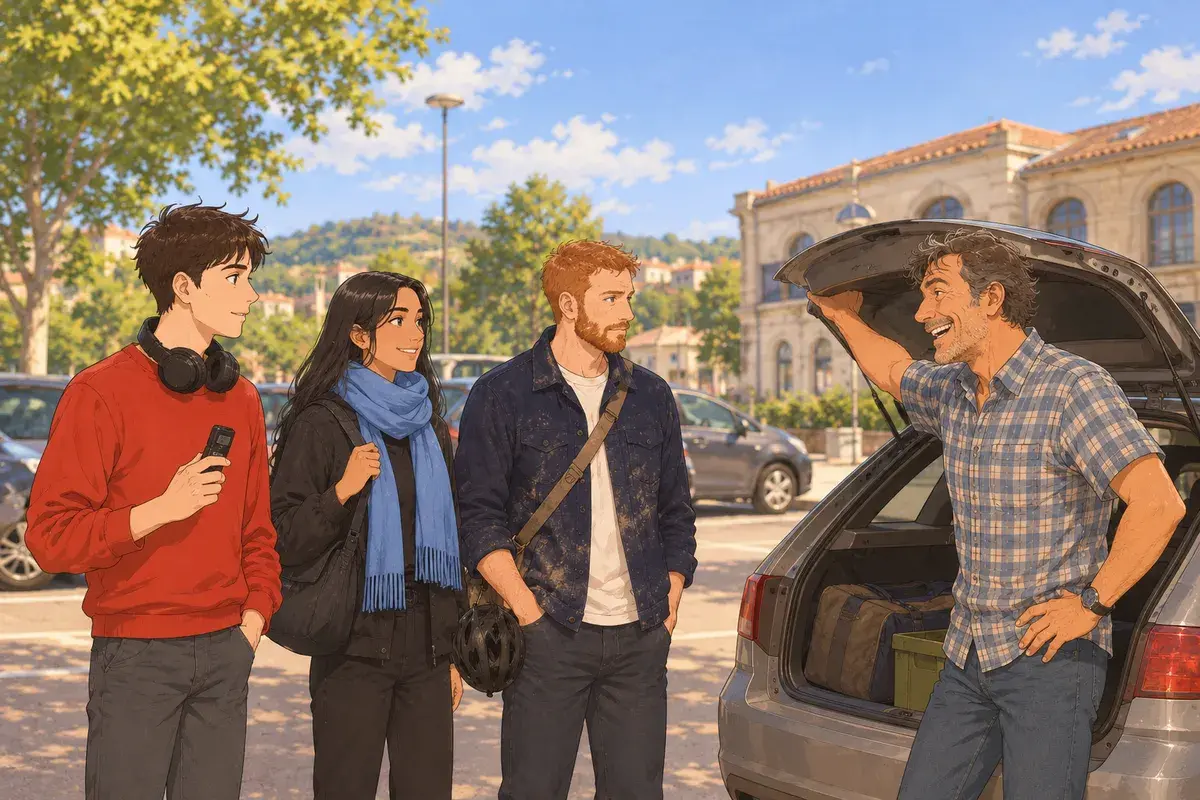
French dialogue with translation · B1 · 17 lines
Excuse-moi, Bruno, mais tu es indiscret Excuse me, Bruno, but you're nosy
Comic · 17 panels
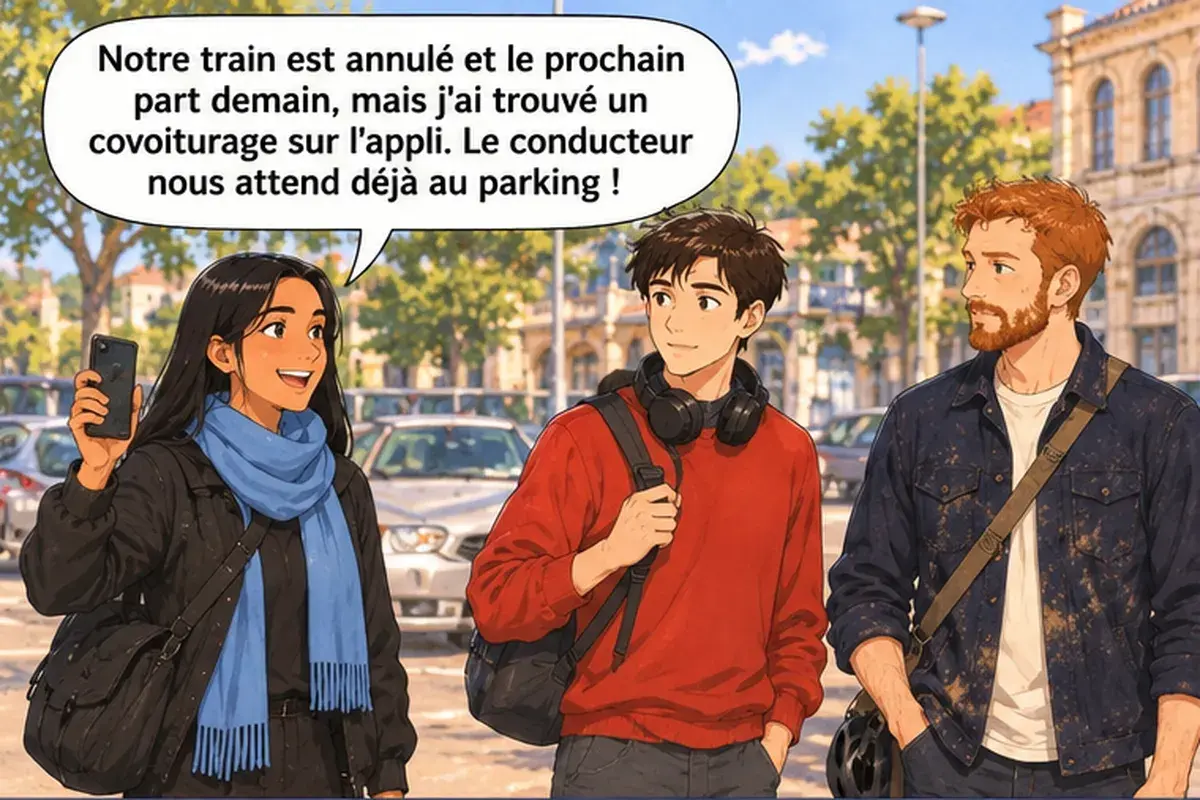
- Inès
Notre train est annulé et le prochain part demain, mais j'ai trouvé un covoiturage sur l'appli. Le conducteur nous attend déjà au parking !
Our train is canceled and the next one leaves tomorrow, but I found a carpool on the app. The driver's already waiting for us in the parking lot!
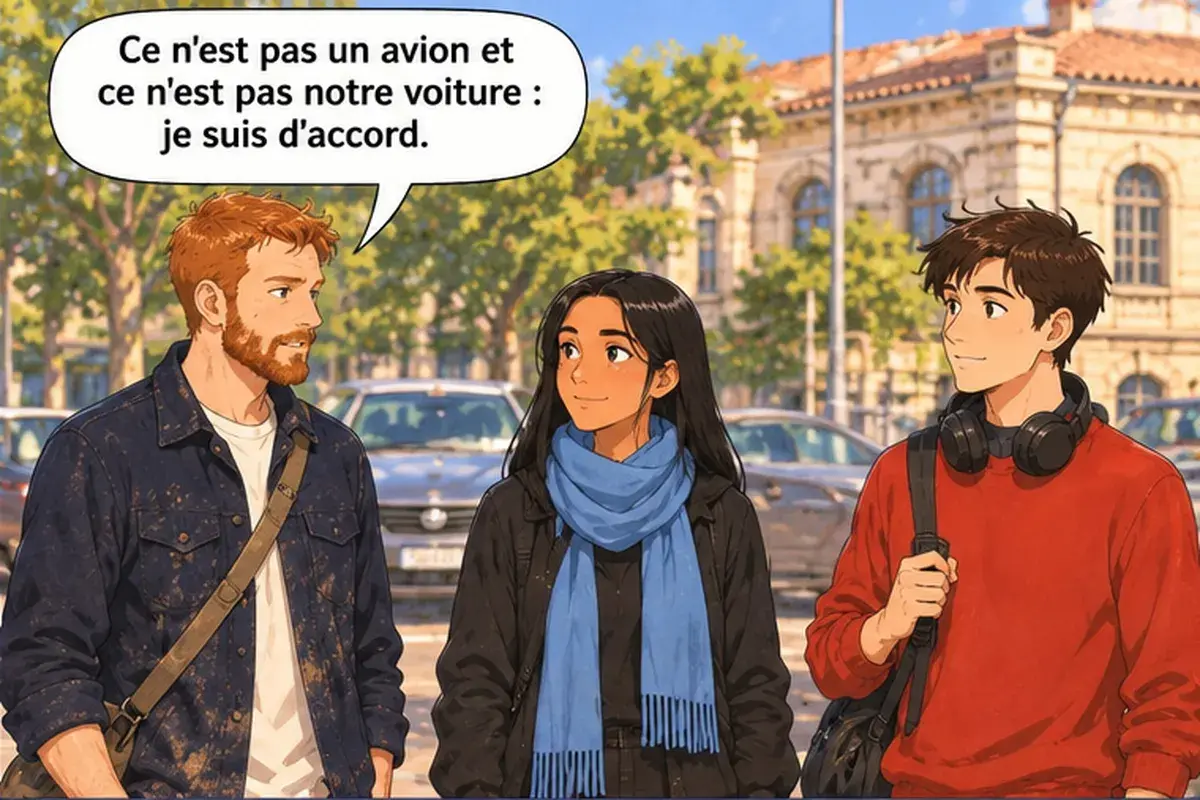
- Hugo
Ce n'est pas un avion et ce n'est pas notre voiture : je suis d'accord.
It's not a plane and it's not our car: I agree.
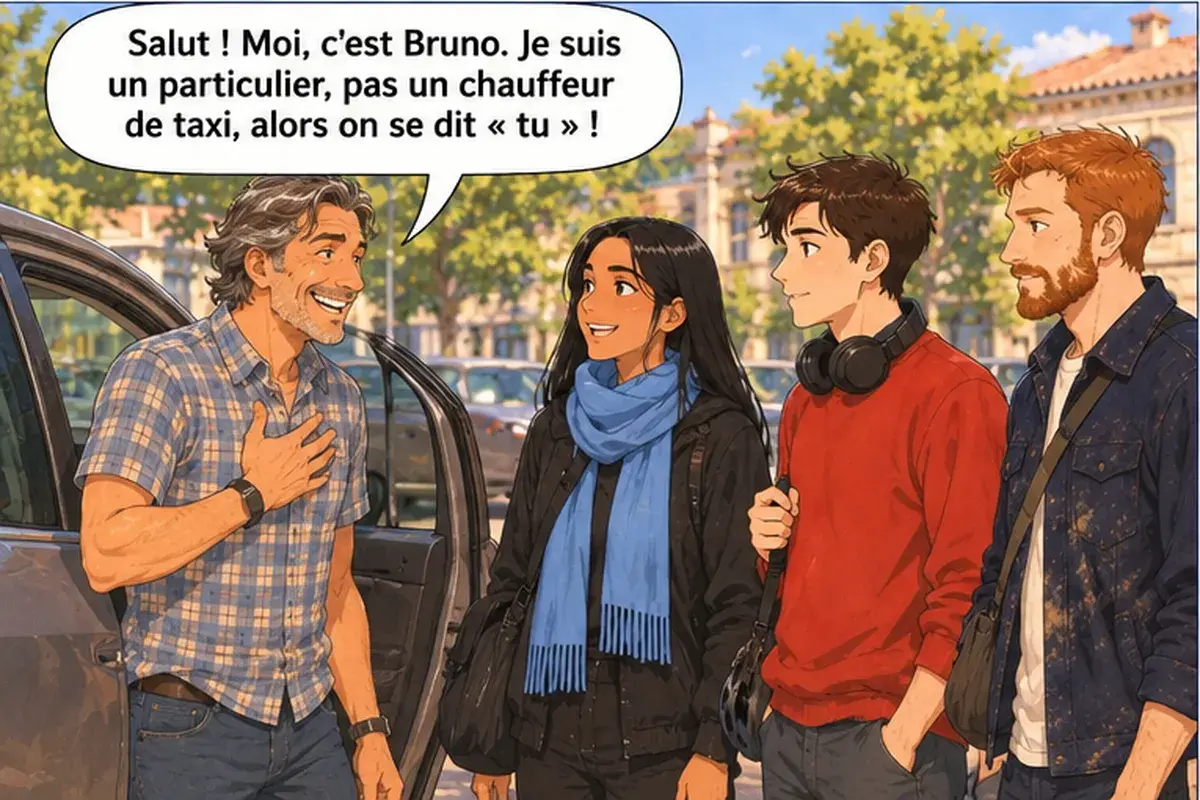
- Bruno
Salut ! Moi, c'est Bruno. Je suis un particulier, pas un chauffeur de taxi, alors on se dit « tu » !
Hi! I'm Bruno. I'm a private individual, not a taxi driver, so we say "tu" to each other!
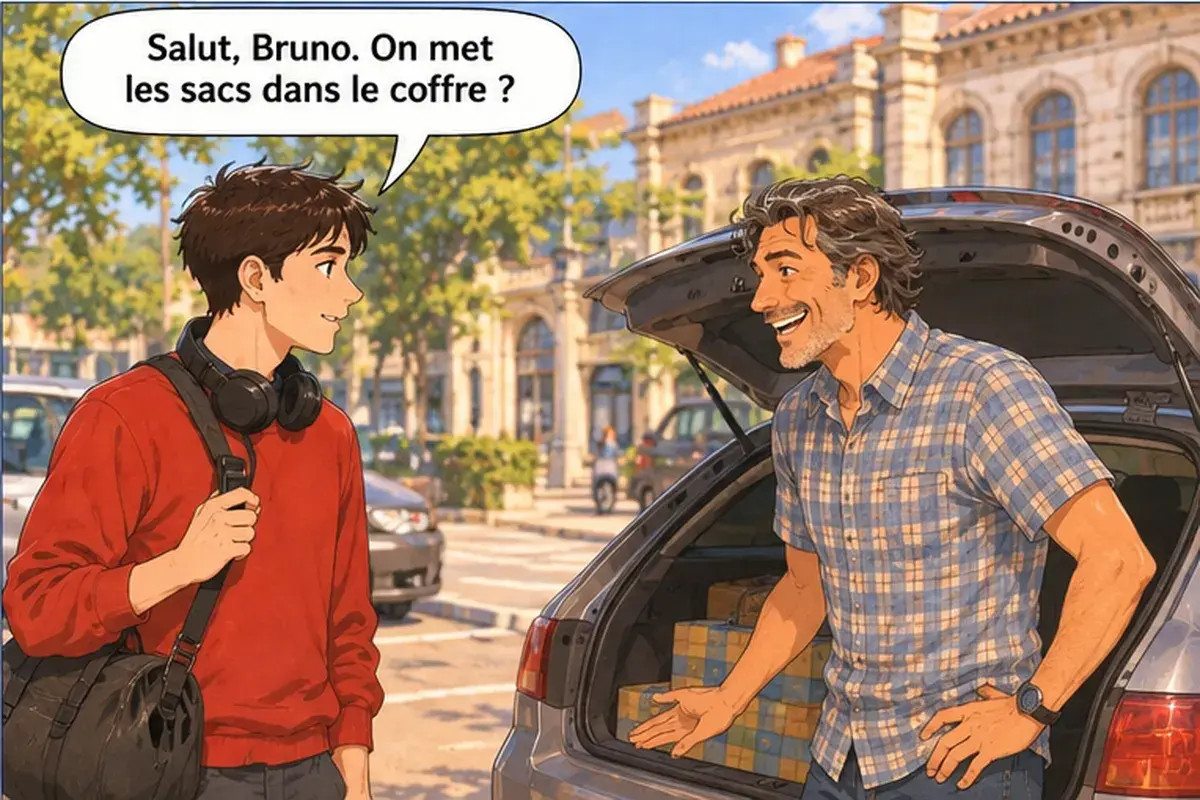
- Pacha
Salut, Bruno. On met les sacs dans le coffre ?
Hi, Bruno. Should we put the bags in the trunk?
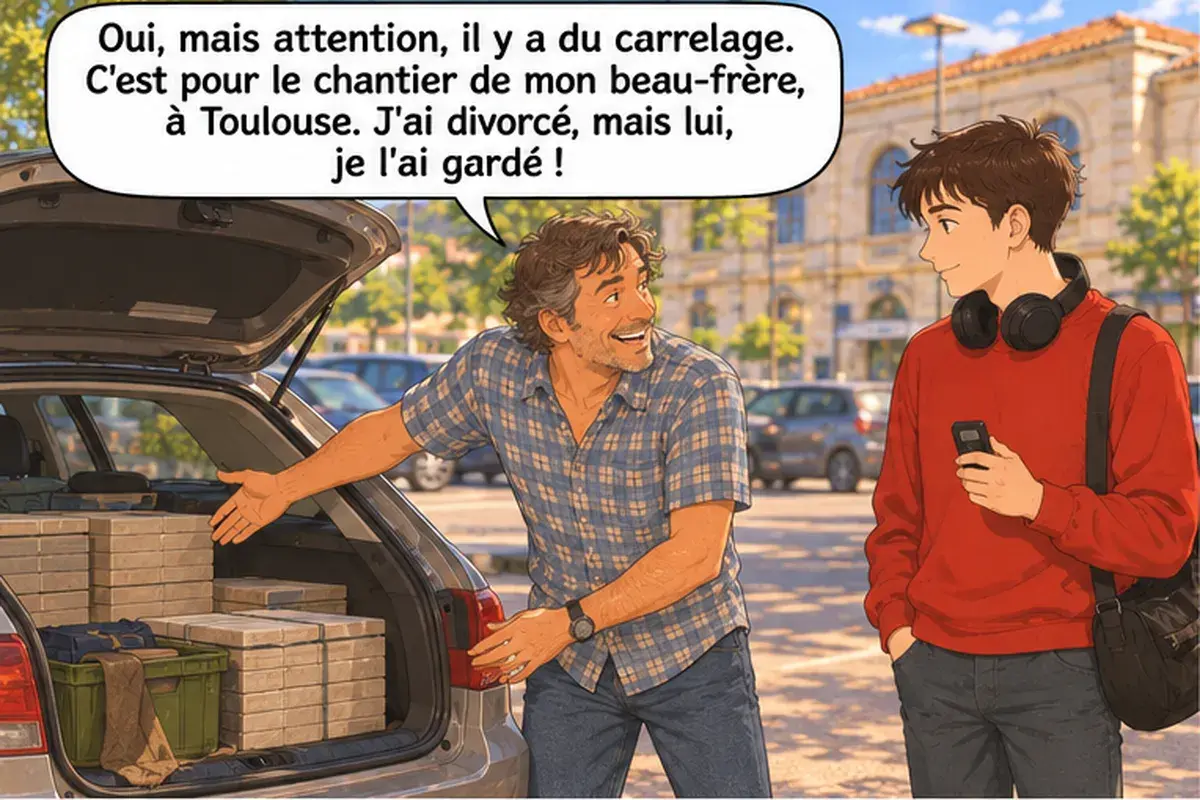
- Bruno
Oui, mais attention, il y a du carrelage. C'est pour le chantier de mon beau-frère, à Toulouse. J'ai divorcé, mais lui, je l'ai gardé !
Yes, but careful, there's tile in there. It's for my brother-in-law's construction site in Toulouse. I got divorced, but him, I kept!
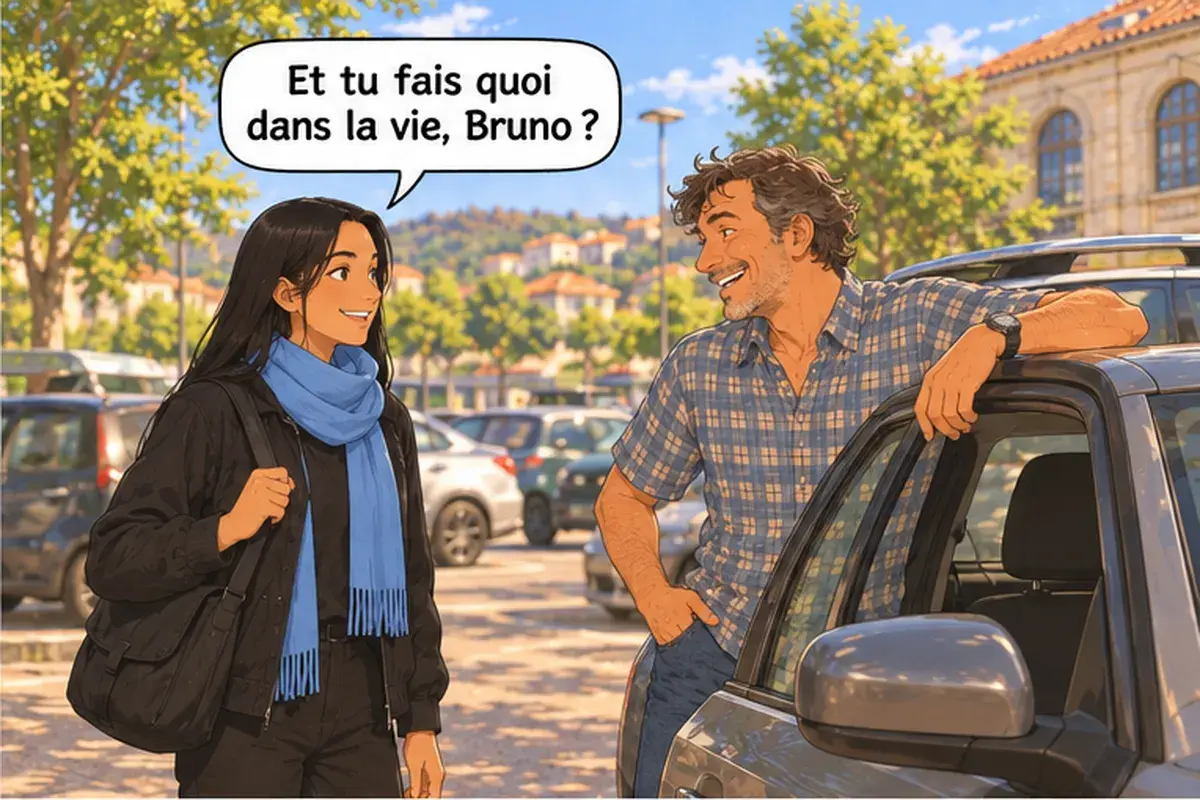
- Inès
Et tu fais quoi dans la vie, Bruno ?
And what do you do for a living, Bruno?
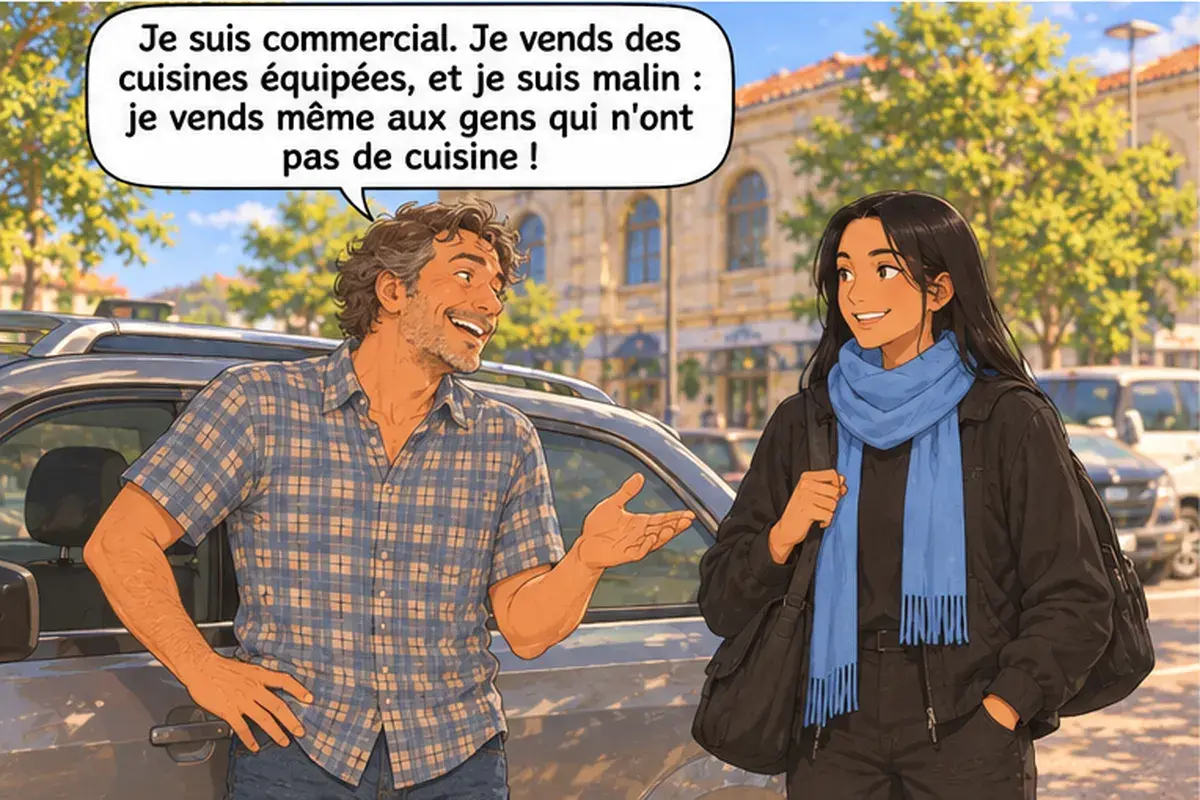
- Bruno
Je suis commercial. Je vends des cuisines équipées, et je suis malin : je vends même aux gens qui n'ont pas de cuisine !
I'm a sales rep. I sell fully equipped kitchens, and I'm clever: I even sell to people who don't have a kitchen! (man speaking)
- Inès
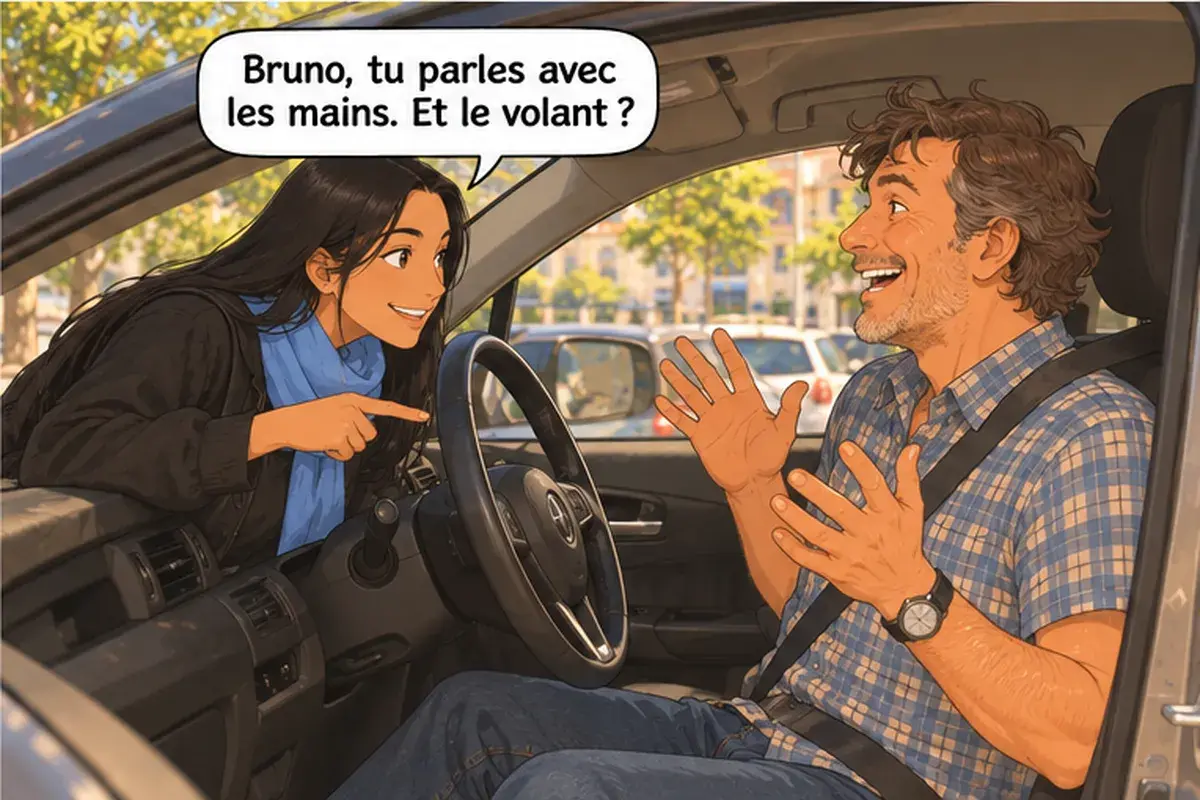
Bruno, tu parles avec les mains. Et le volant ?
Bruno, you're talking with your hands. What about the steering wheel?
- Bruno
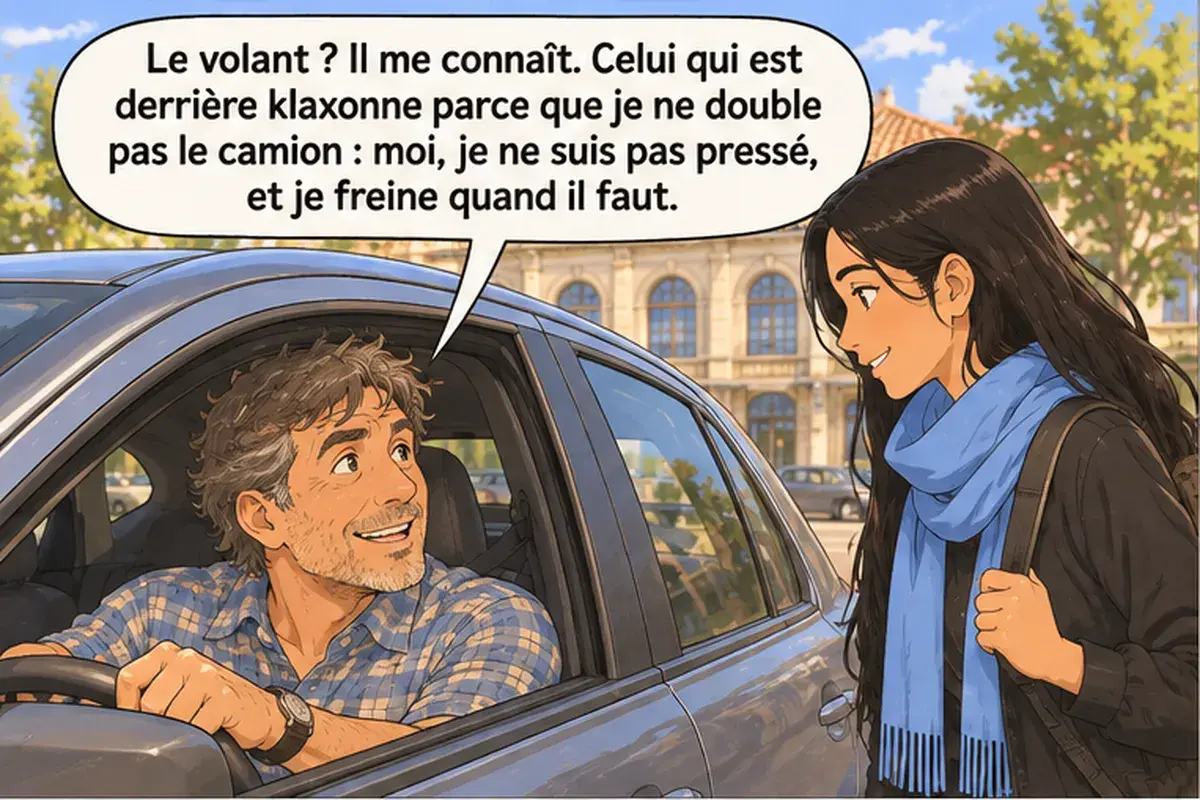
Le volant ? Il me connaît. Celui qui est derrière klaxonne parce que je ne double pas le camion : moi, je ne suis pas pressé, et je freine quand il faut.
The steering wheel? It knows me. The one behind us is honking because I'm not passing the truck: I'm not in a hurry, and I brake when I need to. (man speaking)
- Hugo
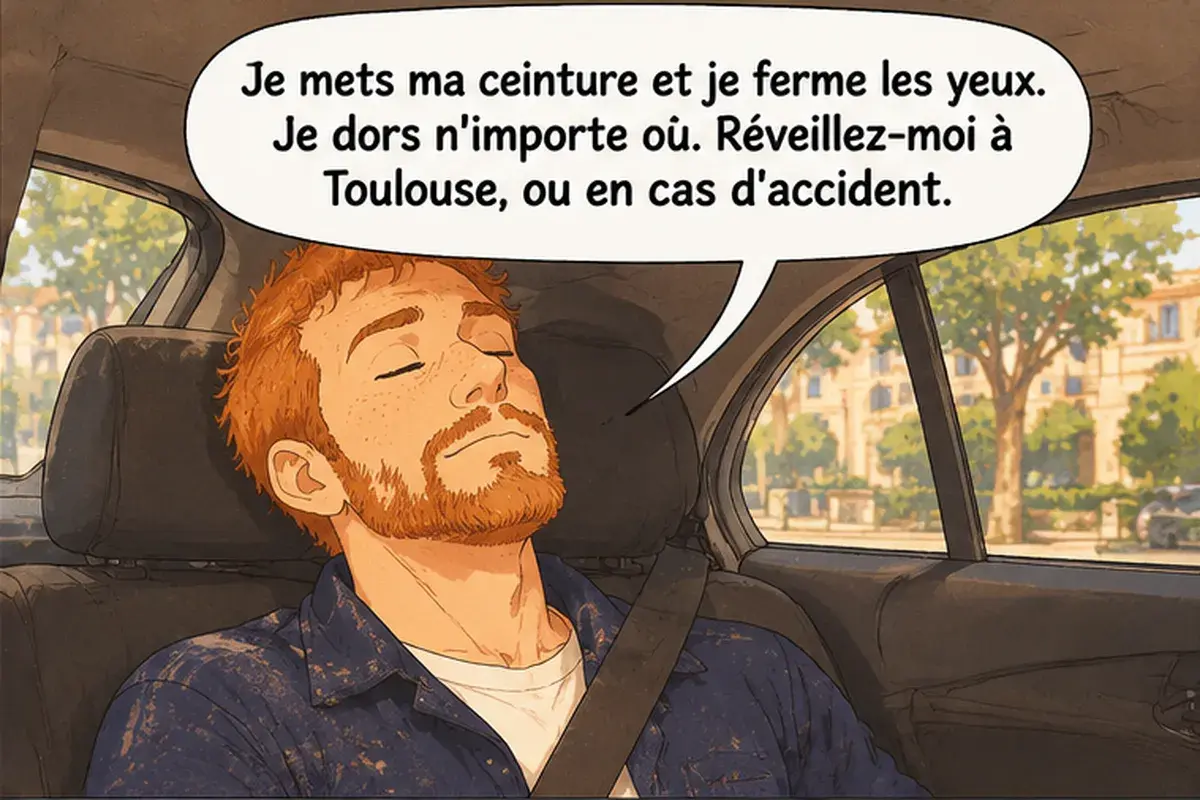
Je mets ma ceinture et je ferme les yeux. Je dors n'importe où. Réveillez-moi à Toulouse, ou en cas d'accident.
I'm putting on my seat belt and closing my eyes. I sleep anywhere. Wake me up in Toulouse, or in case of an accident (to several people).
- Pacha
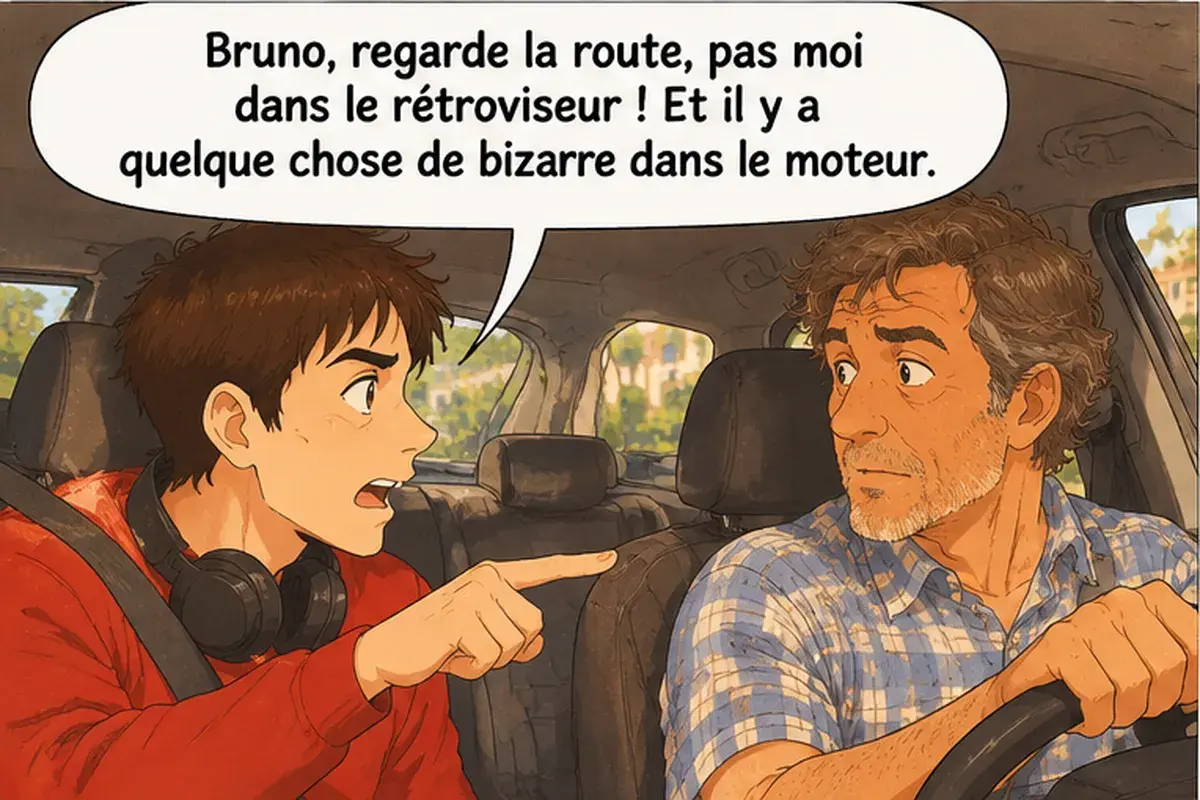
Bruno, regarde la route, pas moi dans le rétroviseur ! Et il y a quelque chose de bizarre dans le moteur.
Bruno, watch the road, not me in the rearview mirror! And there's something strange in the engine.
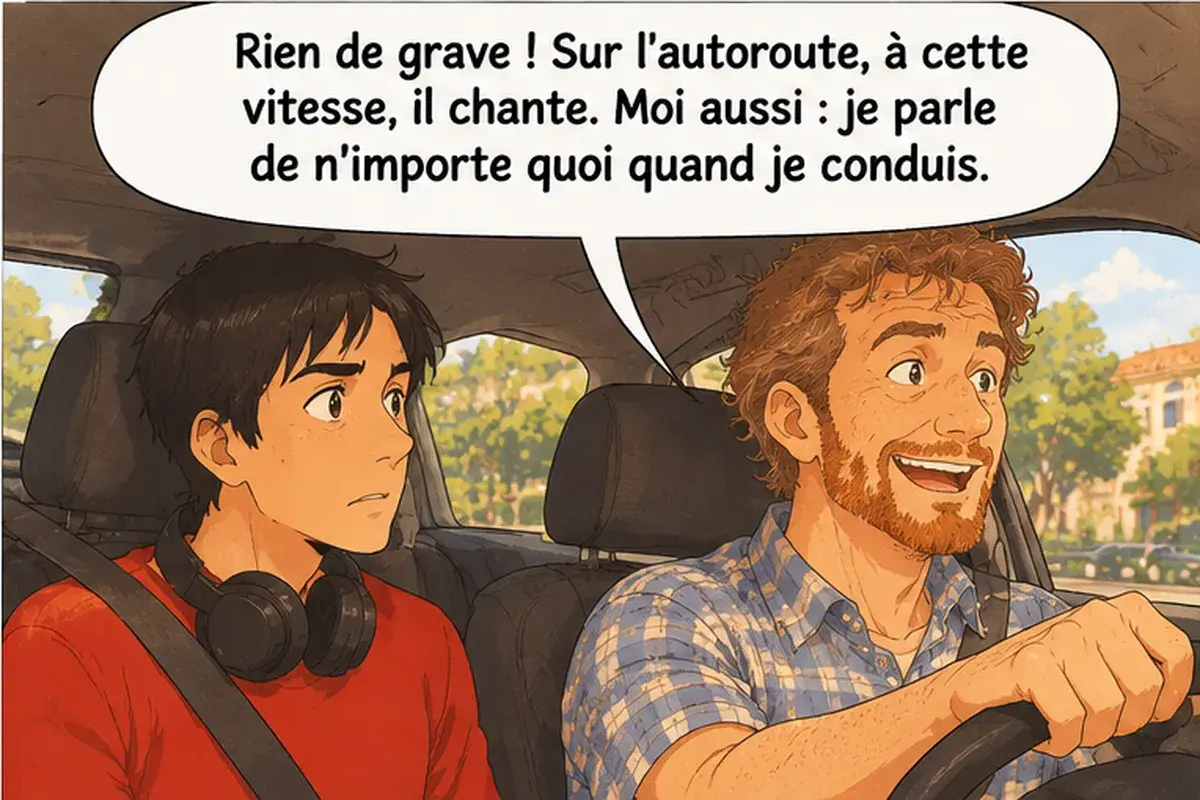
- Bruno
Rien de grave ! Sur l'autoroute, à cette vitesse, il chante. Moi aussi : je parle de n'importe quoi quand je conduis.
Nothing serious! On the highway, at this speed, it sings. Me too: I talk about anything at all when I drive.
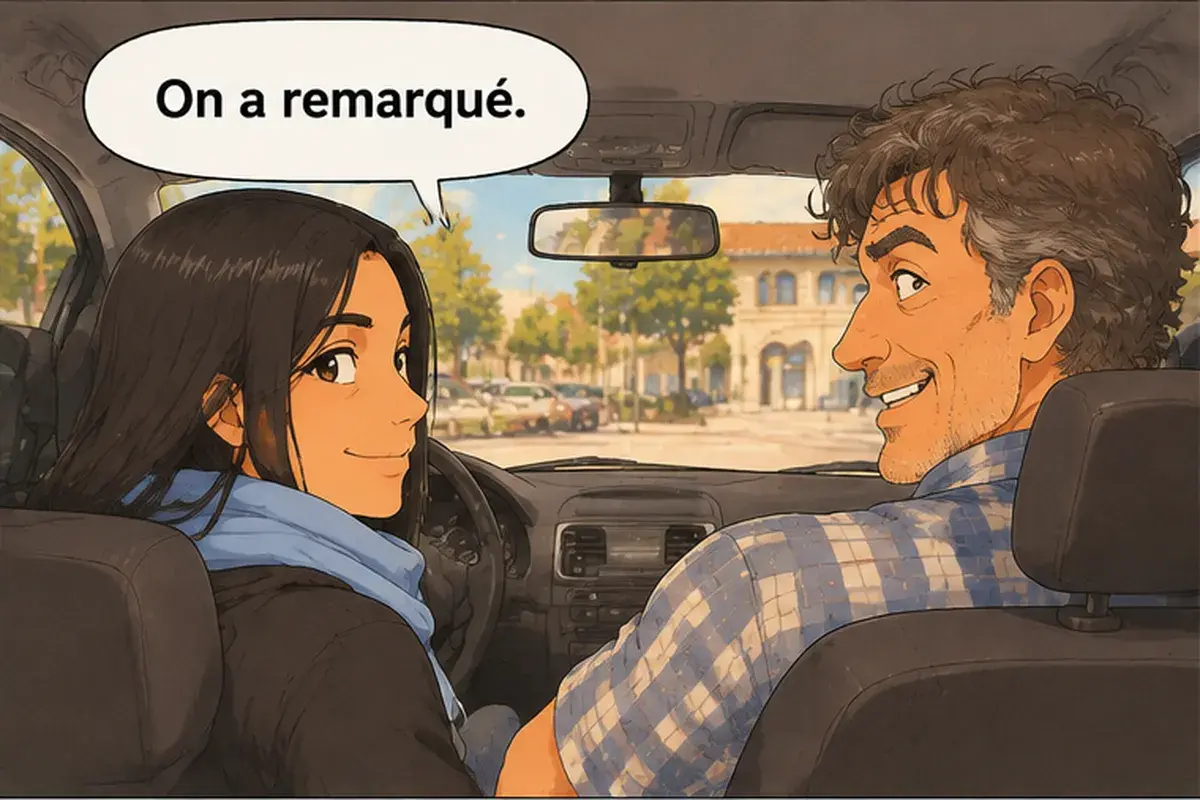
- Inès
On a remarqué.
We noticed.
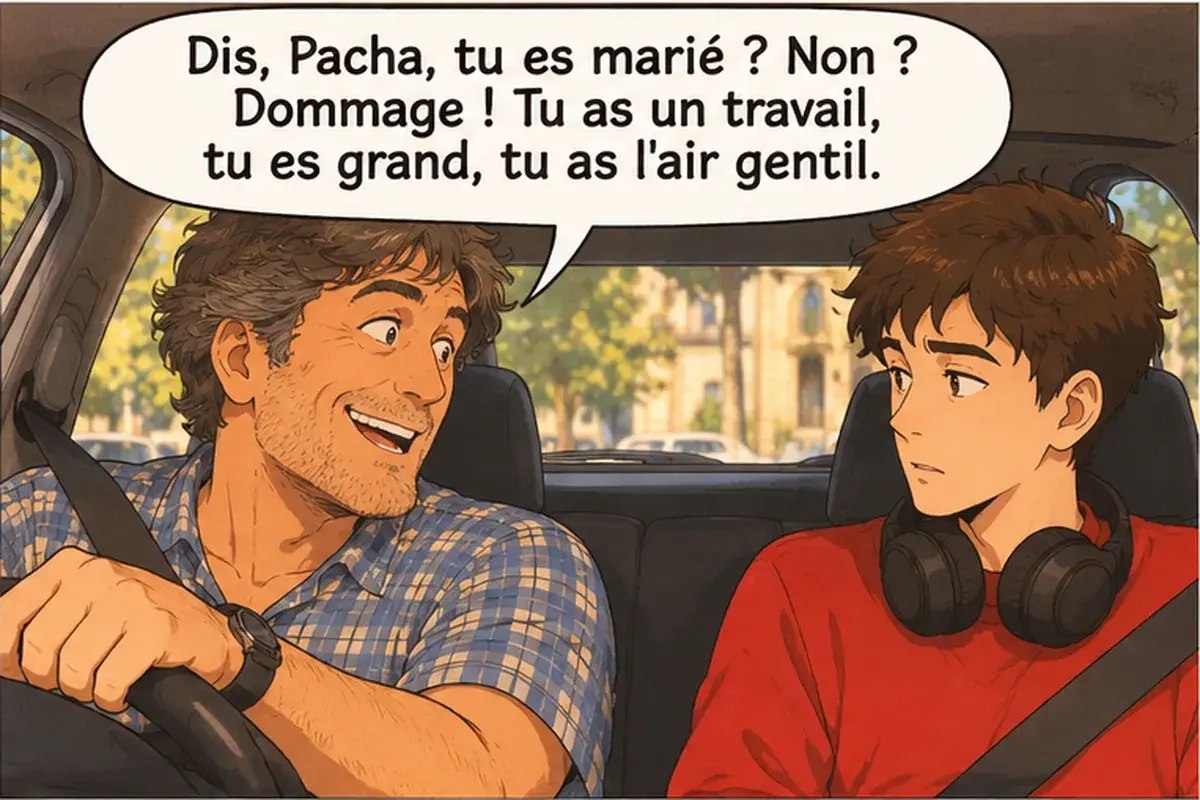
- Bruno
Dis, Pacha, tu es marié ? Non ? Dommage ! Tu as un travail, tu es grand, tu as l'air gentil.
Hey, Pacha, are you married? No? Too bad! You have a job, you're tall, you seem nice (to a man).
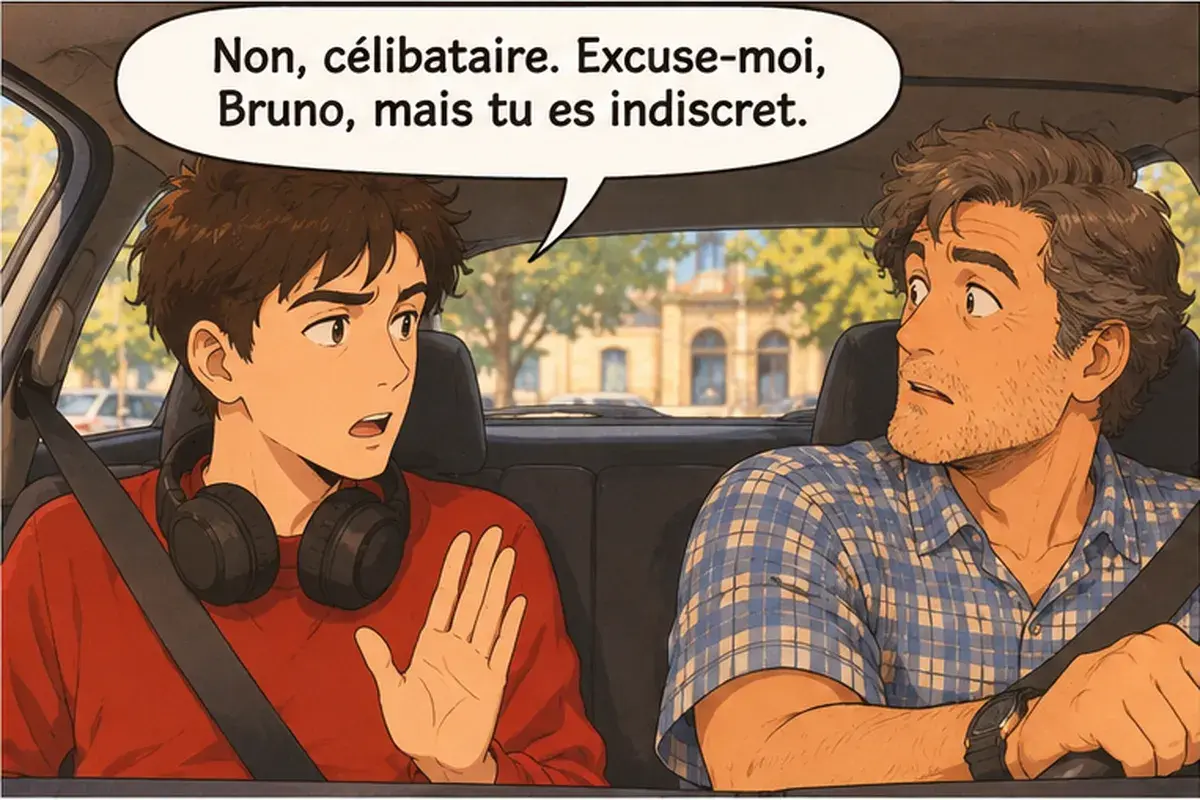
- Pacha
Non, célibataire. Excuse-moi, Bruno, mais tu es indiscret.
No, single. Excuse me, Bruno, but you're nosy (to a man).
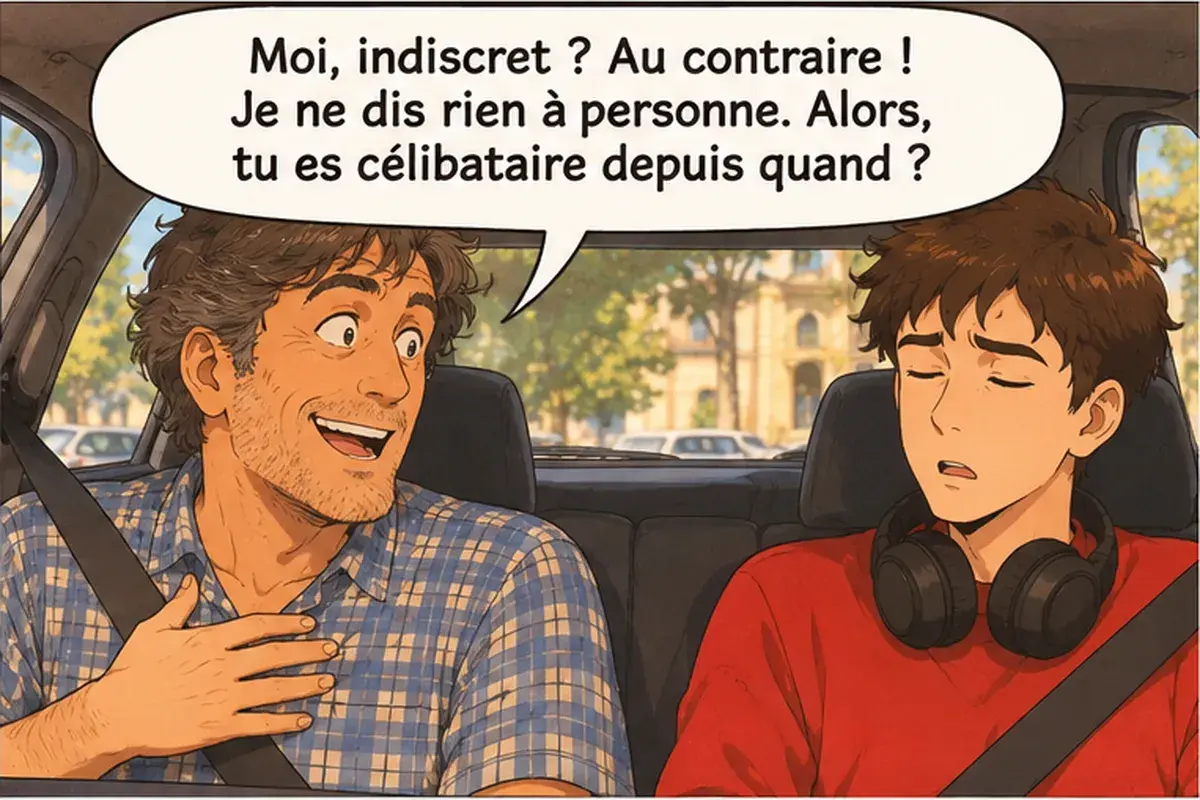
- Bruno
Moi, indiscret ? Au contraire ! Je ne dis rien à personne. Alors, tu es célibataire depuis quand ?
Me, nosy? On the contrary! I don't tell anyone anything. So, since when have you been single? (man speaking)
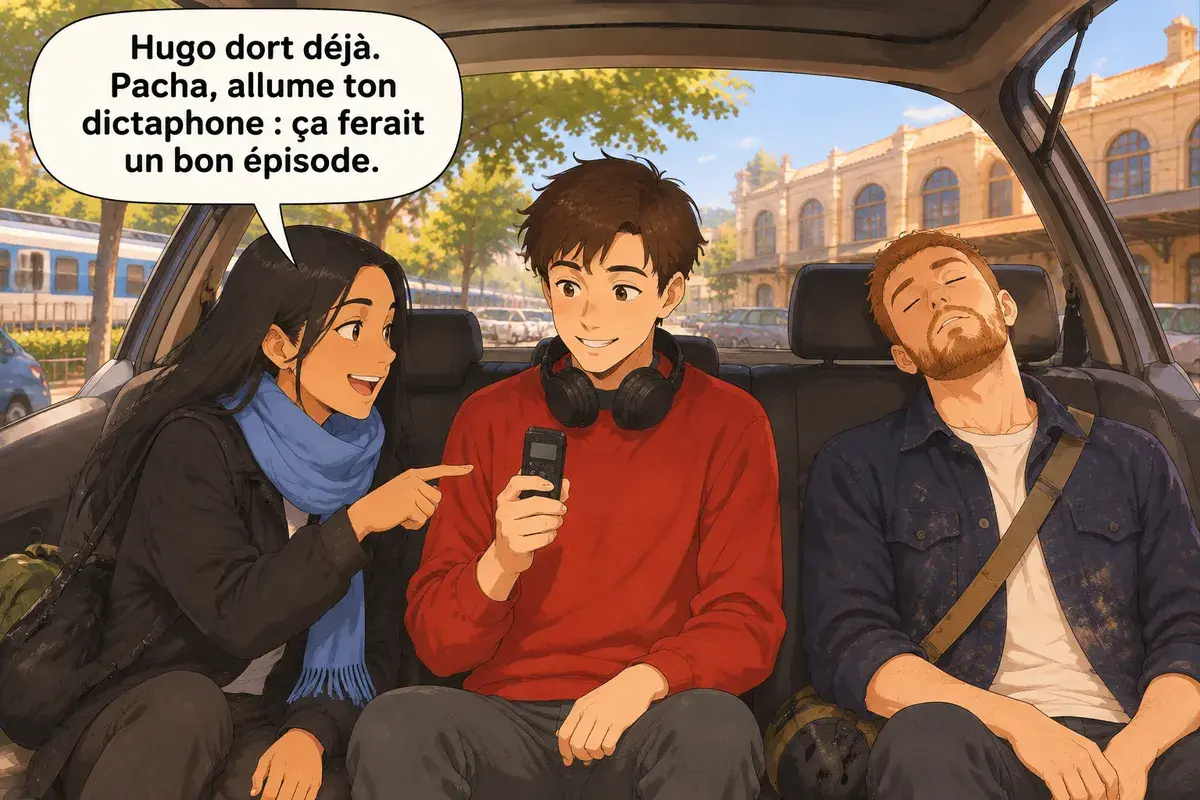
- Inès
Hugo dort déjà. Pacha, allume ton dictaphone : ça ferait un bon épisode.
Hugo's already asleep. Pacha, turn on your voice recorder: this would make a good episode.
Grammar for this text
- on se dit « tu » — se dire here means "to say to each other": "we say tu to each other". This is how French speakers switch to tu.
- je l'ai gardé — l' is le ("him"): it goes before ai and refers to beau-frère; gardé — "kept" (the verb garder). The joke: he lost his wife but kept his brother-in-law.
- Le volant ? Il me connaît. — me means "me": "The steering wheel? It knows me." Bruno drives while waving his hands.
- Celui qui est derrière klaxonne — celui qui means "the one who" (the driver behind; unit 5). Klaxonner — "to honk", from klaxon.
- Réveillez-moi — a command with moi: "wake me up". The -ez form is the vous form: Hugo is talking to everyone at once.
- quelque chose de bizarre, Rien de grave — after quelque chose and rien comes de + an adjective (see the unit grammar).
- Je ne dis rien à personne — ne… rien ("nothing") and à personne ("to no one") together: "I don't tell anyone anything." ça ferait un bon épisode — ferait means "would make": the conditional of faire, "this would make a good episode".
Words and grammar of the unit: Chat with a stranger on a road trip.
Learn the words from the texts with flashcards
In the app, you can tap any word in a text to see its translation, forms and examples, and new words stick with flashcards. 15 minutes a day.
Start for freeEverything is open for free. No card needed to sign up.