

French dialogue with translation · B1 · 18 lines
La tente dont je vous ai parlé The tent I told you about
Comic · 18 panels
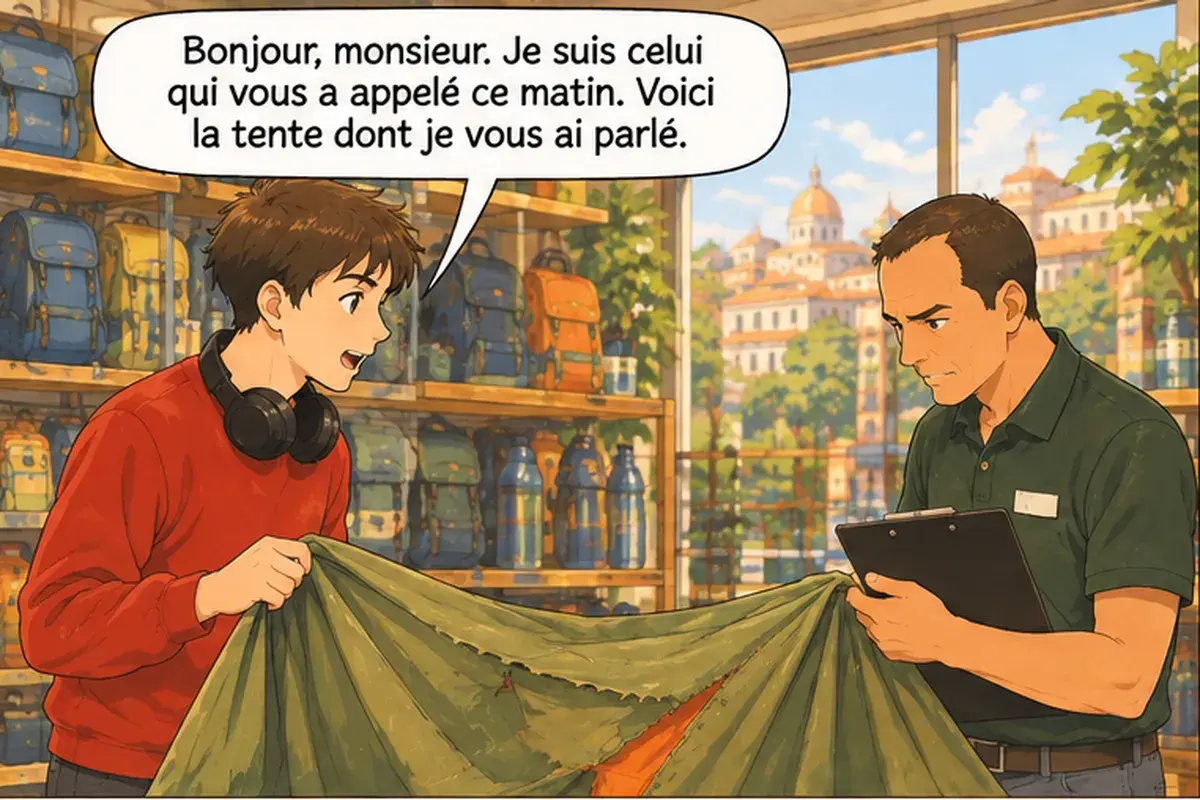
- Pacha
Bonjour, monsieur. Je suis celui qui vous a appelé ce matin. Voici la tente dont je vous ai parlé.
Hello, sir. I'm the one who called you this morning. Here's the tent I told you about. (man speaking, formal)
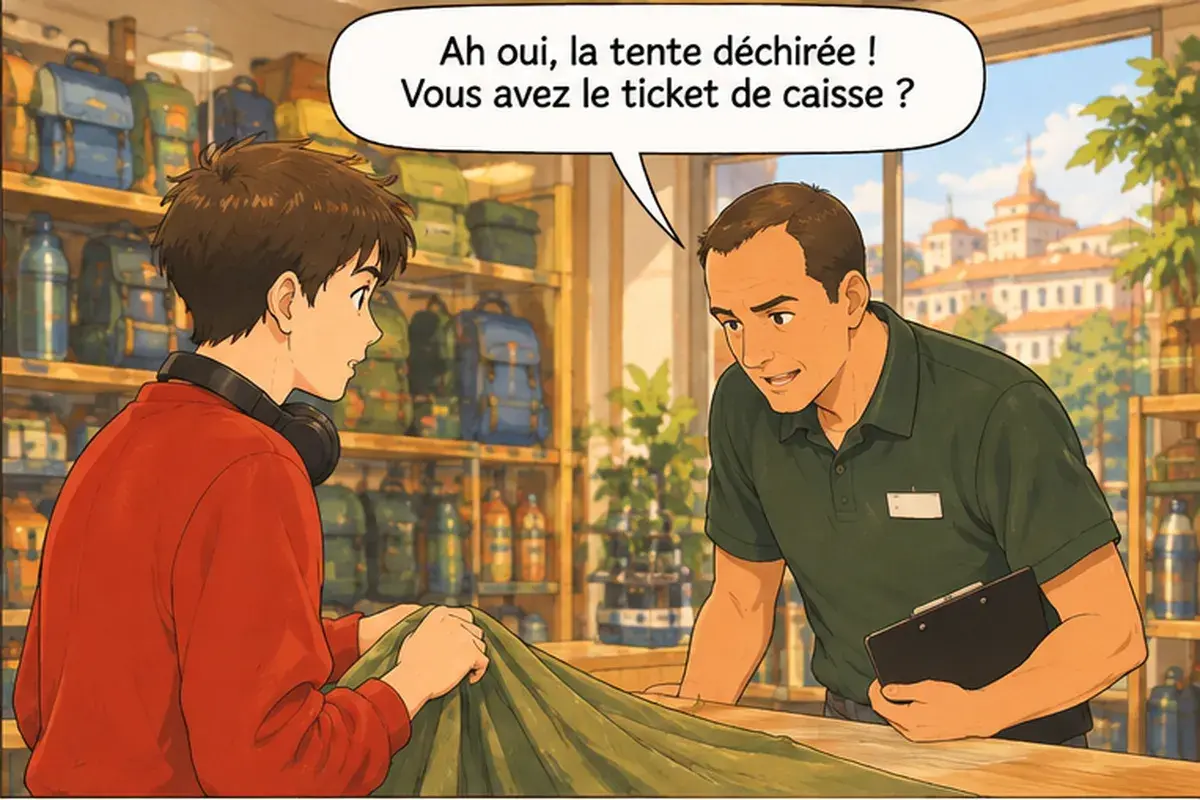
- Employé
Ah oui, la tente déchirée ! Vous avez le ticket de caisse ?
Oh yes, the torn tent! Do you have the receipt? (formal)

- Pacha
Le voici. On l'a achetée hier après-midi dans votre magasin, juste avant de prendre le bus pour le camping.
Here it is. We bought it yesterday afternoon in your store, just before taking the bus to the campsite. (formal)
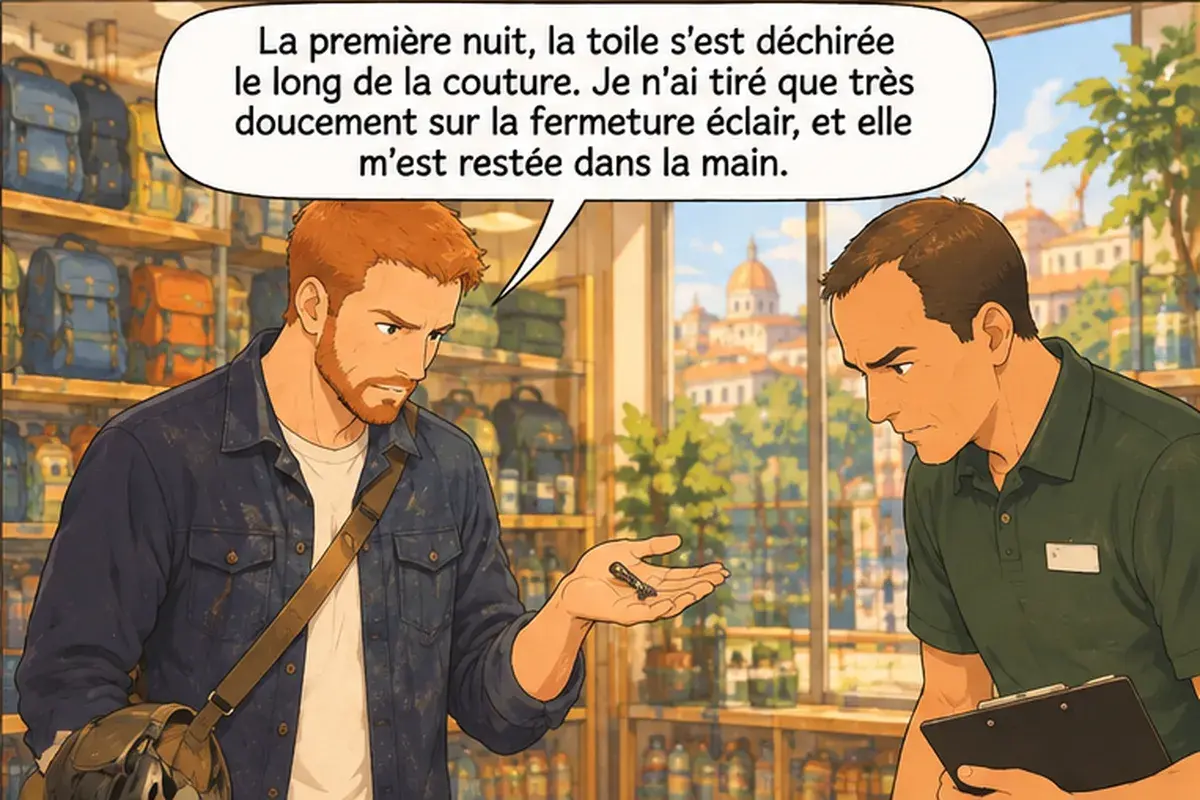
- Hugo
La première nuit, la toile s'est déchirée le long de la couture. Je n'ai tiré que très doucement sur la fermeture éclair, et elle m'est restée dans la main.
The first night, the canvas tore along the seam. I only pulled very gently on the zipper, and it came off in my hand.
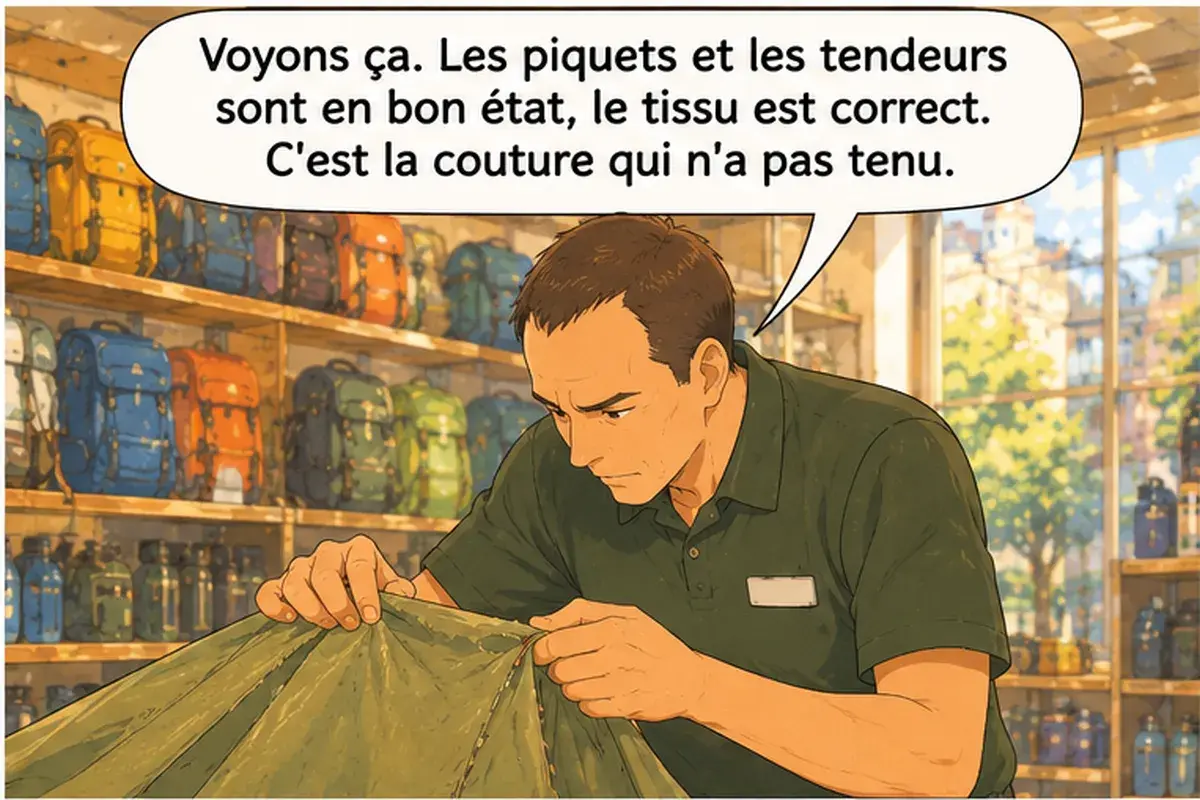
- Employé
Voyons ça. Les piquets et les tendeurs sont en bon état, le tissu est correct. C'est la couture qui n'a pas tenu.
Let's take a look. The stakes and the guy lines are in good shape, the fabric is decent. It's the seam that didn't hold.
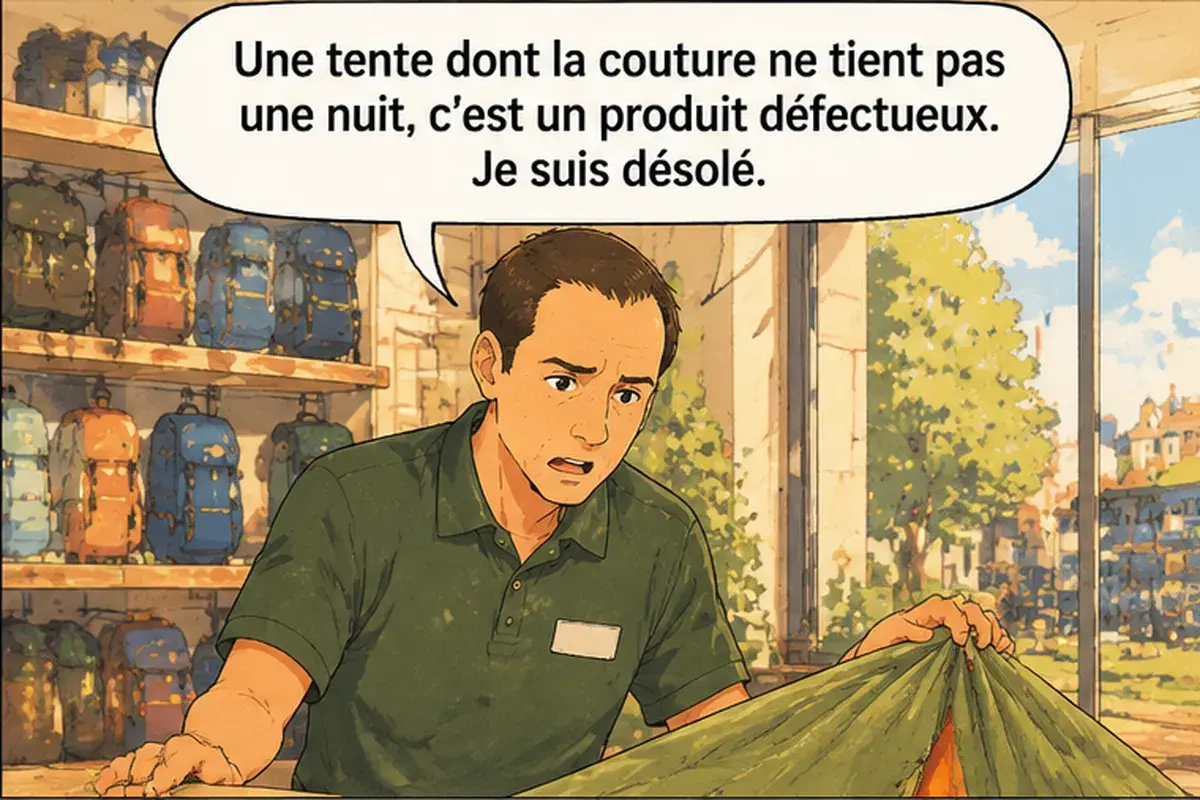
- Employé
Une tente dont la couture ne tient pas une nuit, c'est un produit défectueux. Je suis désolé.
A tent whose seam doesn't hold for one night is a defective product. I'm sorry (man speaking).
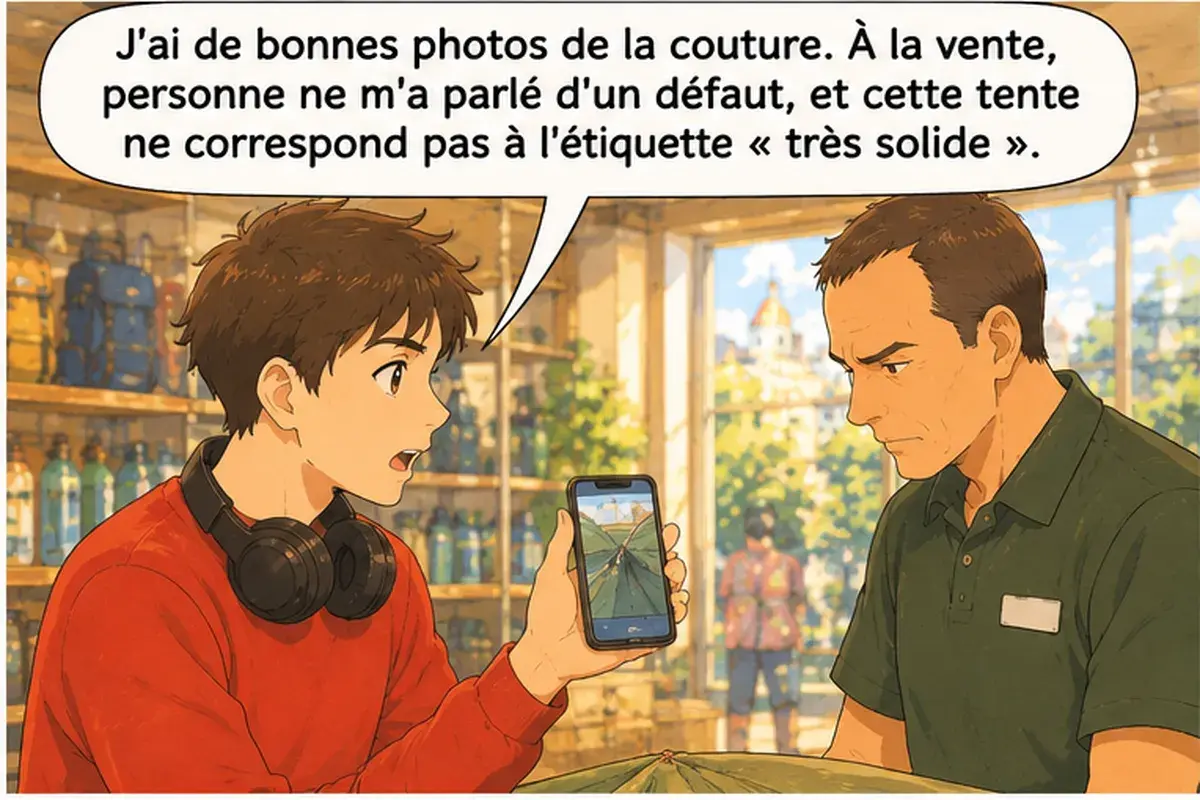
- Pacha
J'ai de bonnes photos de la couture. À la vente, personne ne m'a parlé d'un défaut, et cette tente ne correspond pas à l'étiquette « très solide ».
I have good photos of the seam. At the time of sale, nobody told me about a defect, and this tent doesn't match the "very sturdy" label.
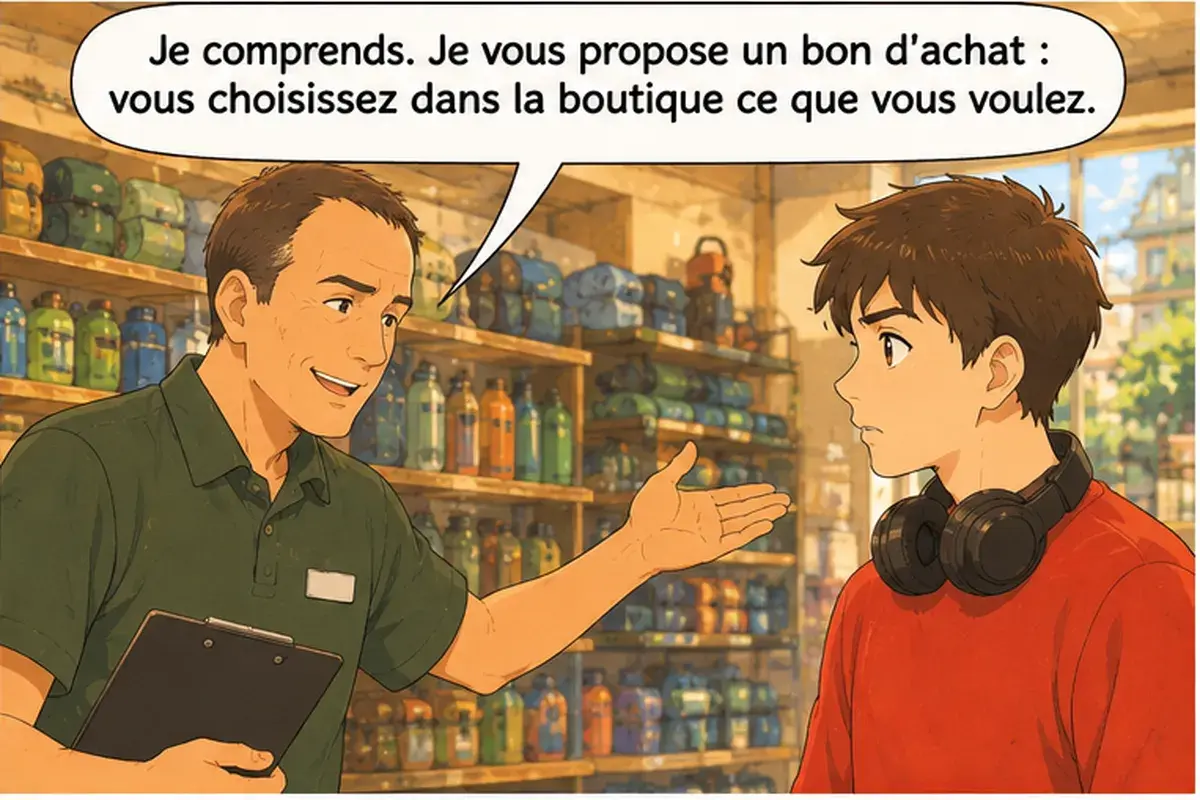
- Employé
Je comprends. Je vous propose un bon d'achat : vous choisissez dans la boutique ce que vous voulez.
I understand. I'm offering you a store credit voucher: you choose whatever you want in the shop. (formal)
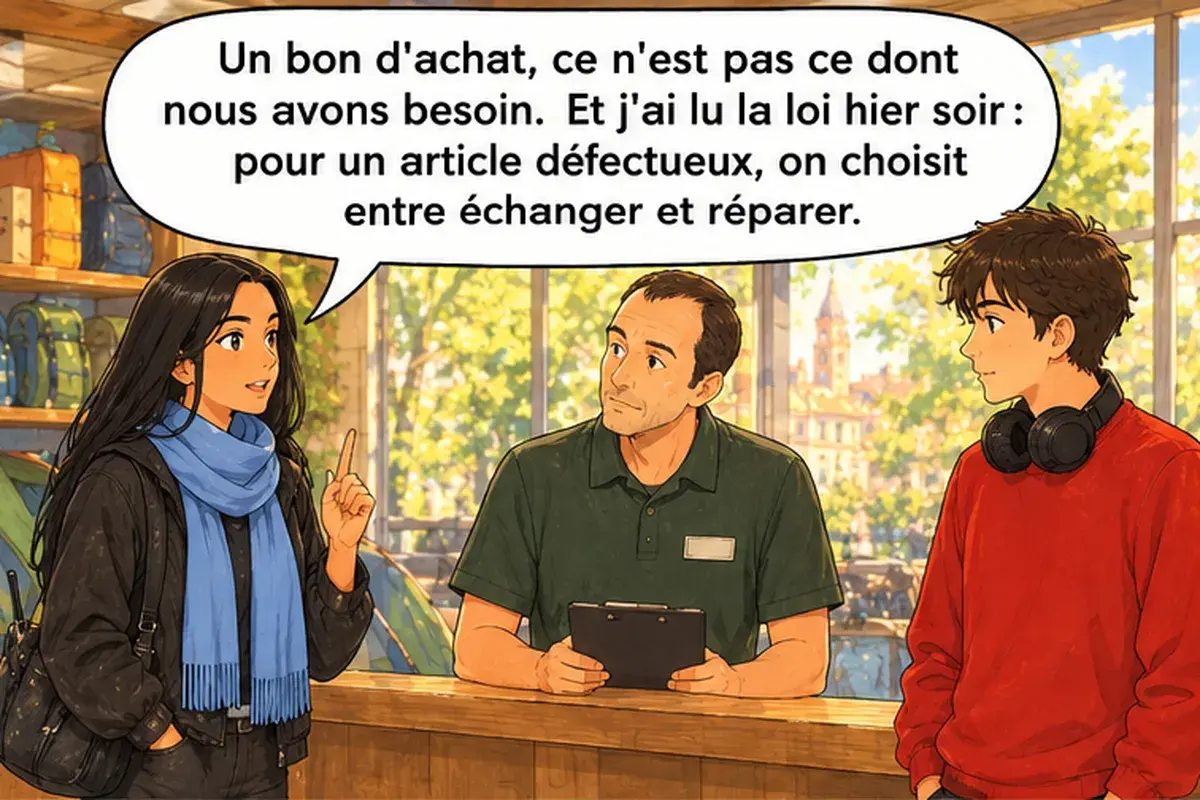
- Inès
Un bon d'achat, ce n'est pas ce dont nous avons besoin. Et j'ai lu la loi hier soir : pour un article défectueux, on choisit entre échanger et réparer.
A store credit voucher isn't what we need. And I read the law last night: for a defective item, people choose between exchanging and repairing.
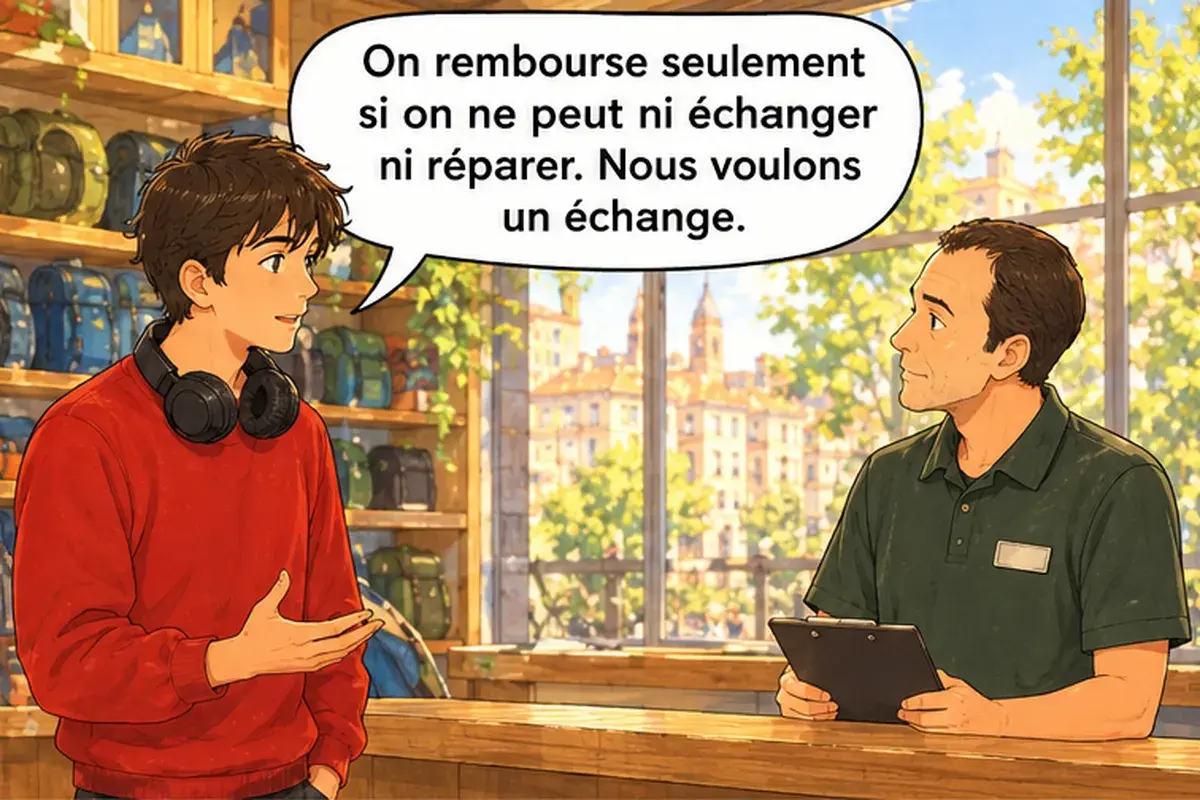
- Pacha
On rembourse seulement si on ne peut ni échanger ni réparer. Nous voulons un échange.
They only refund if they can neither exchange nor repair. We want an exchange.
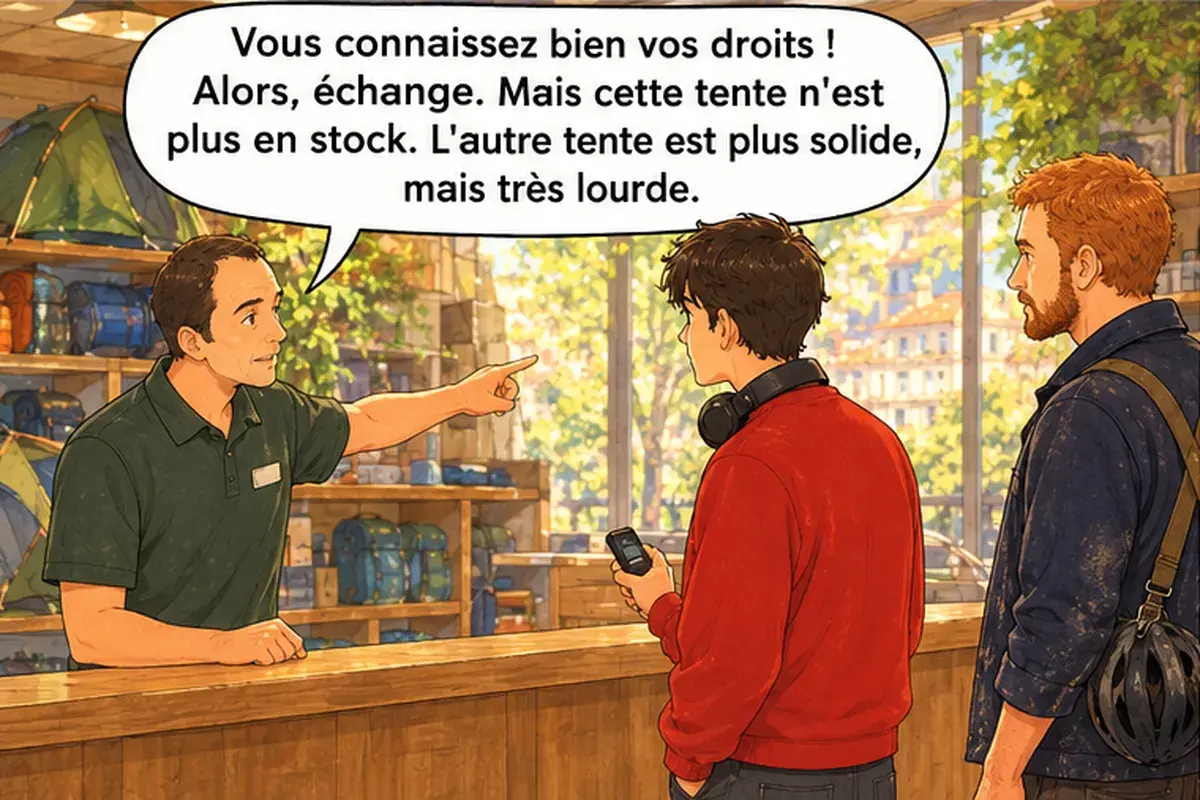
- Employé
Vous connaissez bien vos droits ! Alors, échange. Mais cette tente n'est plus en stock. L'autre tente est plus solide, mais très lourde.
You know your rights well! So, an exchange. But this tent is no longer in stock. The other tent is sturdier, but very heavy. (to several people)
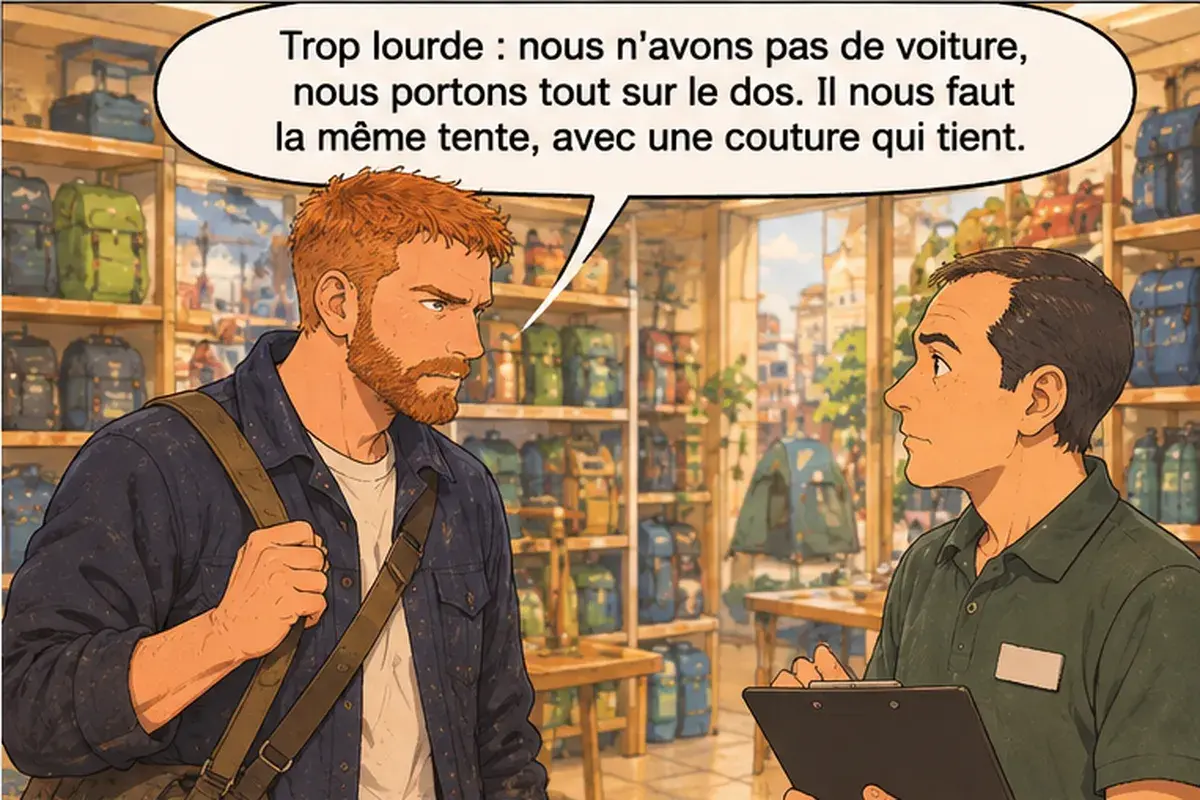
- Hugo
Trop lourde : nous n'avons pas de voiture, nous portons tout sur le dos. Il nous faut la même tente, avec une couture qui tient.
Too heavy: we don't have a car, we carry everything on our backs. We need the same tent, with a seam that holds.
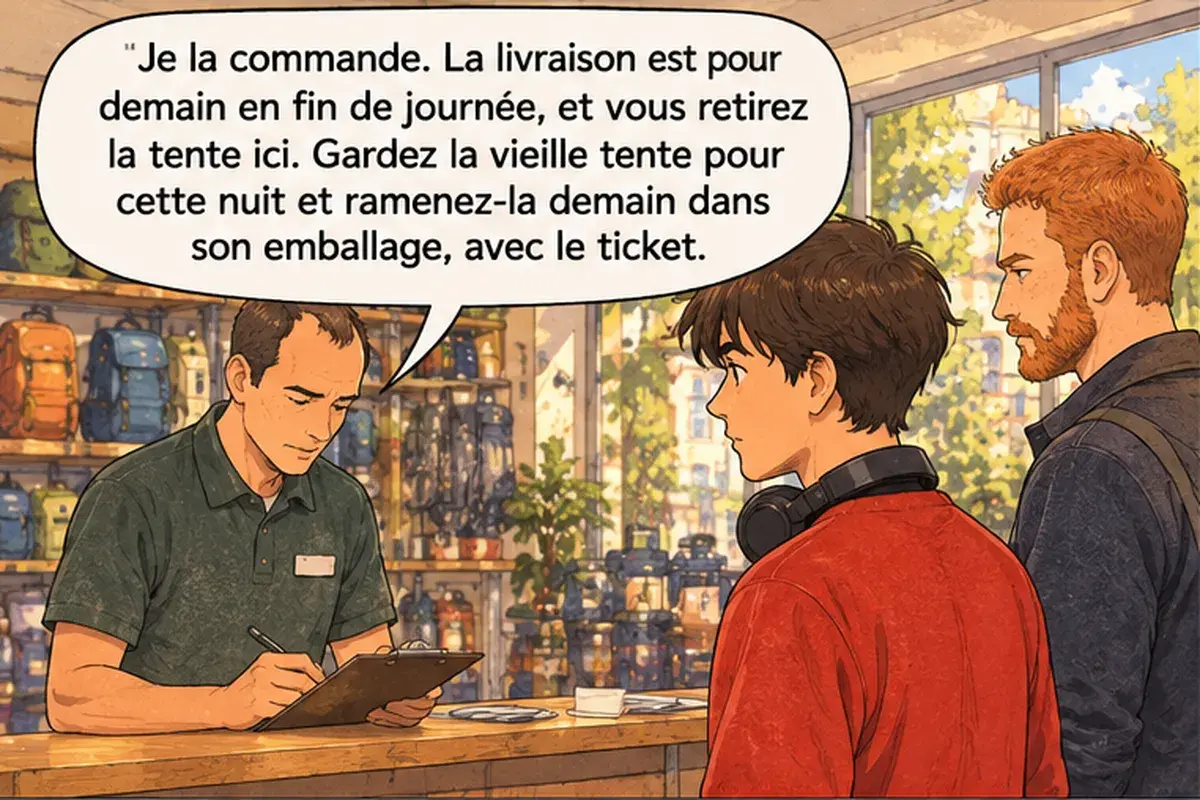
- Employé
Je la commande. La livraison est pour demain en fin de journée, et vous retirez la tente ici. Gardez la vieille tente pour cette nuit et ramenez-la demain dans son emballage, avec le ticket.
I'll order it. Delivery is tomorrow at the end of the day, and you pick up the tent here. Keep the old tent for tonight and bring it back tomorrow in its packaging, with the receipt. (to several people)

- Hugo
L'emballage est la seule chose qui n'est pas déchirée dans cette histoire.
The packaging is the only thing that isn't torn in this whole story.
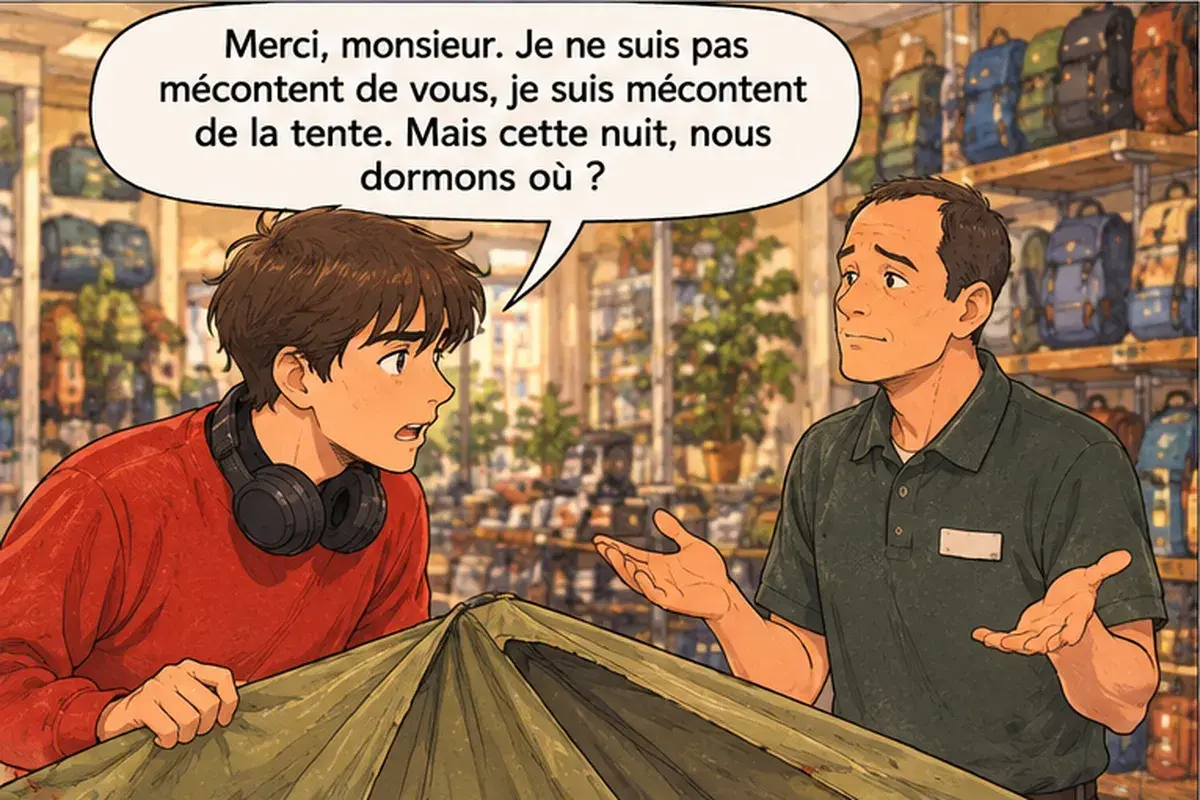
- Pacha
Merci, monsieur. Je ne suis pas mécontent de vous, je suis mécontent de la tente. Mais cette nuit, nous dormons où ?
Thank you, sir. I'm not unhappy with you, I'm unhappy with the tent. But where are we sleeping tonight? (man speaking, formal)
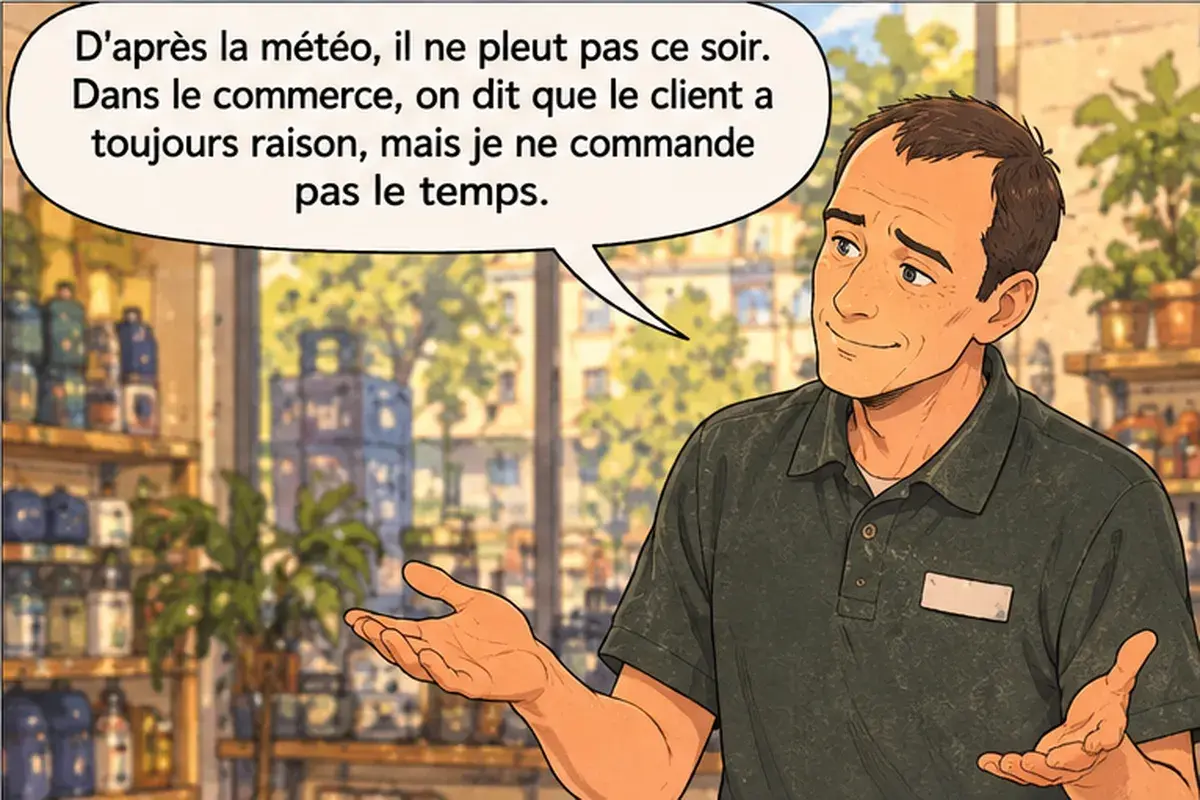
- Employé
D'après la météo, il ne pleut pas ce soir. Dans le commerce, on dit que le client a toujours raison, mais je ne commande pas le temps.
According to the forecast, it's not going to rain tonight. In retail, they say the customer is always right, but I don't order the weather.
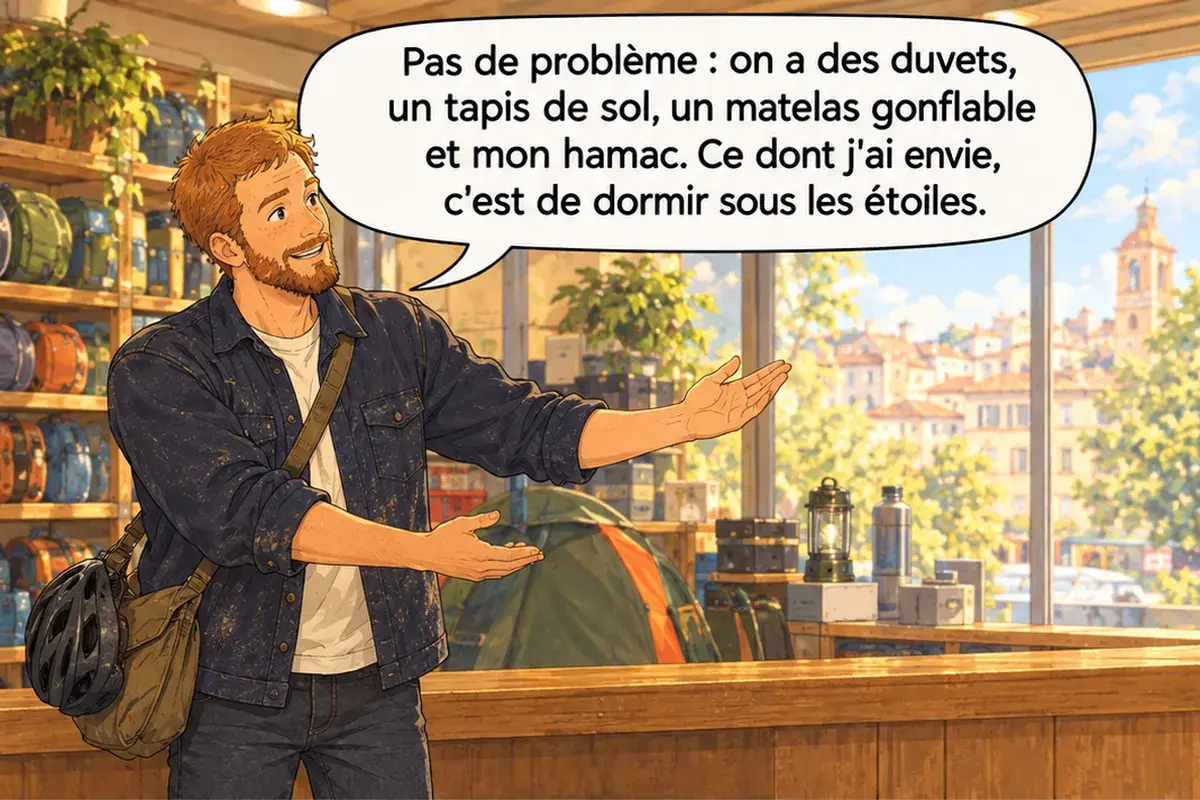
- Hugo
Pas de problème : on a des duvets, un tapis de sol, un matelas gonflable et mon hamac. Ce dont j'ai envie, c'est de dormir sous les étoiles.
No problem: we have sleeping bags, a ground mat, an air mattress and my hammock. What I feel like doing is sleeping under the stars.

- Pacha
Et moi, j'ai le tapis de sol. C'est-à-dire le sol.
And me, I have the ground mat. That is, the ground.
Grammar for this text
- la tente dont je vous ai parlé — the tent I told you about. Here
dontmeans "about which":parler deneedsde, and it hides insidedont. More in the unit grammar. - Je suis celui qui vous a appelé — I'm the one who called you.
celui quimeans "the one who" (unit 5). - On l'a achetée — We bought it. Here
onmeans "we";l'stands forla tente, so the participle ends in-e. - Une tente dont la couture ne tient pas — A tent whose seam doesn't hold. This is the second meaning of
dont: "whose". - ce n'est pas ce dont nous avons besoin — it isn't what we need.
ce dontmeans "what" (avoir besoin de). - J'ai de bonnes photos — I have good photos. It's
de, notdes, before an adjective. - On rembourse seulement si on ne peut ni échanger ni réparer — They only refund if they can neither exchange nor repair. This is the law: for a defect, the buyer first chooses between repair and exchange, and a refund comes only if neither is possible.
ni… nimeans "neither… nor". - Voyons ça — Let's take a look. This is the
nouscommand ("let's"). - Gardez… ramenez-la — Keep it… bring it back. These are commands to several people; the pronoun goes after the verb, joined with a hyphen.
- je ne commande pas le temps — I don't order the weather. A joke:
commandermeans "to order" in a store, but nobody can order the weather.
Words and grammar of the unit: Return a faulty item.
Learn the words from the texts with flashcards
In the app, you can tap any word in a text to see its translation, forms and examples, and new words stick with flashcards. 15 minutes a day.
Start for freeEverything is open for free. No card needed to sign up.