

French dialogue with translation · A2 · 16 lines
Et si on partait cet été ? How about we go away this summer?
Comic · 16 panels

- Inès
Hugo, Pacha, j'ai une idée ! Et si on partait cet été ?
Hugo, Pacha, I have an idea! How about we go away this summer?

- Hugo
Quand Inès dit « j'ai une idée », je cache mon budget.
When Inès says "I have an idea," I hide my budget.

- Inès
Très drôle. Écoutez : on part dans le sud, on rejoint ma famille à Marseille, et Mamie Zohra organise un grand repas pour tout le monde.
Very funny. Listen: we go south, we join my family in Marseille, and Mamie Zohra organizes a big meal for everyone (to several people).

- Pacha
Et après ?
And after that?

- Inès
Après, on suit la côte et on fait le podcast, avec les voix de chaque endroit. Et je veux de la chaleur : dans le nord, j'ai froid depuis septembre !
After that, we follow the coast and make the podcast, with voices from every place. And I want some warmth: in the north, I've been cold since September!

- Pacha
Moi, je viens !
I'm coming!

- Inès
Tu ne réfléchis pas ?
You're not thinking it over?

- Pacha
Si. J'ai réfléchi une minute.
Yes, I am. I thought it over for a minute.

- Hugo
Attends. J'ai une condition. Premier point : pas d'avion. Deuxième point : pas de voiture à nous.
Wait. I have a condition. First point: no planes. Second point: no car of our own.
- Inès
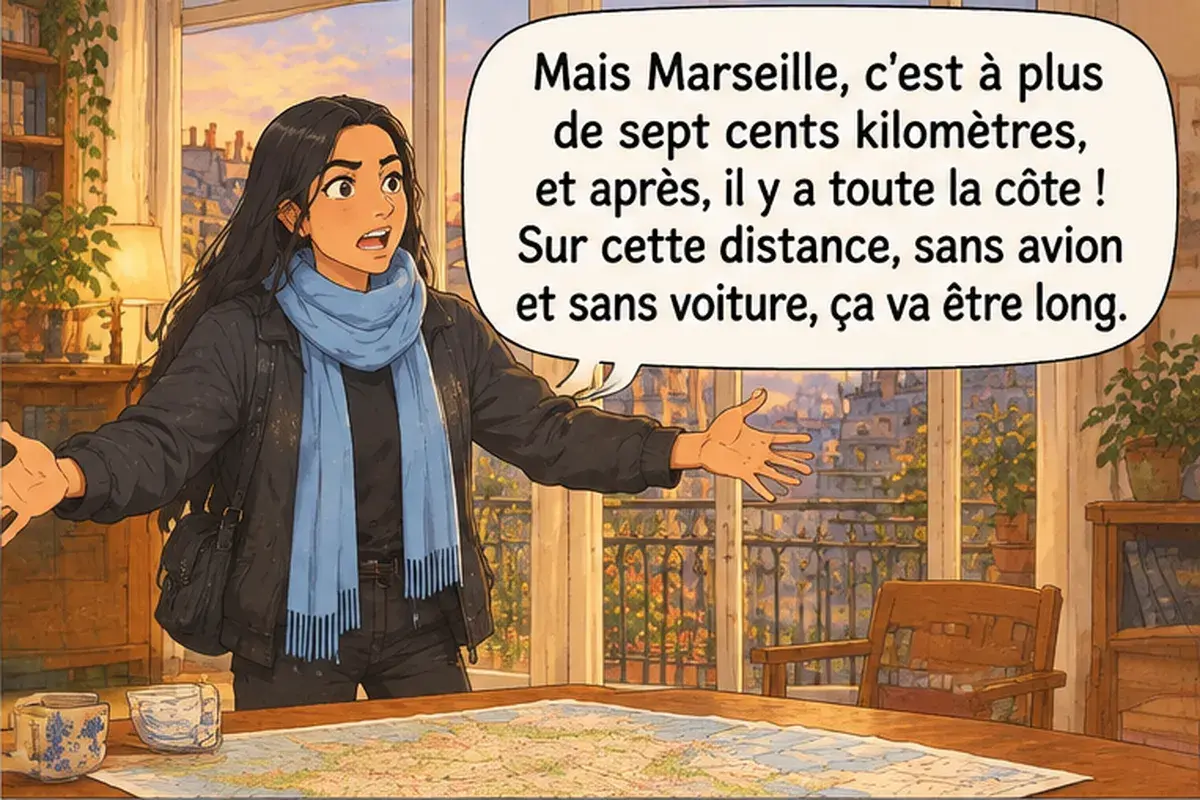
Mais Marseille, c'est à plus de sept cents kilomètres, et après, il y a toute la côte ! Sur cette distance, sans avion et sans voiture, ça va être long.
But Marseille is more than seven hundred kilometers away, and after that there's the whole coast! Over that distance, without a plane and without a car, it's going to take a long time.
- Hugo
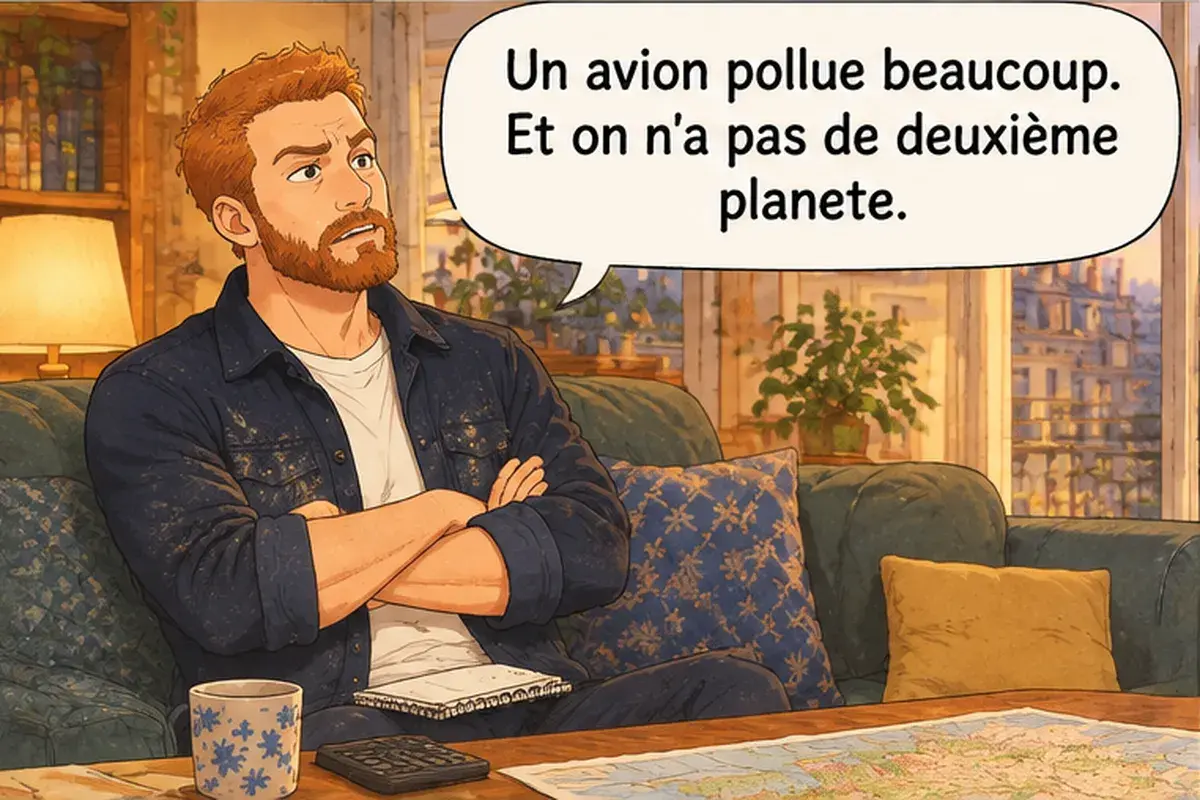
Un avion pollue beaucoup. Et on n'a pas de deuxième planète.
A plane pollutes a lot. And we don't have a second planet.
- Pacha
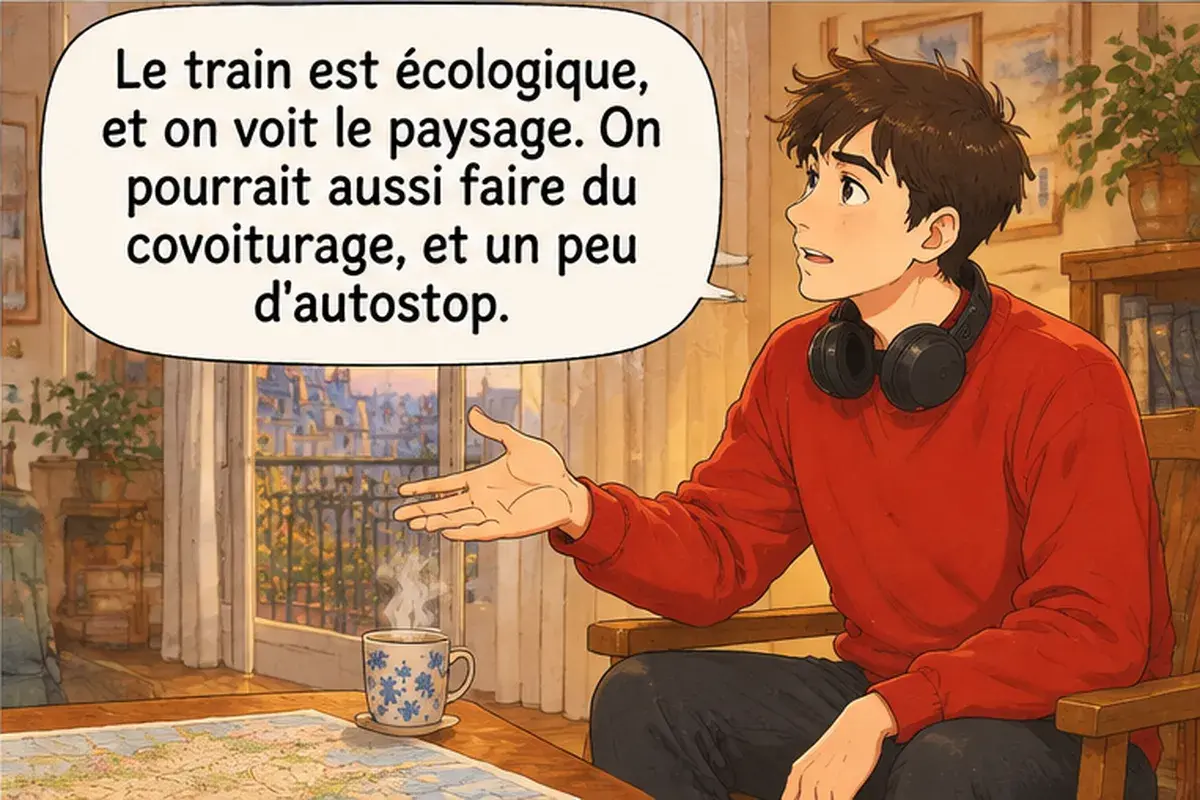
Le train est écologique, et on voit le paysage. On pourrait aussi faire du covoiturage, et un peu d'autostop.
The train is eco-friendly, and we see the scenery. We could also carpool, and do a bit of hitchhiking.
- Hugo
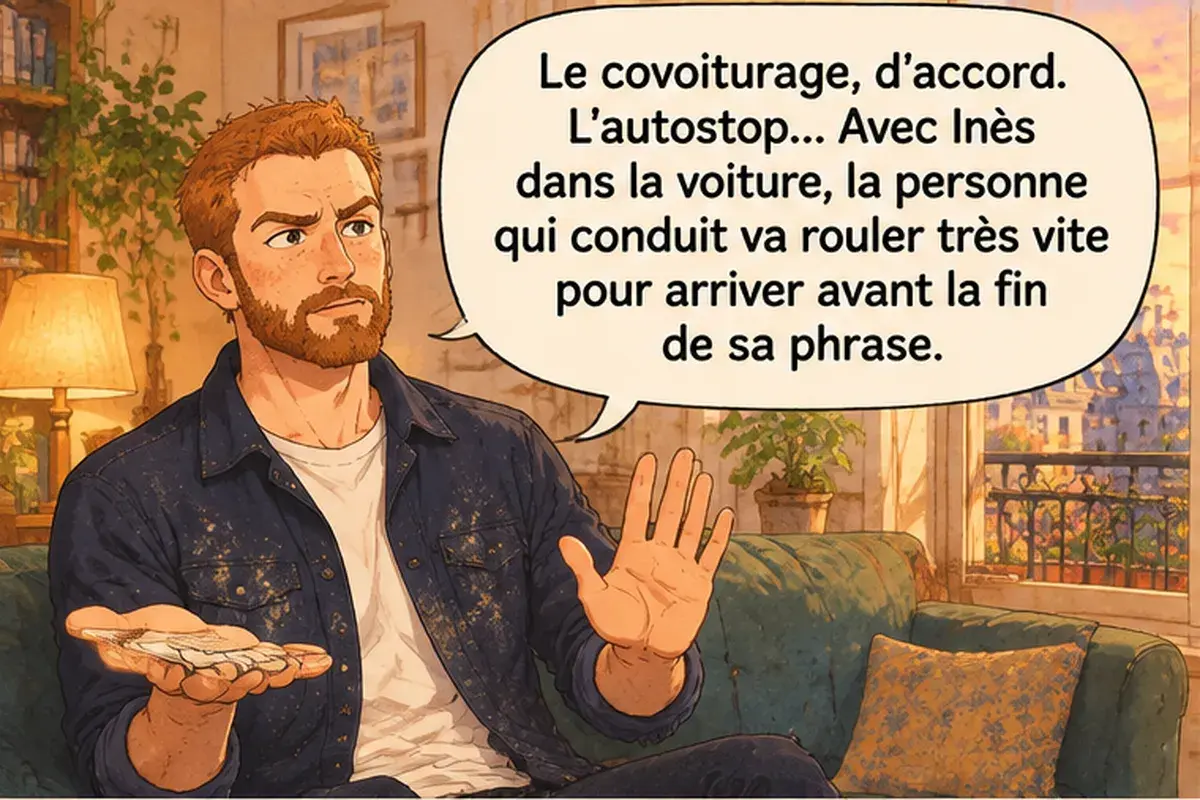
Le covoiturage, d'accord. L'autostop... Avec Inès dans la voiture, la personne qui conduit va rouler très vite pour arriver avant la fin de sa phrase.
Carpooling, OK. Hitchhiking... With Inès in the car, the person driving is going to drive really fast to get there before the end of her sentence.

- Inès
Très gentil. Alors, c'est oui ou c'est non ?
Very kind. So, is it yes or no?

- Hugo
C'est oui. Je m'occupe de l'itinéraire, des étapes et de la durée, et c'est moi qui prévois le budget.
It's yes. I'll take care of the route, the stops and the duration, and I'm the one who plans the budget.

- Pacha
J'ai tout enregistré. Même la phrase sur la voiture.
I recorded everything. Even the sentence about the car.
Grammar for this text
- Et si on partait cet été ? — "how about we go away this summer?" partait looks like a past form (the imperfect), but this isn't a story about the past: it's a suggestion. et si on + the imperfect always works like this. More in the unit grammar.
- On pourrait aussi faire du covoiturage — "we could also carpool". pourrait is a polite form of pouvoir (can), used for suggestions. How it's built is a B1 topic; for now, learn on pourrait + verb as a whole.
- Je m'occupe de l'itinéraire — s'occuper de means "to take care of"; de comes after it: de l'itinéraire, de la durée.
- c'est moi qui prévois le budget — c'est moi qui means "I'm the one who". The verb after qui agrees with moi, so it's prévois (the je form of prévoir, which works like voir).
- Si. J'ai réfléchi une minute. — Si means "yes" when you answer a negative question (Tu ne réfléchis pas ?). The passé composé (the main past tense) with avoir: ai + réfléchi (from réfléchir, to think it over). No word for "for" before a length of time: une minute — for a minute.
- plus de sept cents kilomètres — cents takes an -s here because it's multiplied (seven hundreds) and no other number follows it. plus de + a number — more than.
- pour arriver avant la fin de sa phrase — pour + infinitive: "to, in order to". The joke: Inès talks so much that the driver can get there before she finishes her sentence.
Words and grammar of the unit: Plan a big trip with friends.
Learn the words from the texts with flashcards
In the app, you can tap any word in a text to see its translation, forms and examples, and new words stick with flashcards. 15 minutes a day.
Start for freeEverything is open for free. No card needed to sign up.