
French story with translation · A1 · 14 lines
Demain, nous allons visiter la ville Tomorrow we're going to visit the town
Comic · 9 panels

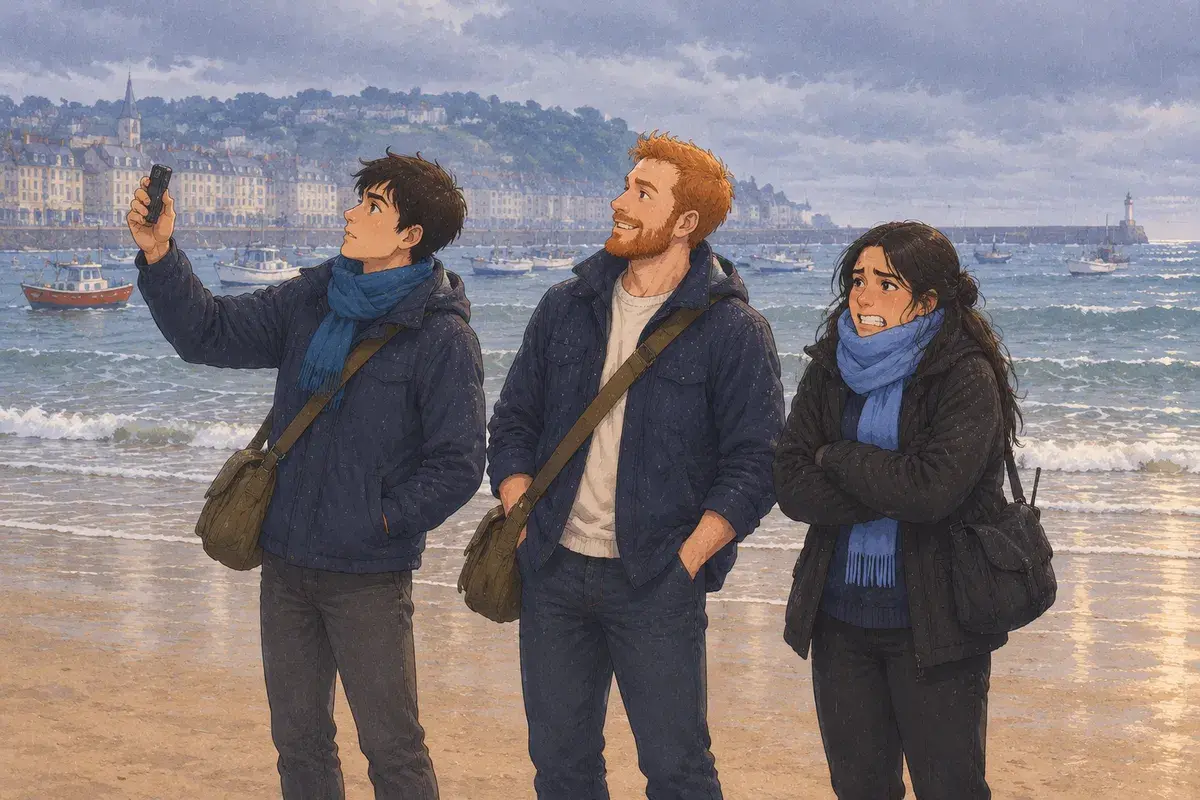
Salut, Dacha ! Je suis sur la plage, à Trouville, en Normandie.
Hi, Dacha! I'm on the beach in Trouville, in Normandy.
Il pleut, il y a du vent et il fait huit degrés. C'est ça, les vacances !
It's raining, it's windy, and it's eight degrees. That's vacation for you!
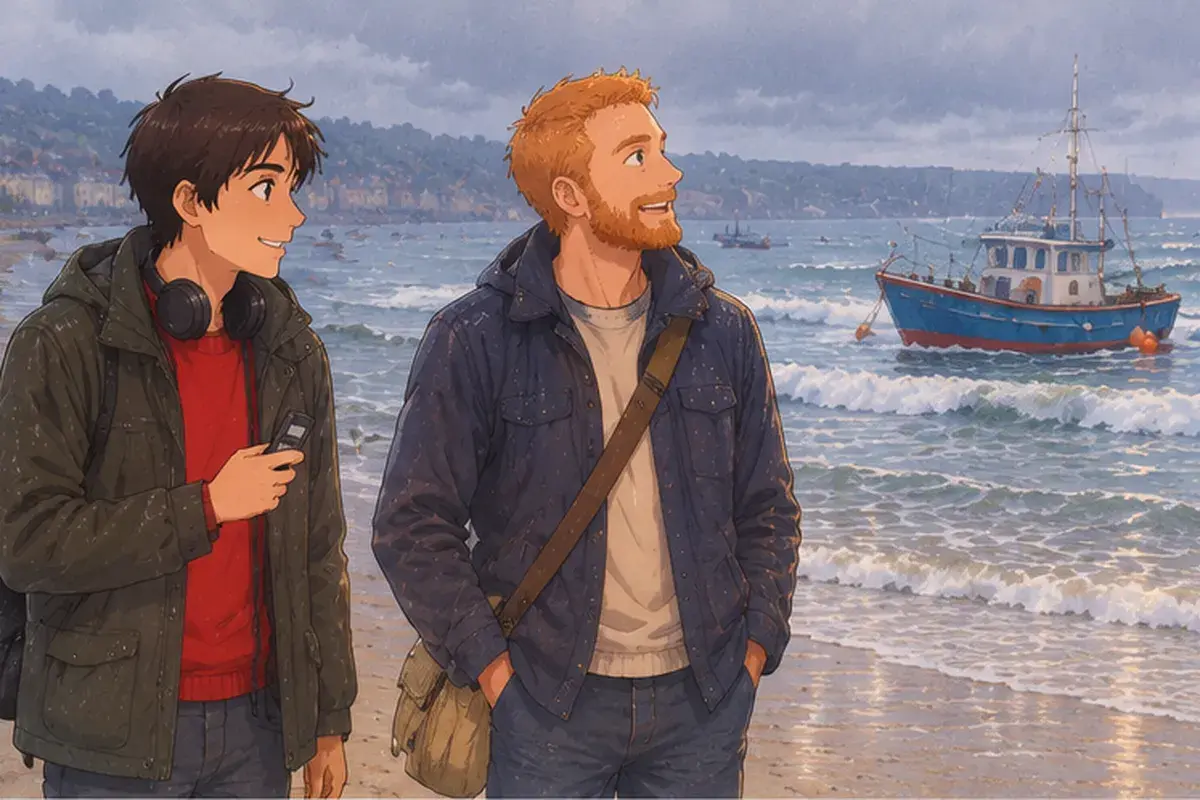
Hugo adore la mer. Il regarde chaque bateau comme un enfant.
Hugo loves the sea. He watches every boat like a child.
Il dit : « Pour moi, un aller simple ! »
He says, "A one-way ticket for me!"

Inès, elle, a froid. Elle porte son écharpe et deux pulls.
As for Inès, she's cold. She's wearing her scarf and two sweaters.
Elle dit : « Moi, un aller-retour, avec chauffage ! »
She says, "Me, a round trip, with heating!"

Notre hôtel est près de la plage. À l'entrée, il n'y a pas de touristes, seulement des parapluies.
Our hotel is near the beach. At the entrance, there are no tourists, only umbrellas.

Pour deux jours, Inès a une grande valise. Hugo a seulement un sac à dos.
For two days, Inès has a big suitcase. Hugo only has a backpack.

Demain, nous allons visiter la ville. Hugo va aller partout à pied.
Tomorrow we're going to visit the town. Hugo is going to go everywhere on foot.
Inès va prendre un taxi pour traverser la rue.
Inès is going to take a taxi to cross the street.

Et moi, je vais enregistrer la pluie, la mer et les bateaux.
And I'm going to record the rain, the sea, and the boats.

Ce soir, nous allons manger des moules-frites.
Tonight we're going to eat mussels and fries.
Hugo ne va pas manger de moules : il va prendre des frites.
Hugo isn't going to eat mussels: he's going to get fries.

À bientôt, Dacha !
See you soon, Dacha!
Grammar for this text
- Demain, nous allons visiter la ville. — "tomorrow we're going to visit the town". allons is the nous form of aller, followed by the infinitive visiter. visiter is only for places (a city, a museum), never for people. The story uses nous; friends talking would say on va.
- Hugo ne va pas manger de moules — the negative goes around va, and after pas, des becomes de: des moules → pas de moules. Hugo doesn't eat mussels because he's a vegetarian, so he only gets fries.
- Pour moi, un aller simple ! — aller simple is a one-way ticket. Hugo jokes with a straight face: he likes the sea so much he doesn't need to go back. Inès answers un aller-retour — a round trip, and with heating, please.
- Inès va prendre un taxi pour traverser la rue. — pour + infinitive means "(in order) to": "to cross the street". The joke is that the street is right there.
- Hugo va aller partout à pied. — aller appears twice: va — "is going to", aller — "go". partout — everywhere; à pied — on foot.
- il n'y a pas de touristes, seulement des parapluies — il n'y a pas de — "there aren't any"; after pas comes de. seulement — only.
- des moules-frites — a dish of mussels and fries; the name has a hyphen.
Words and grammar of the unit: Buy a train ticket.
Learn the words from the texts with flashcards
In the app, you can tap any word in a text to see its translation, forms and examples, and new words stick with flashcards. 15 minutes a day.
Start for freeEverything is open for free. No card needed to sign up.