

French story with translation · A1 · 14 lines
On dit : j'ai froid You say: I'm cold
Comic · 13 panels

Aujourd'hui, je reste au lit. J'ai de la fièvre, j'ai mal partout et je me sens très fatigué.
Today I'm staying in bed. I have a fever, I hurt all over and I feel very tired (man speaking).
Je prends le sirop de la pharmacienne, mais j'ai toujours la toux.
I'm taking the pharmacist's syrup, but I still have a cough.
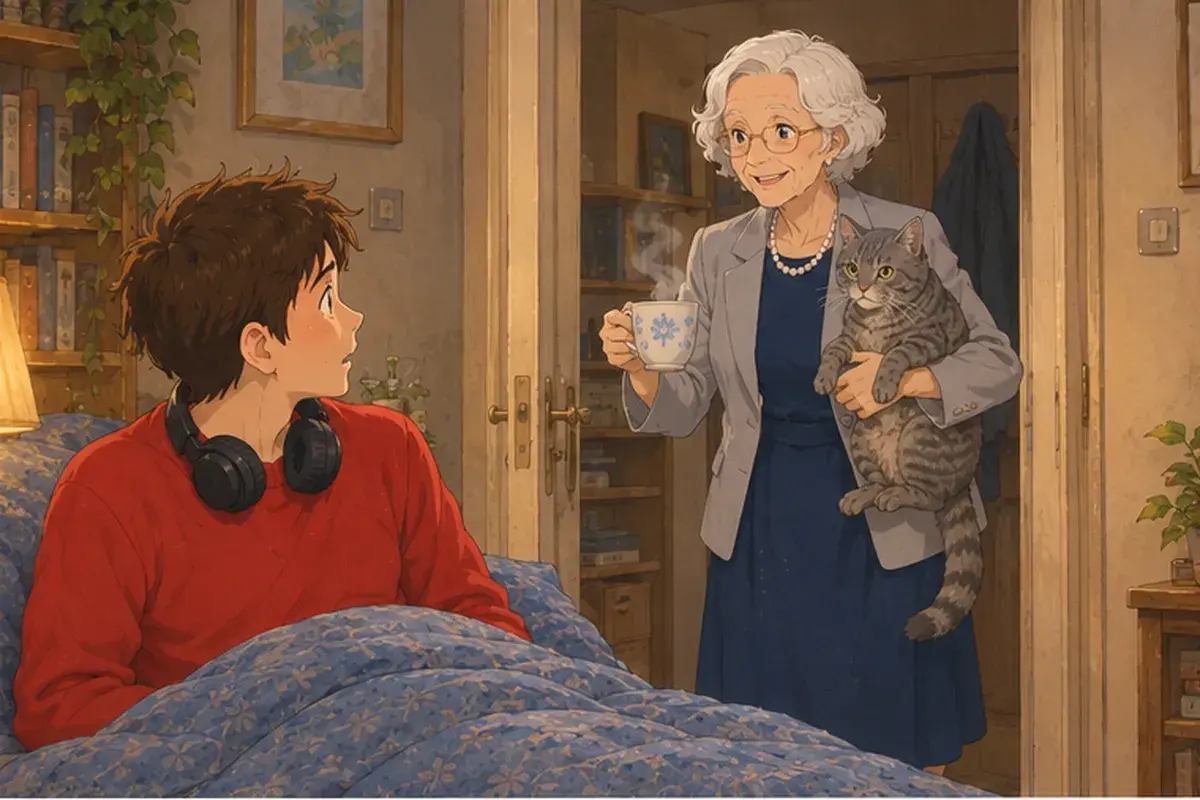
À onze heures, madame Morel est à ma porte avec une tisane et le chat.
At eleven, Madame Morel is at my door with an herbal tea and the cat.

Je dis : « Madame, je suis froid ! » Elle répond : « On ne dit pas ça. On dit : j'ai froid. »
I say: "Ma'am, I am cold!" She answers: "You don't say that. You say: I have cold."

Elle donne la tisane : « Attention, c'est très chaud ! À votre santé ! »
She hands over the herbal tea: "Careful, it's very hot! To your health!" (formal)

J'ai soif, alors je bois tout de suite. Trop tard : j'ai mal à la bouche !
I'm thirsty, so I drink it right away. Too late: my mouth hurts!

Madame Morel dit : « Pauvre Pacha ! » Le chat et moi, on regarde madame Morel.
Madame Morel says: "Poor Pacha!" The cat and I look at Madame Morel.

Vers deux heures, Hugo rentre de la boulangerie avec des croissants.
Around two, Hugo comes back from the bakery with croissants.

Il dit : « Ils ne sont pas de ce matin : ils sont fatigués, comme toi. »
He says: "They're not from this morning: they're tired, like you."

Je mange trois croissants. Maintenant, j'ai mal au ventre !
I eat three croissants. Now my stomach hurts!

Le soir, j'ai faim. Inès veut faire la soupe : j'ai peur, elle ne sait pas cuisiner !
In the evening, I'm hungry. Inès wants to make the soup: I'm scared, she can't cook!

Alors, je fais la soupe, avec la fièvre !
So I make the soup, with a fever!

Après, on regarde un épisode. Inès a froid aux mains : elle mange la soupe avec son écharpe.
Afterward, we watch an episode. Inès's hands are cold: she eats the soup with her scarf on.

À dix heures, j'ai sommeil, mais je me sens mieux. Le chat est toujours là : il dort sur mes pieds.
At ten, I'm sleepy, but I feel better. The cat is still here: he's sleeping on my feet.
Grammar for this text
- Madame, je suis froid ! — Pacha's mistake: je suis froid means "I'm cold to the touch" or "I'm a cold, unfriendly person". For feeling cold French uses avoir: On dit : j'ai froid, literally "I have cold".
- Attention, c'est très chaud ! — attention means "careful!", literally "attention". About tea you say c'est chaud (it's hot); about a person, j'ai chaud (I'm hot).
- À votre santé ! — a toast, "to your health". With friends: à ta santé or just santé ! — cheers!
- Pauvre Pacha ! — pauvre before a name means "poor" as in pity.
- Le chat et moi, on regarde madame Morel — here on means "we": the cat and I. (Madame Morel's cat is also called Pacha.)
- Ils ne sont pas de ce matin — "they're not from this morning", so they're not fresh. comme toi — "like you": after comme use toi, not tu. Hugo jokes with a straight face.
- Le chat est toujours là — here toujours means "still", not "always". The same in j'ai toujours la toux.
- je me sens très fatigué — se sentir (to feel) works like se lever: je me sens. Pacha is talking about himself, so fatigué is masculine; a woman would write fatiguée.
Words and grammar of the unit: Say what hurts at the pharmacy.
Learn the words from the texts with flashcards
In the app, you can tap any word in a text to see its translation, forms and examples, and new words stick with flashcards. 15 minutes a day.
Start for freeEverything is open for free. No card needed to sign up.