

French dialogue with translation · A1 · 14 lines
Ça te dit, Noël chez mes parents ? How about Christmas at my parents'?
Comic · 13 panels
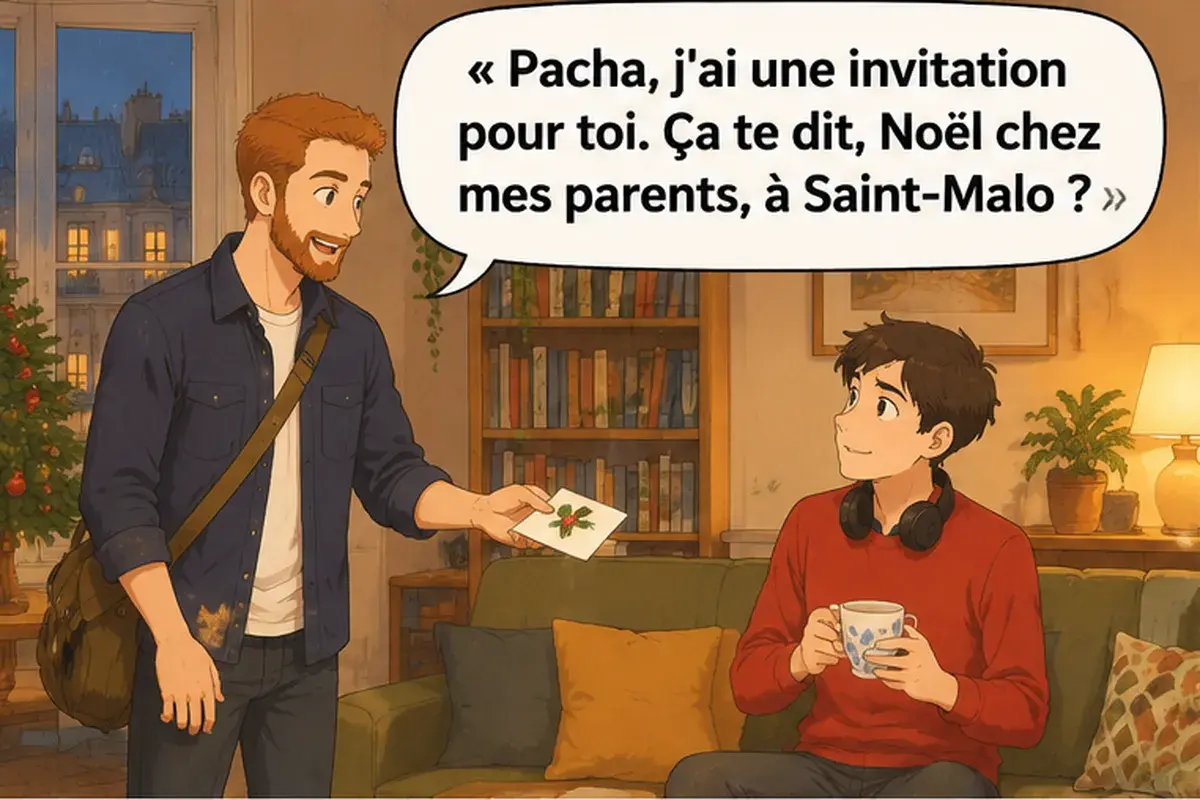
- Hugo
Pacha, j'ai une invitation pour toi. Ça te dit, Noël chez mes parents, à Saint-Malo ?
Pacha, I have an invitation for you. How about Christmas at my parents', in Saint-Malo?
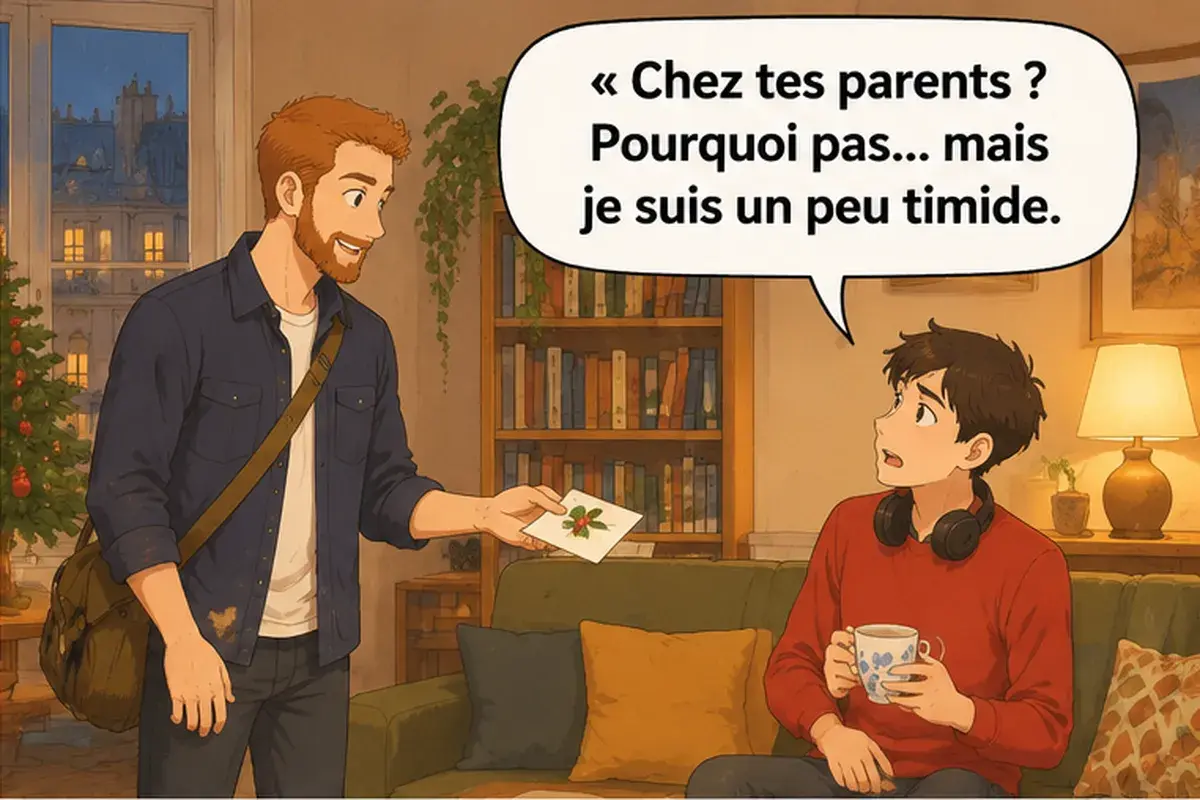
- Pacha
Chez tes parents ? Pourquoi pas... mais je suis un peu timide.
At your parents'? Why not... but I'm a little shy.
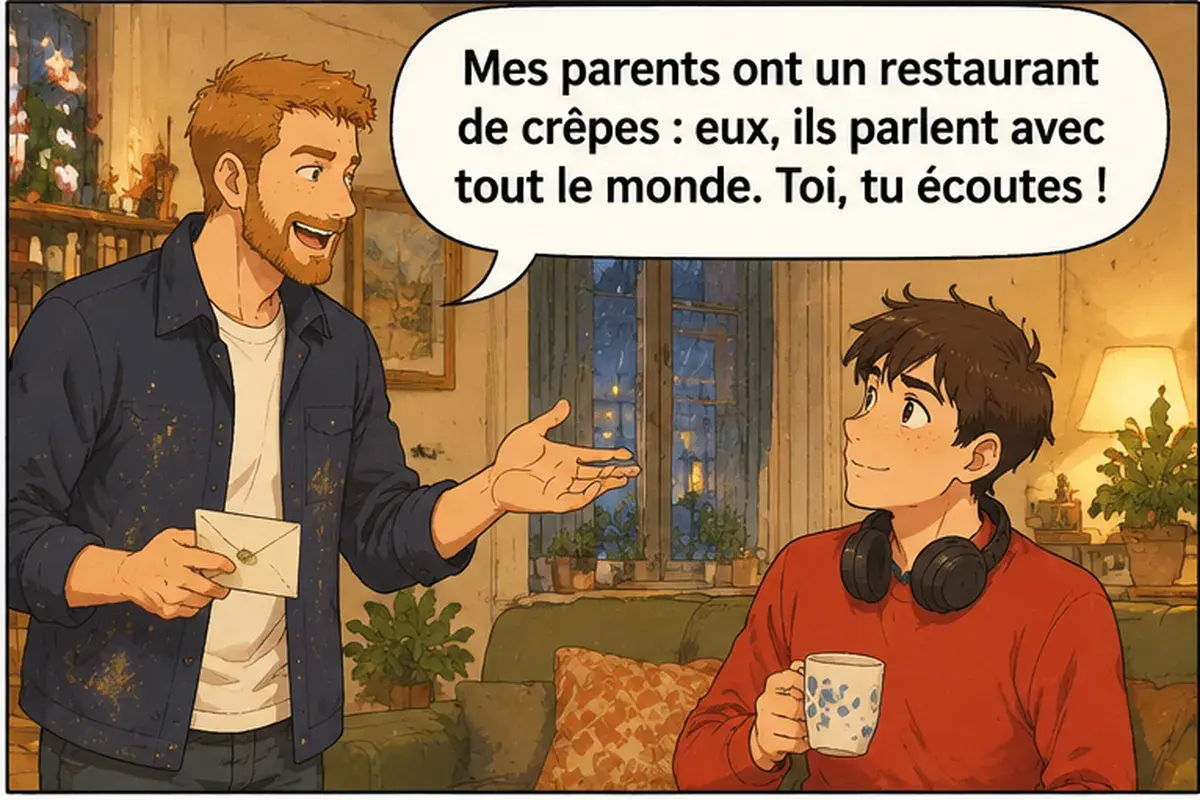
- Hugo
Mes parents ont un restaurant de crêpes : eux, ils parlent avec tout le monde. Toi, tu écoutes !
My parents have a crêpe restaurant: as for them, they talk with everyone. As for you, you listen!

- Pacha
Mais ils ne me connaissent pas. Et moi, je bois du thé !
But they don't know me. And as for me, I drink tea!
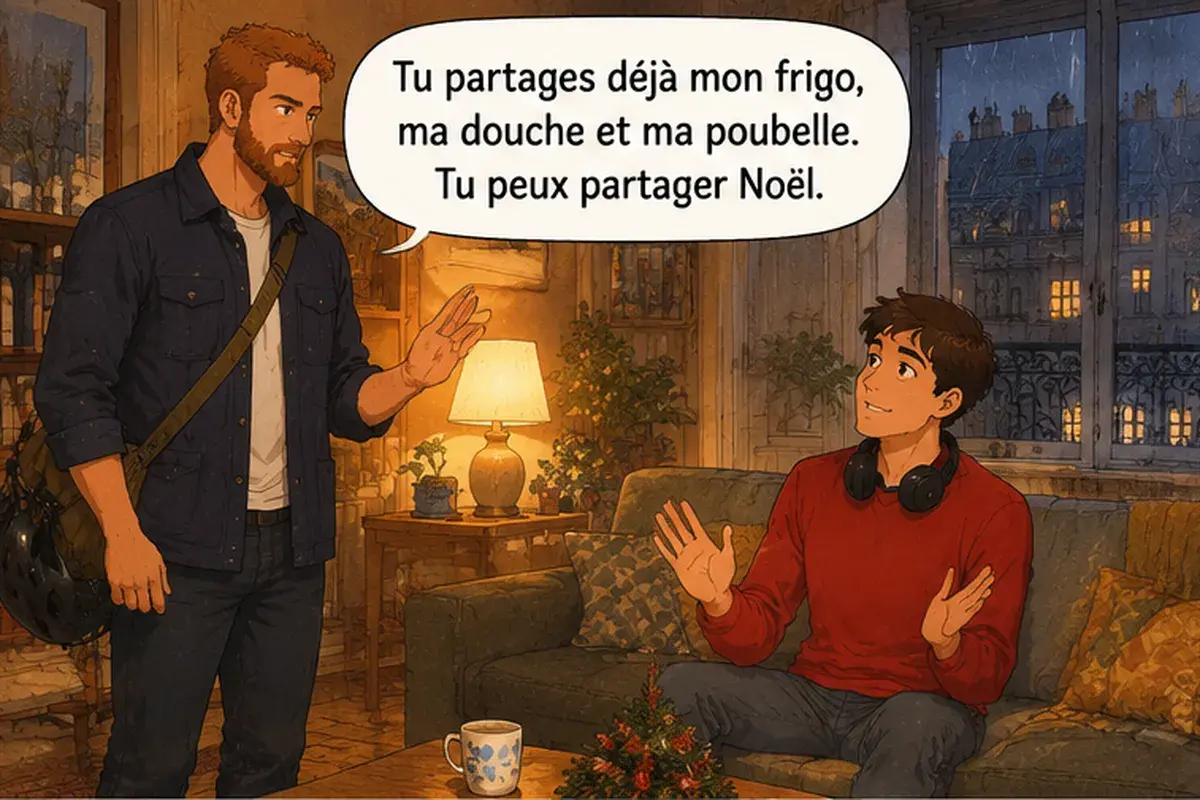
- Hugo
Tu partages déjà mon frigo, ma douche et ma poubelle. Tu peux partager Noël.
You already share my fridge, my shower and my trash can. You can share Christmas.

- Pacha
Bon, j'accepte ! Avec plaisir. J'ai hâte de voir la mer.
Well, I accept! With pleasure. I can't wait to see the sea.
- Hugo
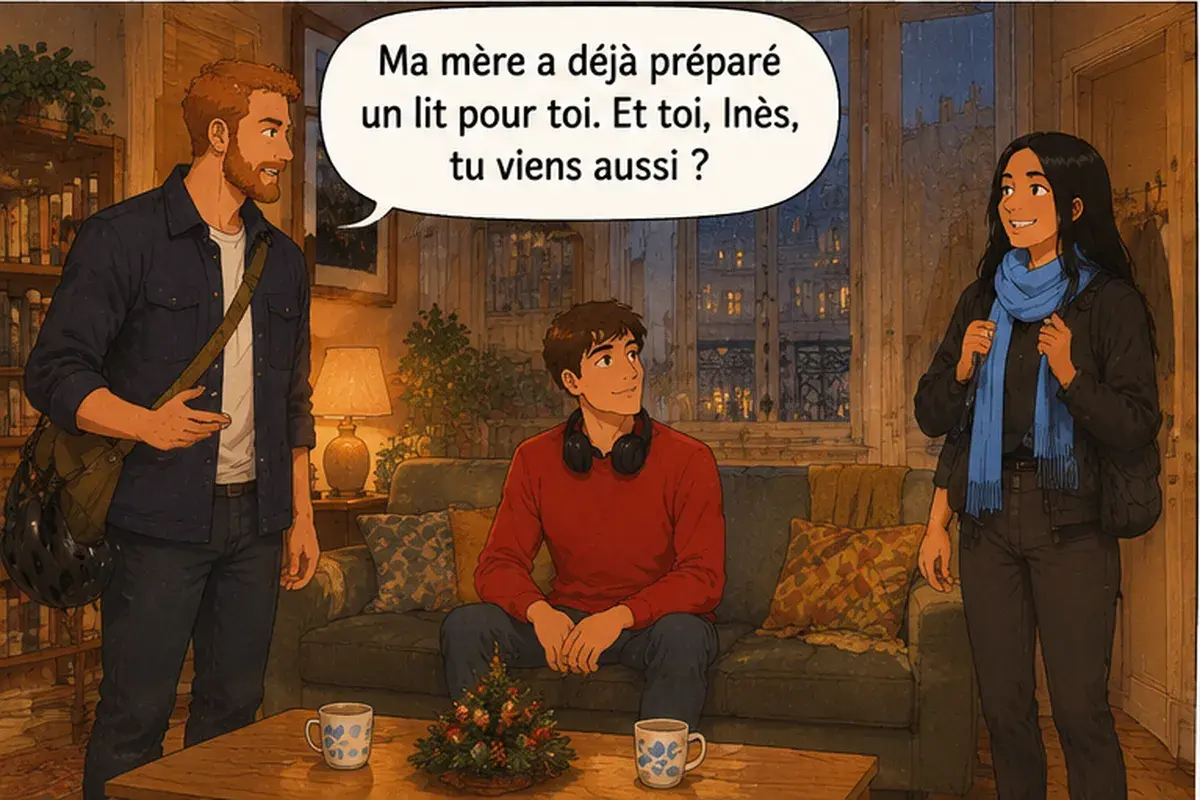
Ma mère a déjà préparé un lit pour toi. Et toi, Inès, tu viens aussi ?
My mom has already prepared a bed for you. And you, Inès, are you coming too?

- Inès
Impossible ! Noël, c'est chez moi, à Marseille. Si je ne viens pas, ma mère pleure.
Impossible! Christmas is at home for me, in Marseille. If I don't come, my mom will cry.

- Hugo
Dommage. Alors, tu refuses l'invitation ?
Too bad. So you're turning down the invitation?

- Inès
Je ne refuse pas ! Je viens à Saint-Malo pour le nouvel an, c'est promis.
I'm not refusing! I'll come to Saint-Malo for New Year's, I promise.

- Pacha
Inès, attention : avec lui, le réveillon finit à neuf heures.
Inès, careful: with him, New Year's Eve dinner ends at nine.
- Hugo
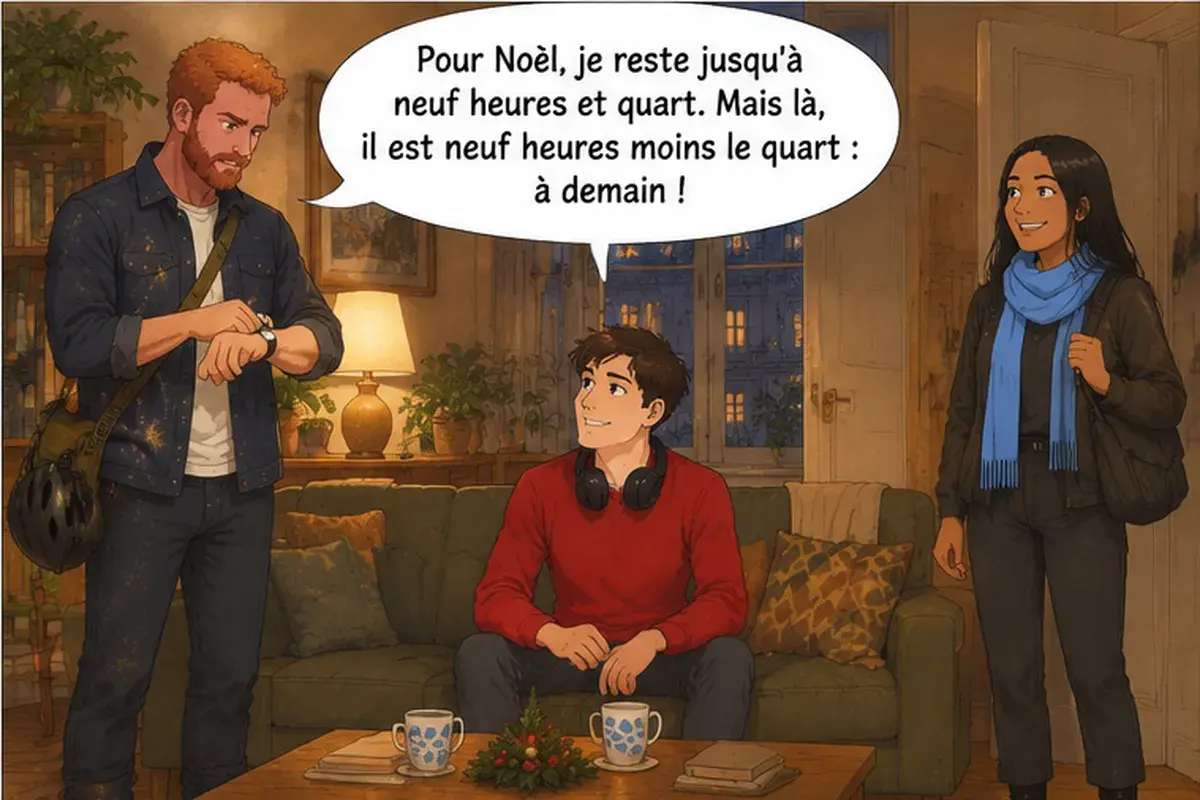
Pour Noël, je reste jusqu'à neuf heures et quart. Mais là, il est neuf heures moins le quart : à demain !
For Christmas, I stay up until a quarter past nine. But right now it's a quarter to nine: see you tomorrow!

- Inès
Moi, je vais chez Momo. À tout à l'heure, Pacha !
As for me, I'm going to Momo's. See you later, Pacha!
- Pacha
À plus, Inès !
See you, Inès!
Grammar for this text
- Chez tes parents ?: chez means both "at" and "to" someone's place: "at your parents'" and "to your parents'". It's followed by a person: chez Momo, chez moi.
- eux, ils parlent avec tout le monde: eux is the stressed form of "they" (men or a mixed group). It doesn't replace ils, it adds emphasis: "they're the ones who talk with everyone". The same goes for Toi, tu écoutes ("as for you, you listen") and Et moi, je bois du thé ("and as for me, I drink tea").
- Ma mère a déjà préparé un lit pour toi: "has already prepared": a is the il form of avoir, plus the past participle préparé. This is the passé composé (the main past tense) from unit 15. After pour comes the stressed form: pour toi.
- J'ai hâte de voir la mer: avoir hâte de + infinitive means "can't wait to", literally "to have haste". j'ai = je + ai.
- Si je ne viens pas, ma mère pleure: viens is the je and tu form of venir (to come); the il form is vient. All three sound the same. French uses the present tense in both parts. English uses the present after "if" too ("if I don't come"), but then says "my mom will cry"; French says ma mère pleure, literally "my mom cries".
- le réveillon finit à neuf heures: a real réveillon goes on until midnight. Pacha is joking: Hugo goes to bed around nine, so with him the party ends at nine. Hugo answers seriously: at Christmas he stays up until neuf heures et quart, a quarter past nine.
- À demain and À tout à l'heure: "see you tomorrow" and "see you later" (later the same day).
Words and grammar of the unit: Accept an invitation.
Learn the words from the texts with flashcards
In the app, you can tap any word in a text to see its translation, forms and examples, and new words stick with flashcards. 15 minutes a day.
Start for freeEverything is open for free. No card needed to sign up.