
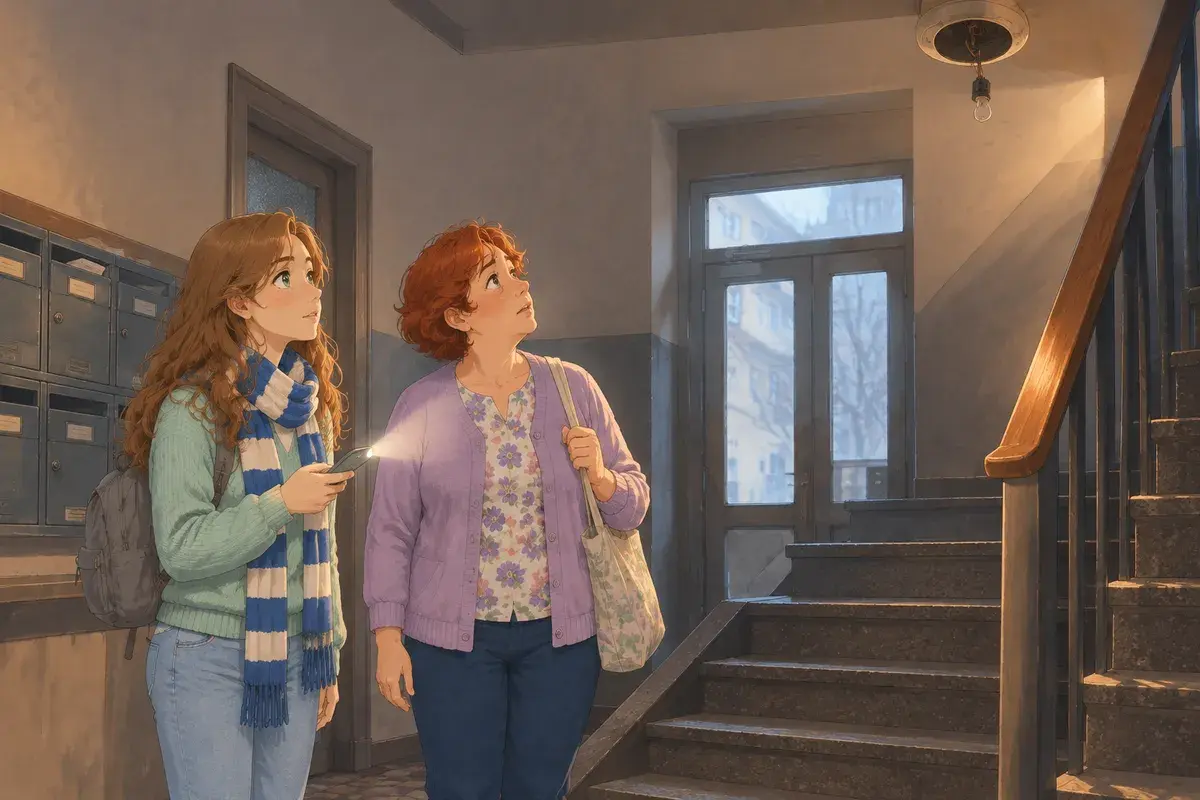
German story with translation · B1 · 18 lines
Ich bitte Sie, sich bald darum zu kümmern I'm asking you to take care of it soon
Comic · 9 panels

Guten Tag, ich wohne seit März in Ihrem Haus und habe ein Problem mit der Lampe.
Hello, I've been living in your building since March, and I have a problem with the lamp. (formal)
Leider geht die Lampe, die über der Treppe hängt, seit zwei Wochen nicht mehr.
Unfortunately, the lamp that hangs over the stairs hasn't worked for two weeks.
Ich habe den Lichtschalter schon oft gedrückt, aber es bleibt dunkel.
I've pressed the light switch many times, but it stays dark.
Ich habe versucht, die Glühbirne selbst zu wechseln, aber mit Technik kenne ich mich leider nicht aus.
I tried to replace the light bulb myself, but unfortunately I don't know much about technology.

Vor allem unten, wo die Briefkästen sind, sieht man abends die Stufen nur schlecht. Letzte Woche bin ich dort selbst gestolpert.
Especially downstairs, where the mailboxes are, it's hard to see the steps in the evening. Last week I tripped there myself.

Gestern konnte der Paketbote, der ein Paket für mich hatte, die Namen an den Briefkästen nicht lesen.
Yesterday the delivery man, who had a package for me, couldn't read the names on the mailboxes.

Frau Petersen, deren Wohnung unten an der Treppe liegt, ist schon 70 Jahre alt.
Frau Petersen, whose apartment is downstairs by the stairs, is already 70 years old.
Sie beschwert sich nie, obwohl sie abends vorsichtig gehen muss.
She never complains, even though she has to walk carefully in the evening.
Sie geht immer ganz langsam und hält sich am Geländer.
She always walks very slowly and holds on to the railing.
Meine größte Sorge ist, dass sie auf der dunklen Treppe stürzt.
My biggest worry is that she'll fall on the dark stairs.

Der ehemalige Hausmeister, der nebenan wohnt, hat mir gesagt, dass Sie zuständig sind.
The former building manager, who lives next door, told me that you're responsible. (formal)

Deshalb bitte ich Sie, auch aus Rücksicht auf Frau Petersen, sich bald darum zu kümmern.
That's why I'm asking you, also out of consideration for Frau Petersen, to take care of it soon. (formal)
Es ist wichtig, die Lampe schnell zu wechseln, bevor etwas passiert.
It's important to replace the lamp quickly, before something happens.
Vielleicht kann ein Elektriker noch diese Woche kommen?
Maybe an electrician can still come this week?

Bitte sagen Sie mir, wann die Lampe gewechselt wird.
Please tell me when the lamp will be replaced. (formal)

Bis die Lampe wieder funktioniert, benutze ich eine Taschenlampe oder das Licht von meinem Handy.
Until the lamp works again, I'm using a flashlight or the light from my phone.

Rufen Sie mich gern an, wenn Sie noch Fragen haben.
Feel free to call me if you have any more questions. (formal)
Vielen Dank für Ihre Hilfe. Mit freundlichen Grüßen, Katja
Thank you very much for your help (formal). Sincerely, Katja
Grammar for this text
- Leider geht die Lampe, die über der Treppe hängt, seit zwei Wochen nicht mehr. —
dieafter the comma means "that":Lampeis feminine and it's the one that "hangs", sodie. The relative clause sits in the middle of the main clause, withhängtat its end.seit zwei Wochen— "for two weeks"; German uses the present tense because it's still going on, English uses "hasn't worked". - Vor allem unten, wo die Briefkästen sind, sieht man abends die Stufen nur schlecht. —
woinstead ofan der Stelle, an der("in the place where"): for a place, just "where". Right after the clause comes the verb of the main clause:sieht man("you can see"). - Letzte Woche bin ich dort selbst gestolpert. —
stolpern(to trip) is a movement, so its Perfekt usessein:bin … gestolpert.selbsthere means "myself". - Frau Petersen, deren Wohnung unten an der Treppe liegt, ist schon 70 Jahre alt. —
derenmeans "whose"; just recognize it. The word after it (Wohnung) belongs to Frau Petersen, and it has no article. - Sie beschwert sich nie, obwohl sie abends vorsichtig gehen muss. —
Sieat the start of the sentence means "she" here, not the formal "you". Afterobwohl(although) the verb goes to the end:gehen muss. - Der ehemalige Hausmeister, der nebenan wohnt, hat mir gesagt, dass Sie zuständig sind. —
derafter the comma means "who"; thedassclause reports what someone said.Siewith a capital letter in the middle of a sentence is the formal "you". - Deshalb bitte ich Sie, sich bald darum zu kümmern. — after
deshalb(that's why) the verb comes second:bitte ich.sich kümmern um— to take care of,darum— "of it"; the phrase withzuis set off with a comma. - Bitte sagen Sie mir, wann die Lampe gewechselt wird. — the passive voice (unit 5):
wird … gewechselt— "will be replaced"; in an indirect questionwirdgoes to the end.
Words and grammar of the unit: Get to know your neighbors.
Learn the words from the texts with flashcards
In the app, you can tap any word in a text to see its translation, forms and examples, and new words stick with flashcards. 15 minutes a day.
Start for freeEverything is open for free. No card needed to sign up.