

German dialogue with translation · B1 · 14 lines
Du bist auf stumm! You're on mute!
Comic · 14 panels

- Sabine
Moin! Die Videokonferenz fängt an. Katja, du bist auf stumm!
Hi! The video conference is starting. Katja, you're on mute!

- Katja
Sorry! Wo ist der Knopf? Da! Hört ihr mich jetzt?
Sorry! Where's the button? There! Can you hear me now? (to several people)

- Priya
Ja, jetzt hören wir dich. Schöner Hintergrund übrigens!
Yes, now we can hear you. Nice background, by the way!

- Katja
Danke! Aber Tobias, dein Bild friert ein.
Thanks! But Tobias, your picture is freezing.

- Tobias
Wie ärgerlich! Mein Internet ist heute wackelig. Ich verbinde mich neu.
How annoying! My internet is shaky today. I'll reconnect.
- Sabine
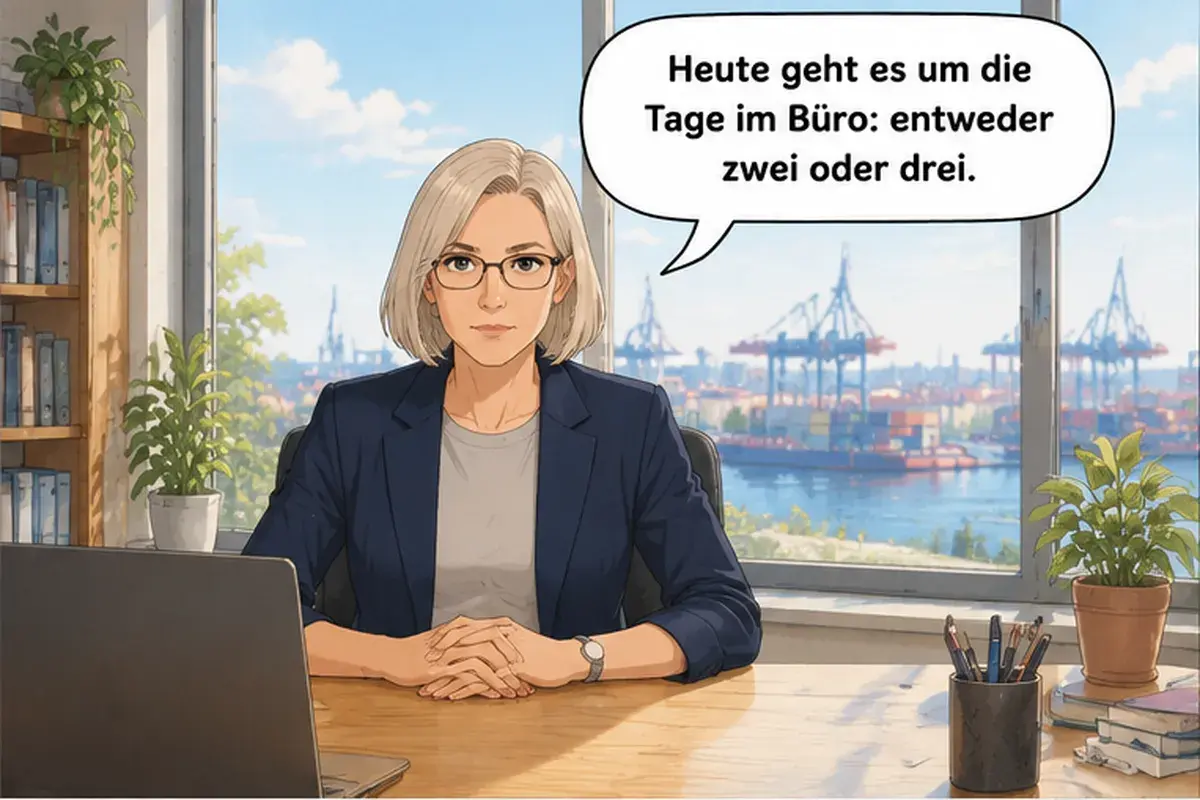
Heute geht es um die Tage im Büro: entweder zwei oder drei.
Today it's about the days at the office: either two or three.

- Priya
Zwei. Ich pendle mit öffentlichen Verkehrsmitteln, außerdem bin ich zu Hause ungestört.
Two. I commute by public transportation, and besides, I'm undisturbed at home.

- Tobias
Mich lenkt nicht nur der Kühlschrank ab, sondern auch das Handy.
It's not only the fridge that distracts me, but also the cell phone.

- Katja
Ich arbeite gern sowohl im Büro als auch zu Hause.
I like working both at the office and at home.

- Tobias
Ich nicht! Mein Arbeitsweg ist stressig, und die Klimaanlage nervt.
Not me! My commute is stressful, and the air conditioning is annoying.

- Priya
Tobias, du bist weder im Büro noch zu Hause zufrieden!
Tobias, you're happy neither at the office nor at home!

- Sabine
Leute, bitte nicht alle gleichzeitig, sonst versteht man nichts. Wer schreibt das Protokoll?
Guys, please, not all at the same time, otherwise you can't understand anything. Who's taking the minutes?

- Katja
Ich! Dann seid ihr alle auf dem Laufenden.
Me! Then you'll all be up to date.

- Sabine
Danke, Katja! Ich beende die Besprechung. Tragt eure Tage bitte ein.
Thanks, Katja! I'm ending the meeting. Please enter your days (to several people).
Grammar for this text
- Katja, du bist auf stumm — in a video call,
auf stumm seinmeans "to be on mute".bistis theduform ofsein. - Die Videokonferenz fängt an and Tobias, dein Bild friert ein — separable verbs
anfangenandeinfrieren: the prefix (an,ein) goes to the end of the sentence. Like English freeze,einfrierenworks for food and for a picture on a screen. - Ich verbinde mich neu —
sich neu verbinden: "to reconnect".verbindenmeans "to connect". - Heute geht es um die Tage im Büro: entweder zwei oder drei —
es geht um+ accusative: "it's about …". Afterentwederandoderyou can have just numbers, with no verb. - Ich pendle mit öffentlichen Verkehrsmitteln —
pendeln: "to commute". Aftermitcomes the dative:öffentlichgets-en, and the pluraldie Verkehrsmittelgets-nin the dative. - Mich lenkt nicht nur der Kühlschrank ab —
ablenken: "to distract".michcomes first for emphasis. The verb is still second, the subjectder Kühlschrankcomes after it, and the prefixabgoes to the end. English can't move "me" to the front like this; it says "the fridge distracts me". - Tragt eure Tage bitte ein — the
ihrcommand: the same form asihr tragt, but without the pronoun.eintragen: "to enter, to put down";eingoes to the end. Dann seid ihr alle auf dem Laufenden —auf dem Laufenden sein: "to be up to date".
Words and grammar of the unit: Plan work-from-home days and vacation.
Learn the words from the texts with flashcards
In the app, you can tap any word in a text to see its translation, forms and examples, and new words stick with flashcards. 15 minutes a day.
Start for freeEverything is open for free. No card needed to sign up.