
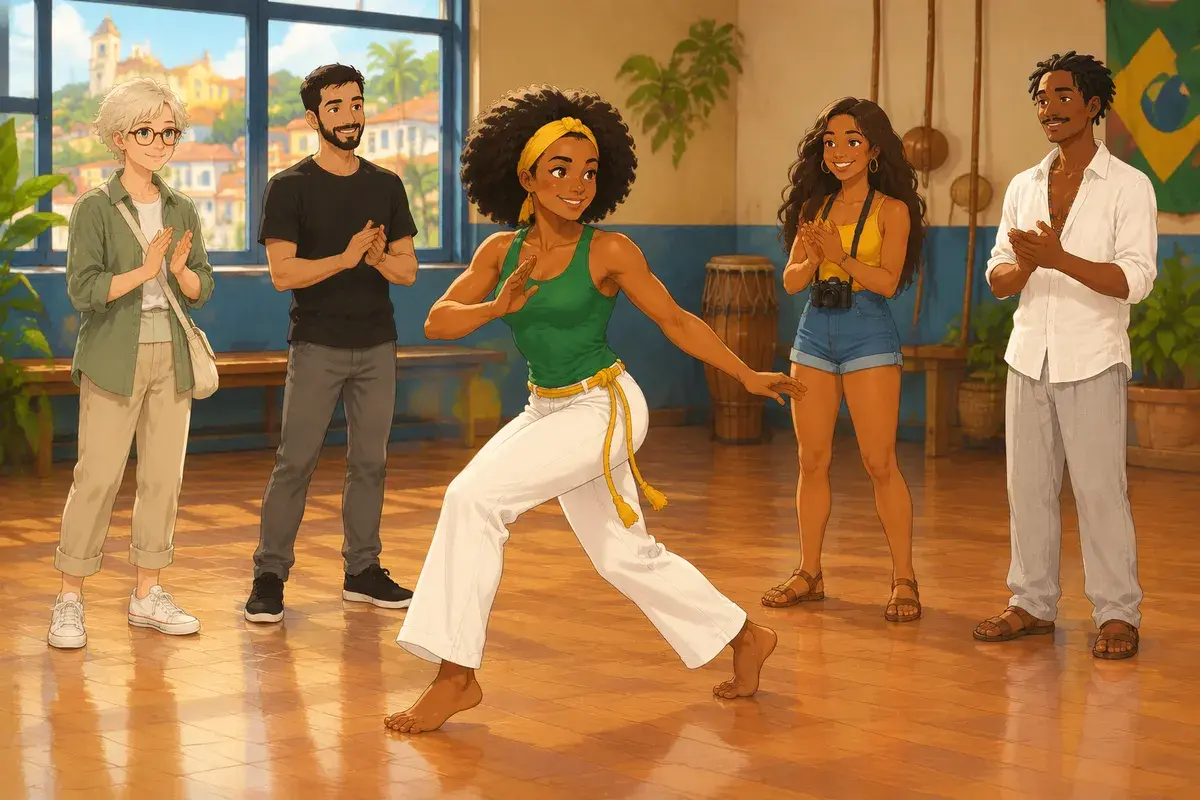
Portuguese dialogue with translation · B1 · 18 lines
Por que você não quis entrar na roda? Why didn't you want to go into the roda?
Comic · 15 panels
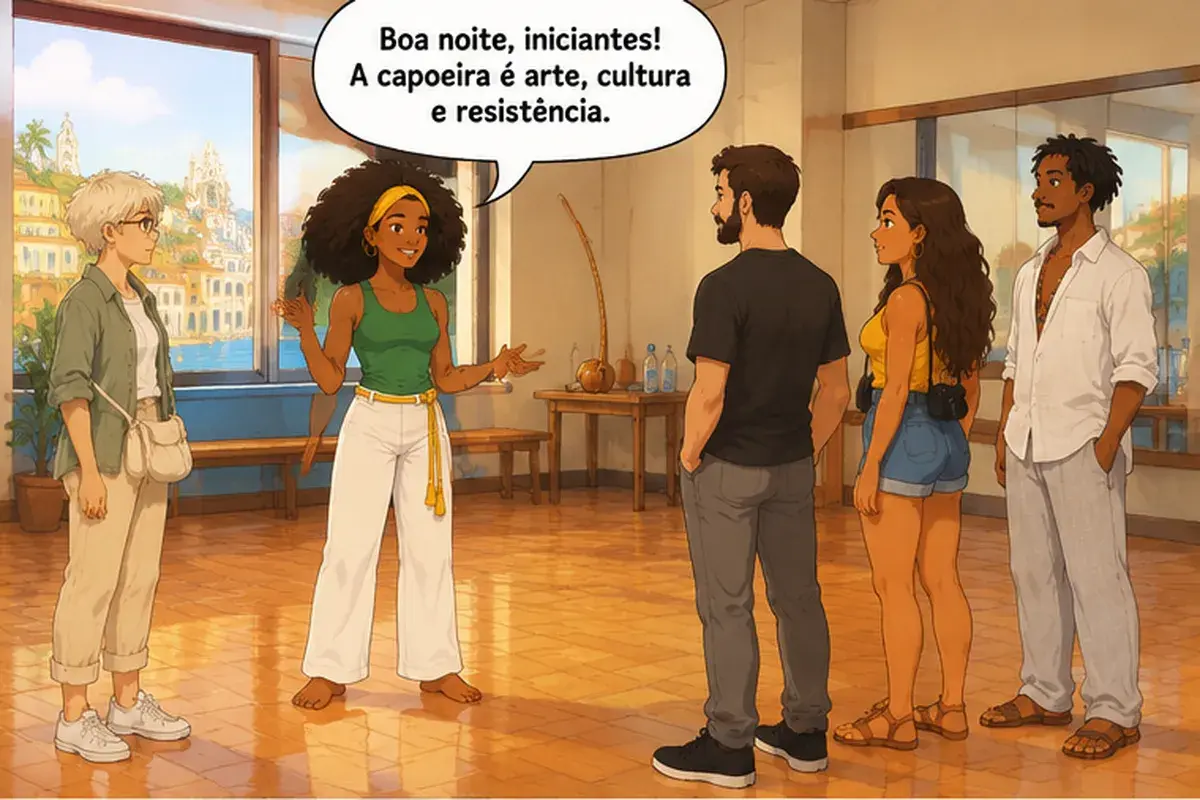
- Jamile
Boa noite, iniciantes! A capoeira é arte, cultura e resistência.
Good evening, beginners! Capoeira is art, culture and resistance.
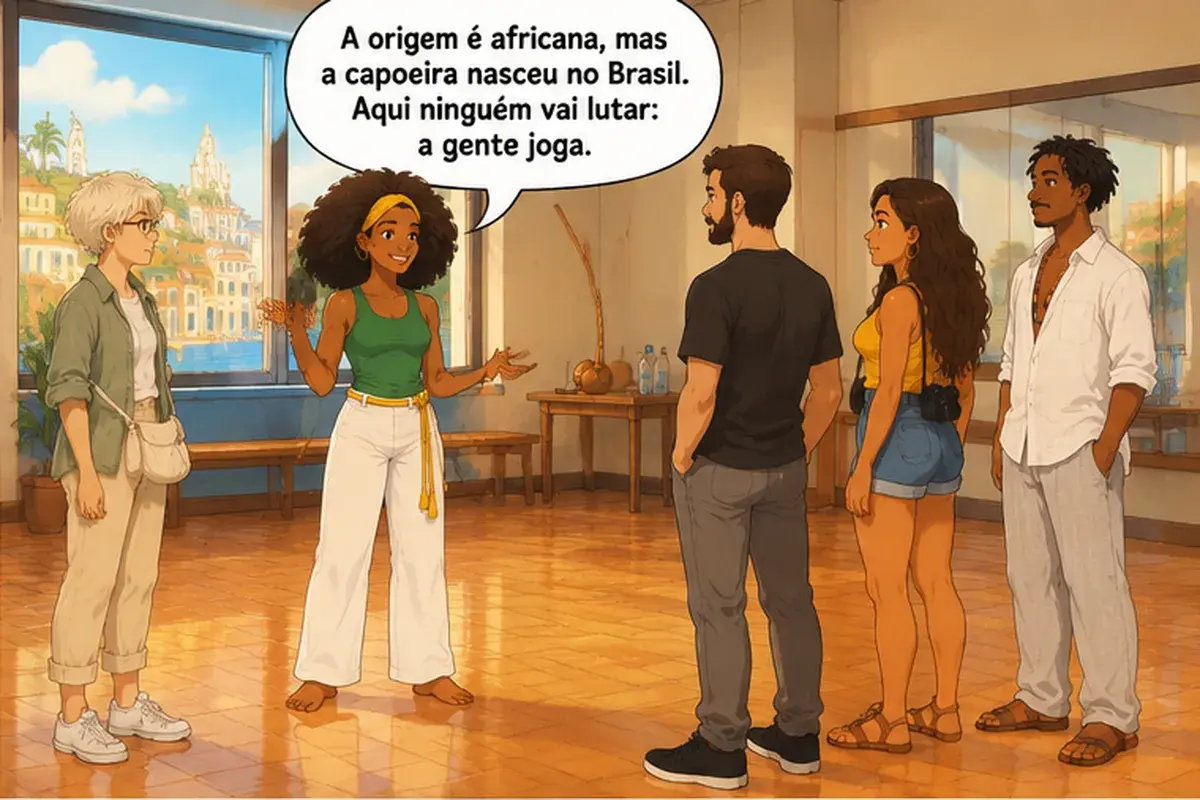
- Jamile
A origem é africana, mas a capoeira nasceu no Brasil. Aqui ninguém vai lutar: a gente joga.
Its origin is African, but capoeira was born in Brazil. Nobody's going to fight here: we play.
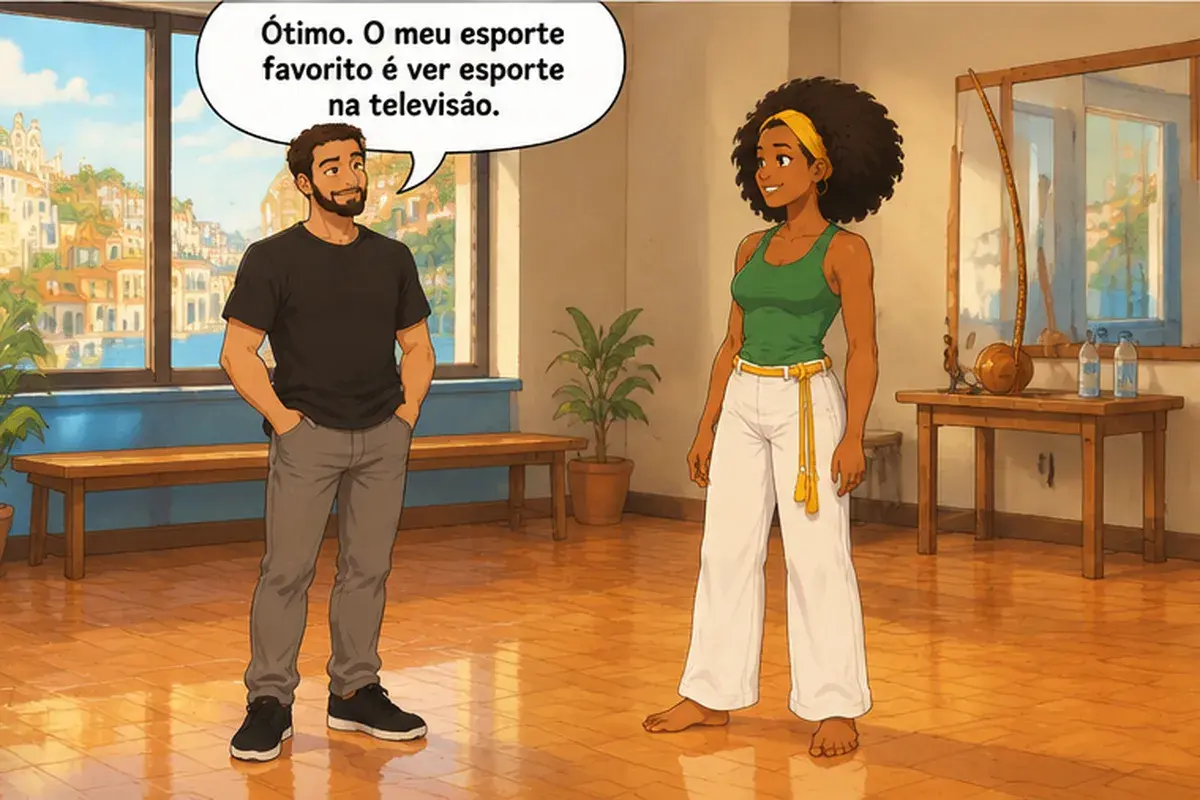
- Léo
Ótimo. O meu esporte favorito é ver esporte na televisão.
Great. My favorite sport is watching sports on TV.
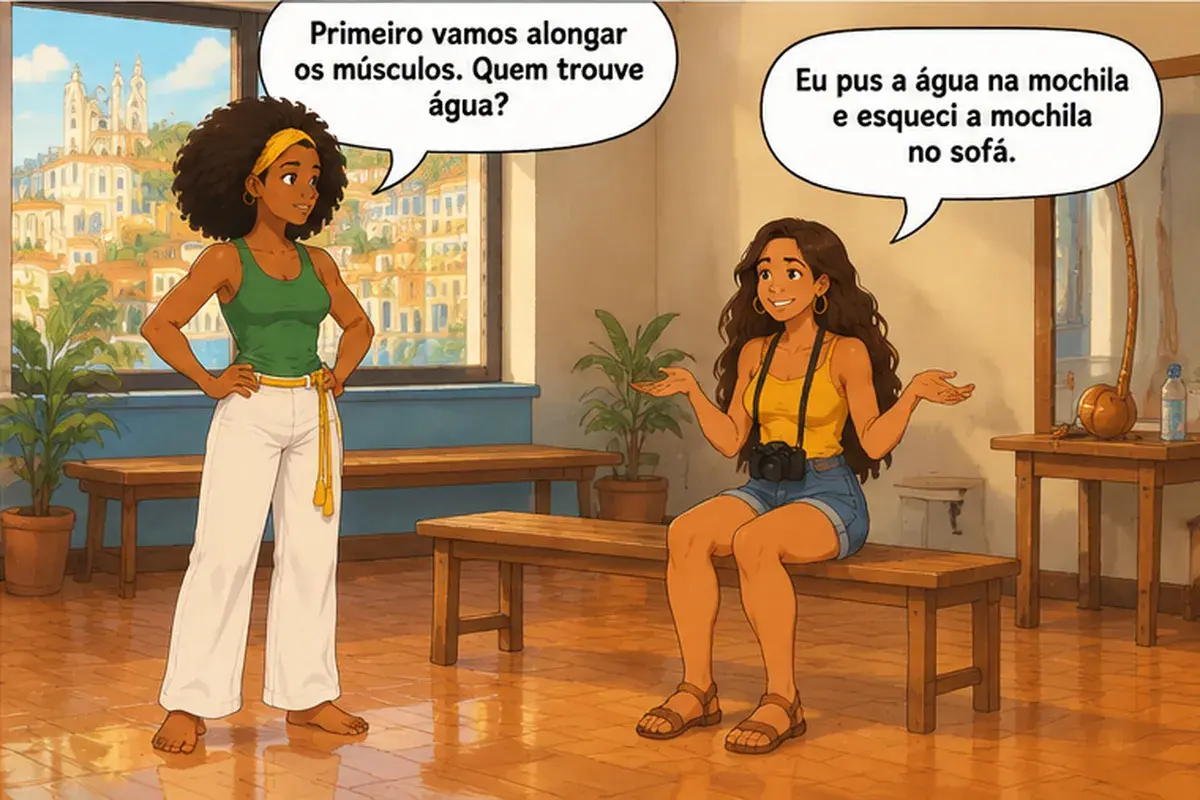
- Jamile
Primeiro vamos alongar os músculos. Quem trouxe água?
First, let's stretch our muscles. Who brought water?
- Bia
Eu pus a água na mochila e esqueci a mochila no sofá.
I put the water in my backpack and forgot the backpack on the couch.
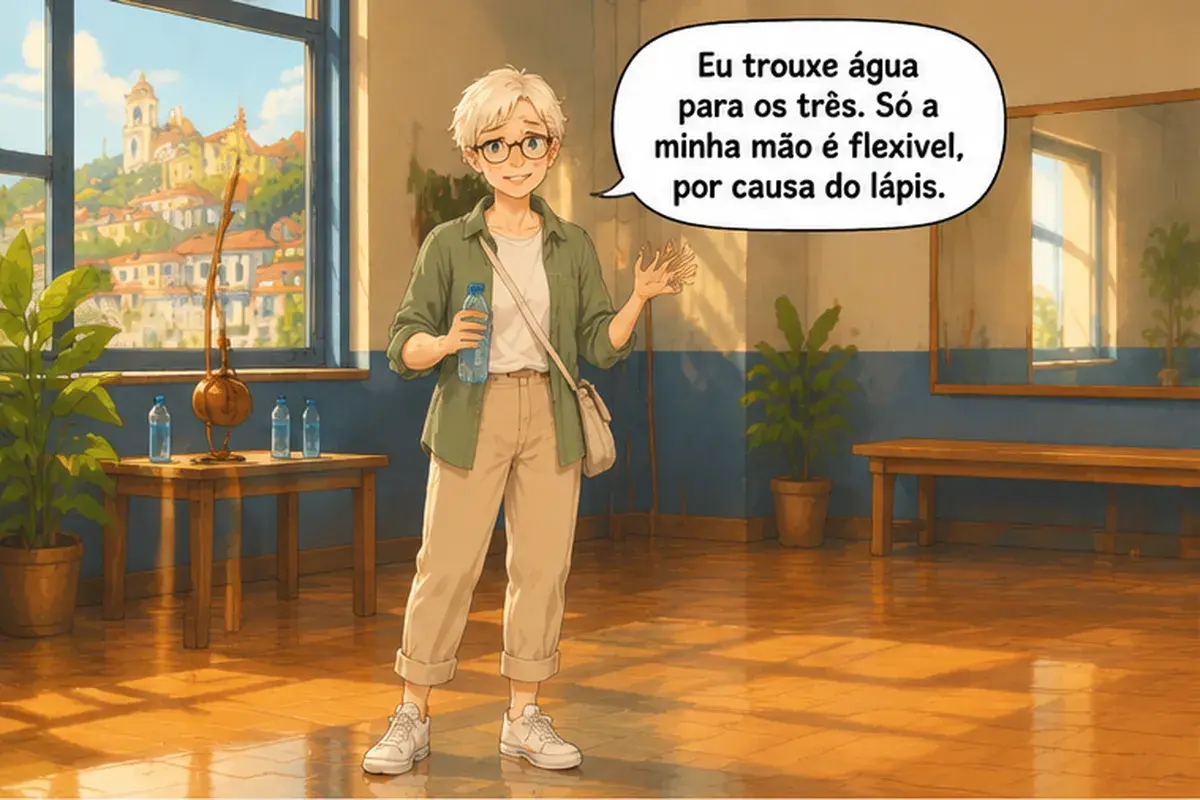
- Nina
Eu trouxe água para os três. Só a minha mão é flexível, por causa do lápis.
I brought water for the three of us. Only my hand is flexible, because of the pencil.
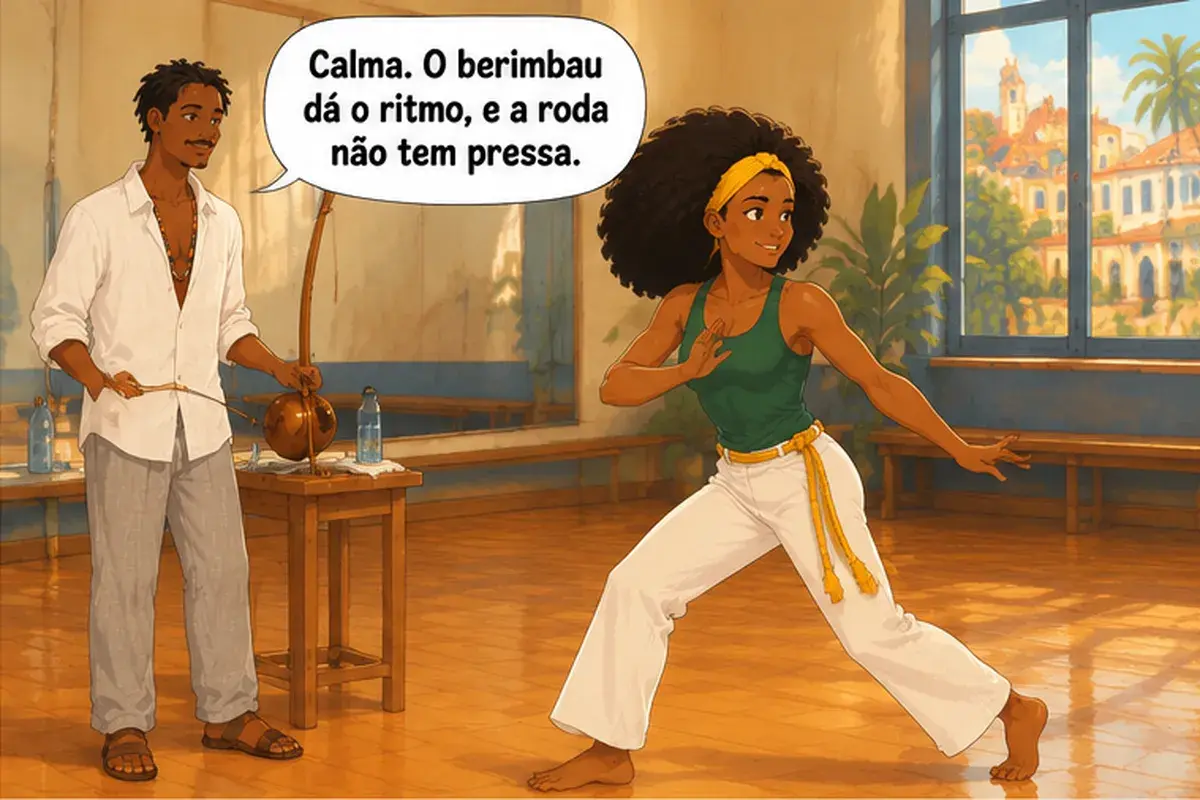
- Tiago
Calma. O berimbau dá o ritmo, e a roda não tem pressa.
Relax. The berimbau sets the rhythm, and the roda is in no hurry.
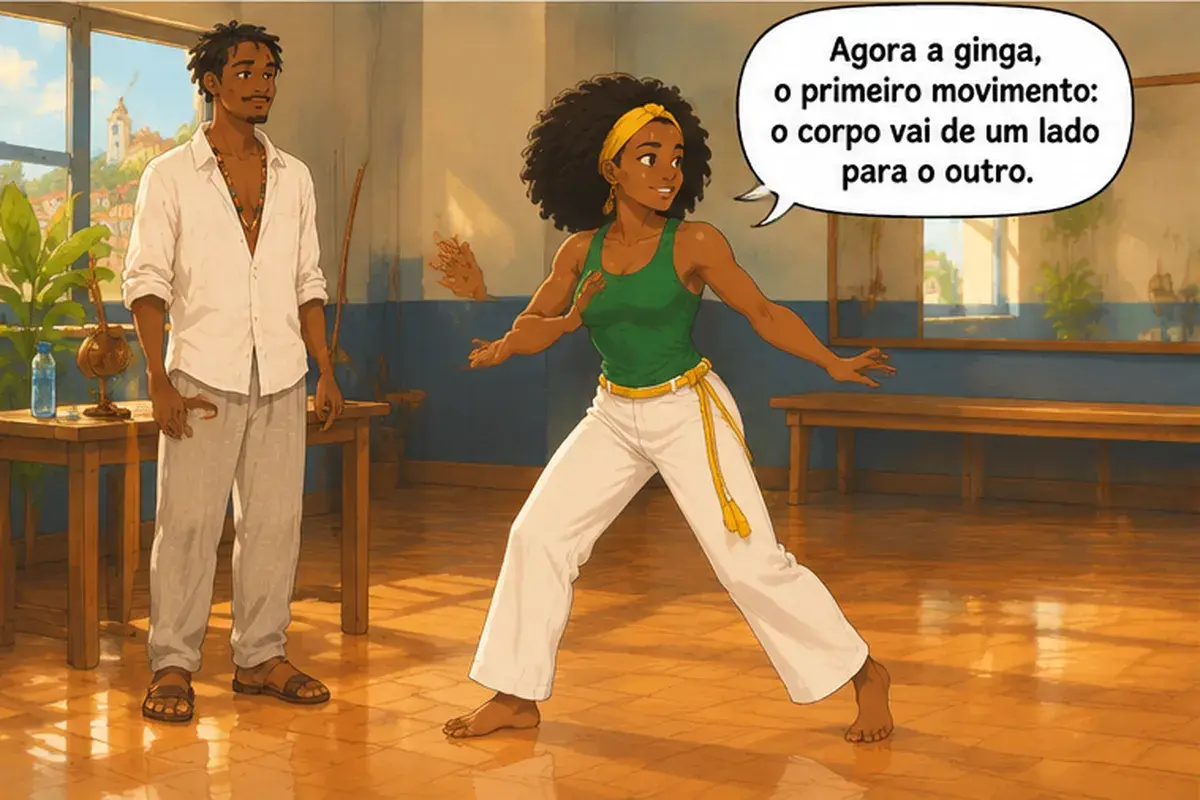
- Jamile
Agora a ginga, o primeiro movimento: o corpo vai de um lado para o outro.
Now the ginga, the first movement: the body goes from one side to the other.
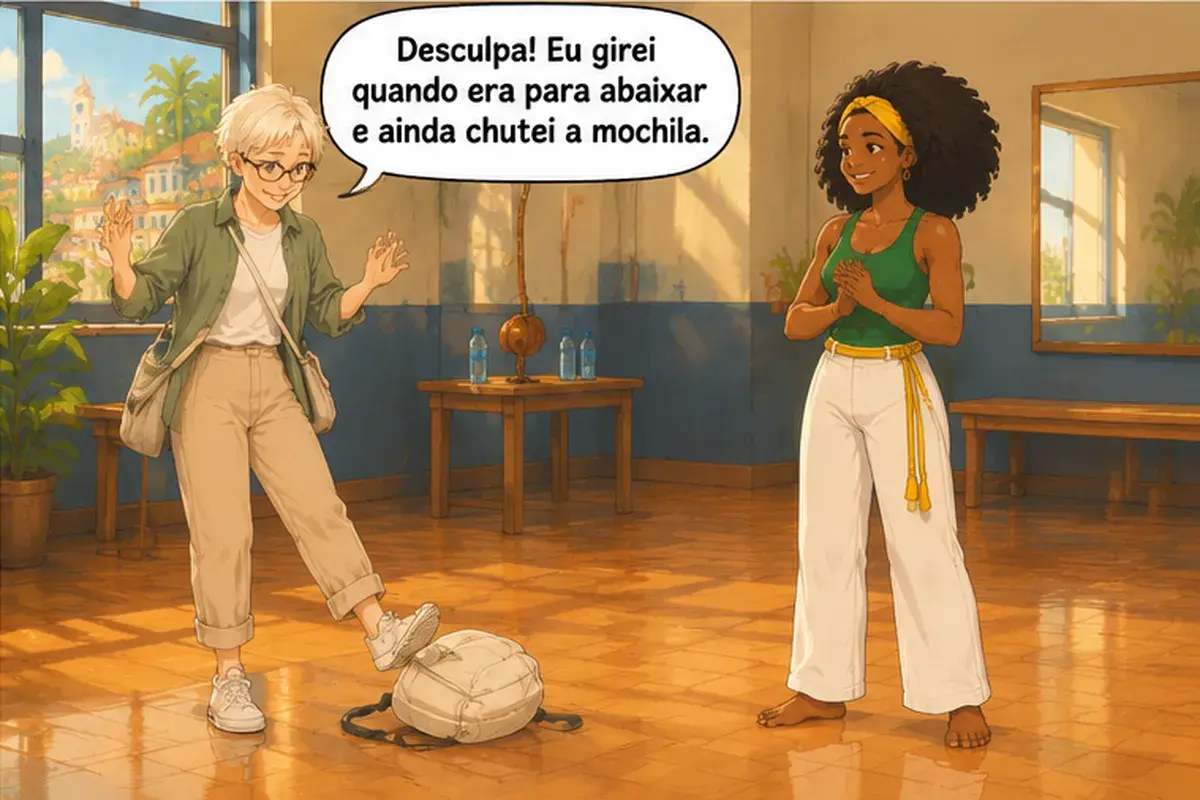
- Nina
Desculpa! Eu girei quando era para abaixar e ainda chutei a mochila.
Sorry! I spun when I was supposed to crouch, and on top of that I kicked the backpack.
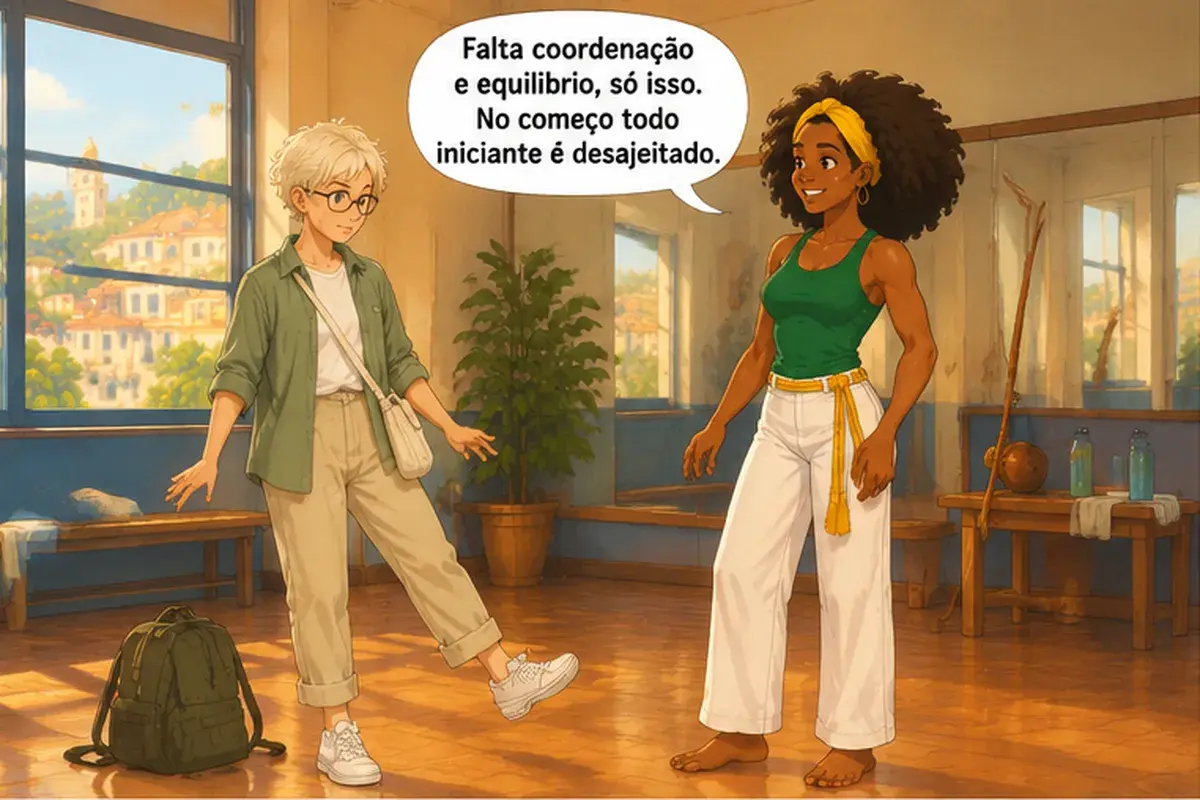
- Jamile
Falta coordenação e equilíbrio, só isso. No começo todo iniciante é desajeitado.
What's missing is coordination and balance, that's all. At first, every beginner is clumsy.
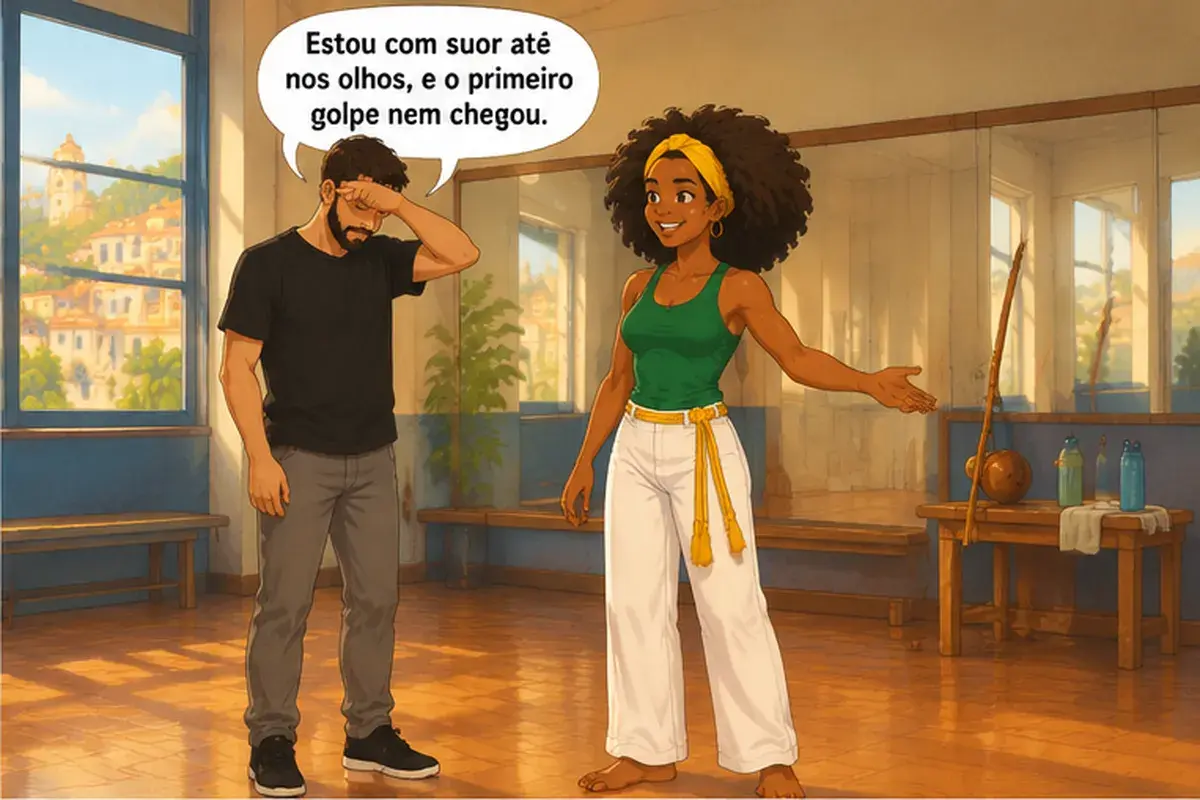
- Léo
Estou com suor até nos olhos, e o primeiro golpe nem chegou.
I've got sweat even in my eyes, and the first strike hasn't even come yet.
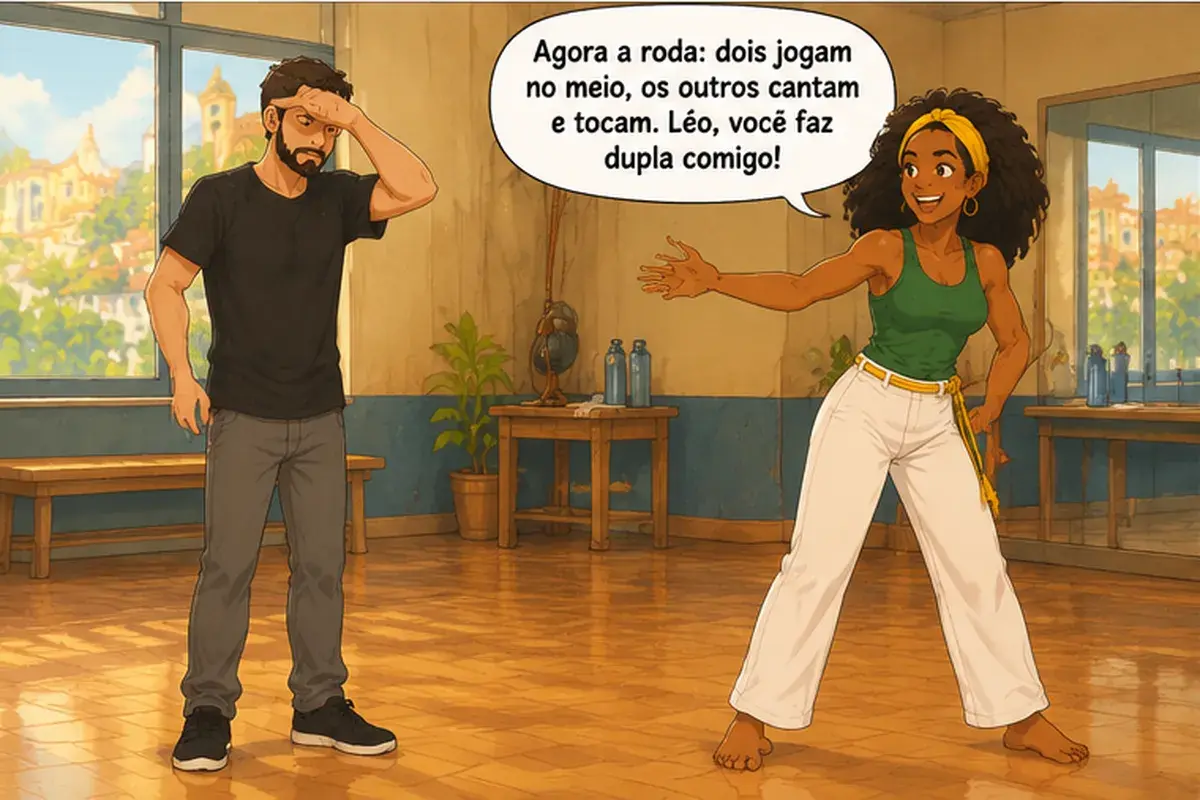
- Jamile
Agora a roda: dois jogam no meio, os outros cantam e tocam. Léo, você faz dupla comigo!
Now the roda: two play in the middle, and the others sing and play. Léo, you pair up with me!
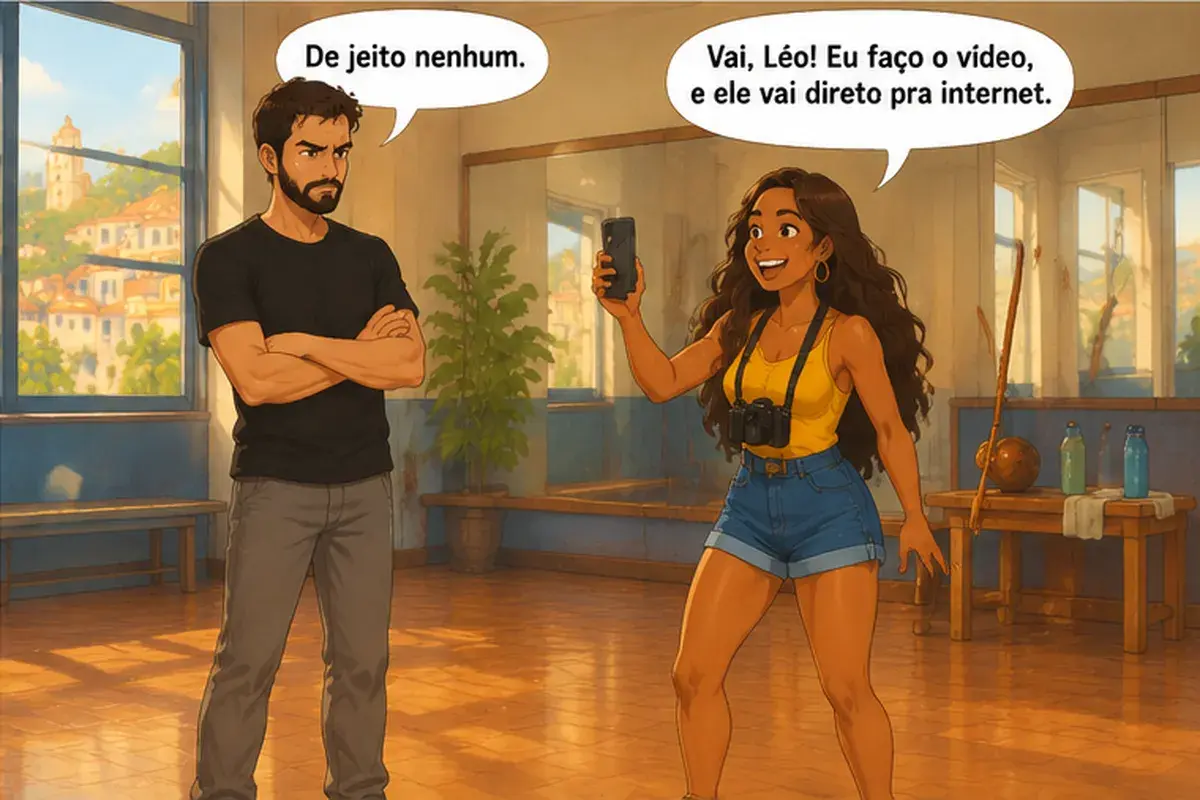
- Léo
De jeito nenhum.
No way.
- Bia
Vai, Léo! Eu faço o vídeo, e ele vai direto pra internet.
Come on, Léo! I'll make the video, and it'll go straight to the internet.
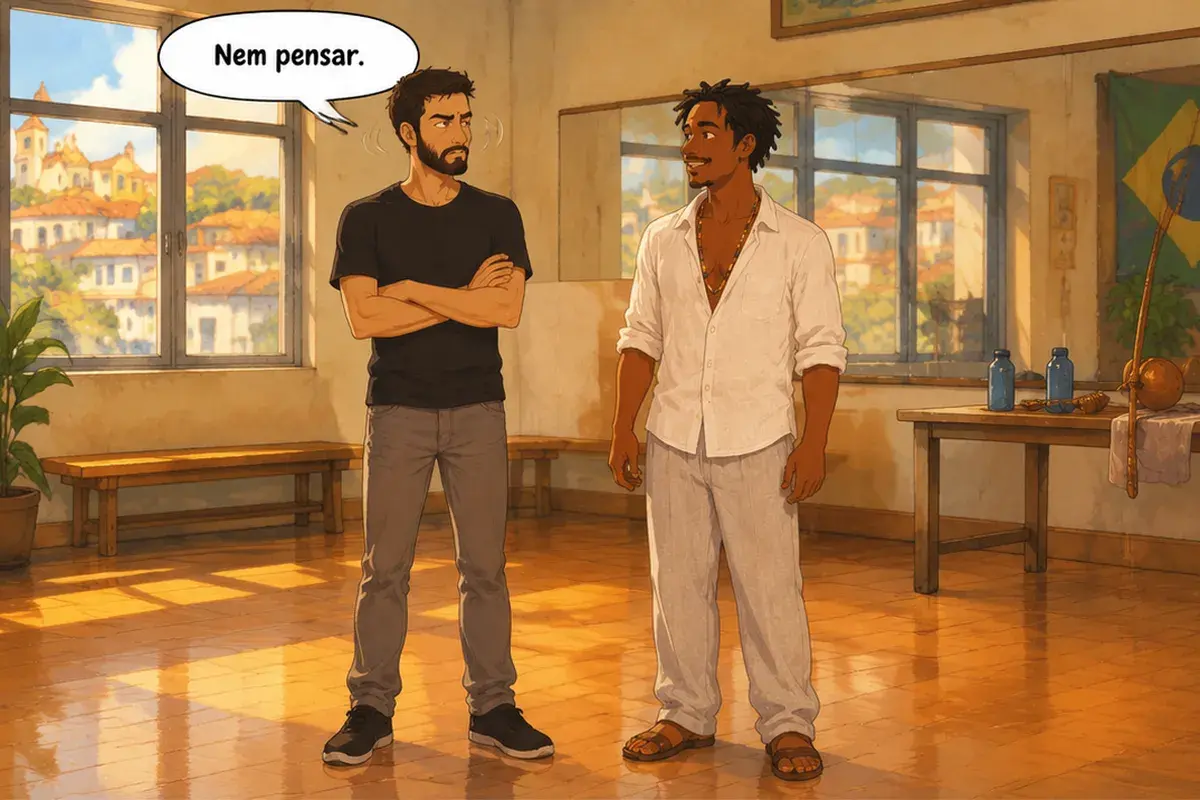
- Léo
Nem pensar.
Don't even think about it.
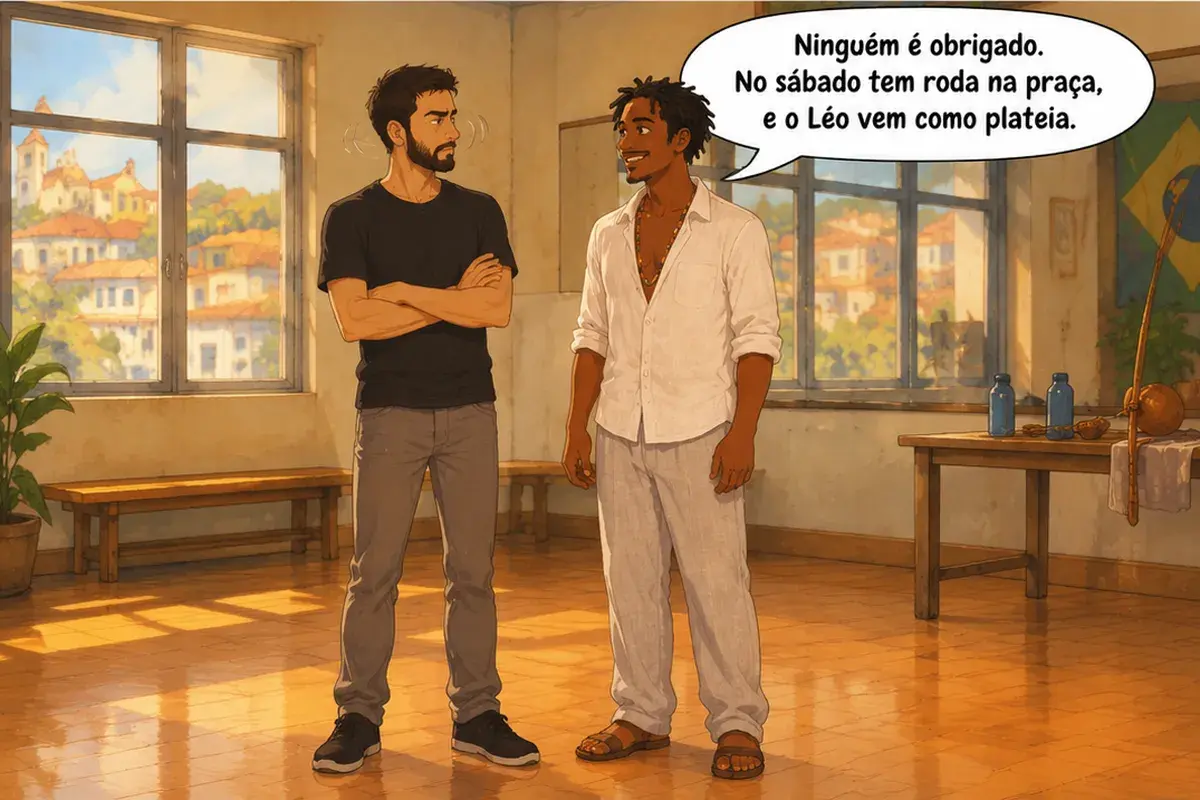
- Tiago
Ninguém é obrigado. No sábado tem roda na praça, e o Léo vem como plateia.
Nobody has to. On Saturday there's a roda in the square, and Léo comes as the audience.
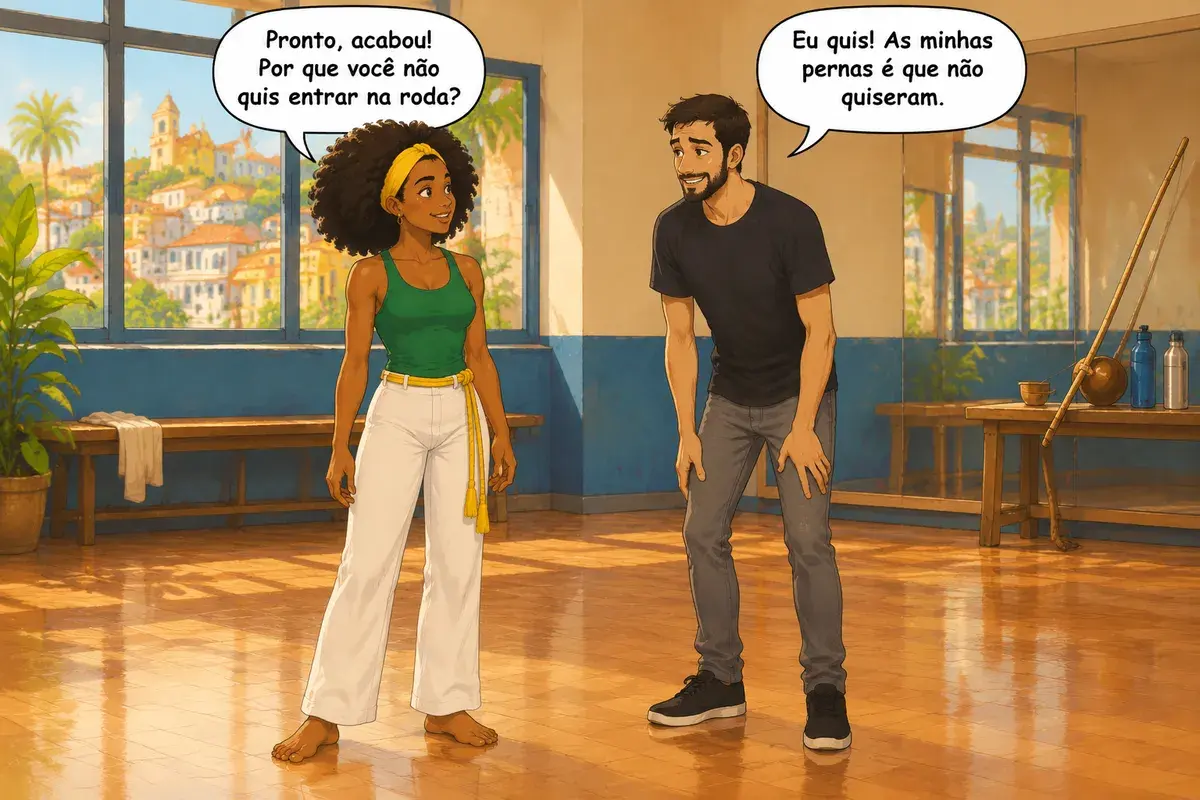
- Jamile
Pronto, acabou! Por que você não quis entrar na roda?
OK, that's it! Why didn't you want to go into the roda?
- Léo
Eu quis! As minhas pernas é que não quiseram.
I did want to! It was my legs that didn't want to.
Grammar for this text
- Quem trouxe água? and Eu trouxe água para os três — trouxe is the preterite of trazer (to bring): the eu form and the ele / ela form are the same. The stem changes (traz- → troux-), and the endings are short. The rule is in the unit grammar.
- Eu pus a água na mochila — pus means "I put", from pôr (to put). The ele / ela form is different: pôs. Don't confuse it with the present põe.
- Por que você não quis entrar na roda? — quis is the preterite of querer. Não quis means "didn't want to, refused" (while não queria means "didn't feel like it").
- As minhas pernas é que não quiseram — Léo's joke: quiseram is "they wanted"; é que adds emphasis: "it was my legs that didn't want to".
- De jeito nenhum and Nem pensar — a sharp "no way". People say this to friends and family; to a clerk or an older person they'd answer more softly.
- Aqui ninguém vai lutar: a gente joga — you "play" capoeira (jogar), you don't "fight" it; lutar means "to fight".
- Eu girei quando era para abaixar — era para + infinitive: "I was supposed to". Abaixar is "to lower"; here, "to crouch".
- vai direto pra internet — pra is casual for para; friends say it, but it's not for formal writing.
Words and grammar of the unit: Talk about a first class that went wrong.
Learn the words from the texts with flashcards
In the app, you can tap any word in a text to see its translation, forms and examples, and new words stick with flashcards. 15 minutes a day.
Start for freeEverything is open for free. No card needed to sign up.