

Portuguese story with translation · A2 · 16 lines
Fiquei vermelha como um camarão I turned as red as a shrimp (woman speaking)
Comic · 9 panels

Ontem passei o dia inteiro na praia, pela primeira vez no Rio.
Yesterday I spent the whole day at the beach, for the first time in Rio.
Semana passada eu arrumei a mala em São Paulo. Hoje tenho areia no cabelo.
Last week I packed my suitcase in São Paulo. Today I have sand in my hair.

Na minha cidade, em novembro, tem neve e o sol é fraco. No Rio, no início de novembro, o sol já queima.
In my city, in November, there's snow and the sun is weak. In Rio, at the beginning of November, the sun already burns.

A Bia levou o guarda-sol do pai, uma canga e os óculos de sol.
Bia took her dad's beach umbrella, a beach wrap and the sunglasses.
Eu levei um chapéu enorme e o caderno. Os cariocas usam boné.
I took a huge hat and my notebook. People from Rio wear caps.

Todo mundo usa biquíni ou sunga. Eu usei bermuda e camiseta.
Everyone wears a bikini or swim briefs. I wore shorts and a T-shirt.
Depois de mergulhar nas ondas, deitei na canga, na sombra do guarda-sol.
After diving into the waves, I lay down on the beach wrap, in the shade of the beach umbrella.
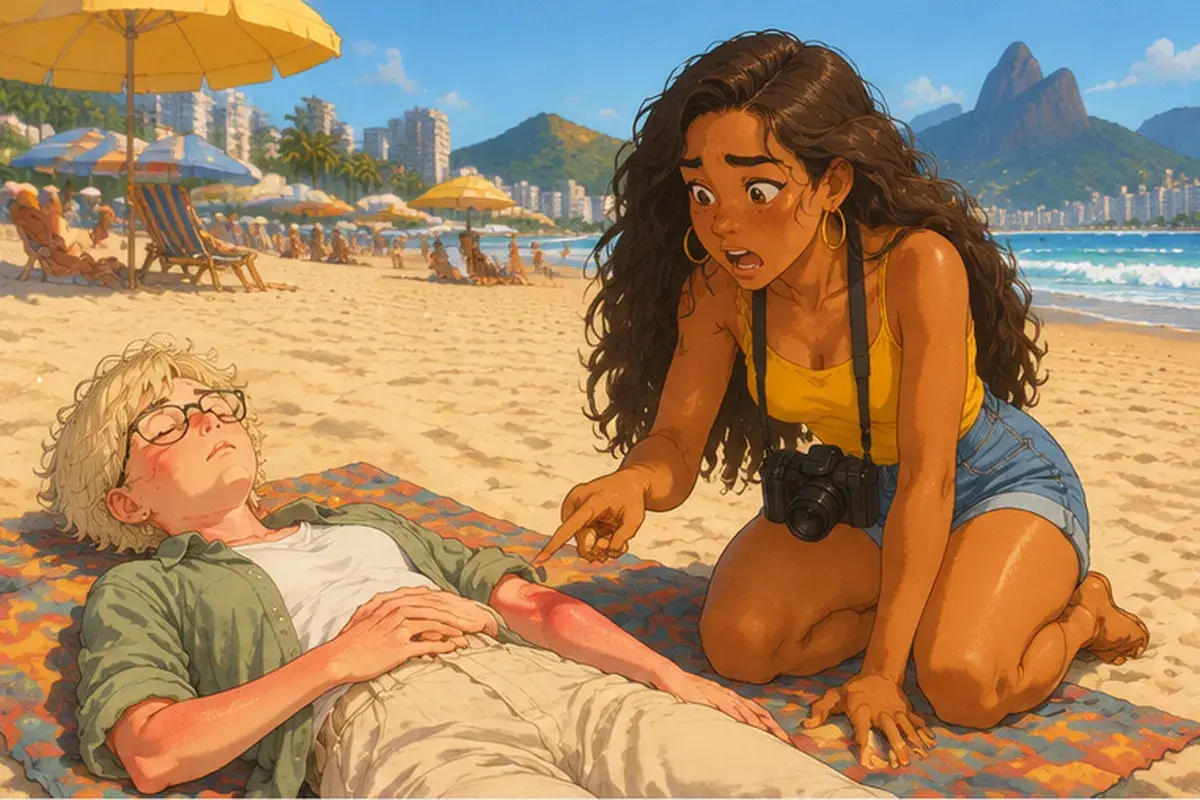
Logo a sombra mudou de lugar, e eu fiquei no sol “só um pouco”: mais ou menos metade da tarde.
Soon the shade moved, and I stayed in the sun “just for a bit”: about half the afternoon.
No fim da tarde, a Bia olhou para mim: “Nina, você queimou!”
At the end of the afternoon, Bia looked at me: “Nina, you got burned!”

Olhei a minha pele. Queimei as costas, o nariz, tudo: fiquei vermelha como um camarão.
I looked at my skin. I burned my back, my nose, everything: I turned as red as a shrimp (woman speaking).

Mesmo assim, a Bia me levou ao Arpoador para ver o pôr do sol. Tinha tanta gente!
Even so, Bia took me to Arpoador to see the sunset. There were so many people!
Ipanema, o morro, o mar… Que vista incrível!
Ipanema, the hill, the sea… What an incredible view!

O pôr do sol começou, e então: um aplauso enorme!
The sunset began, and then: huge applause!
Procurei uma pessoa famosa. A Bia falou: “O famoso é o sol, Nina. Todo dia!”
I looked for a famous person. Bia said: “The famous one is the sun, Nina. Every day!”

Ficamos até o último minuto. Que dia maravilhoso!
We stayed until the last minute. What a wonderful day!
Gastei quinze reais em mate e biscoito. O melhor não custa nada.
I spent fifteen reais on mate and cookies. The best part costs nothing.
Grammar for this text
- fiquei vermelha como um camarão — a set phrase. fiquei is the eu form of ficar in the preterite. Here it doesn't mean "I stayed" (as in A1) but "I turned, I became": "I turned as red as a shrimp". vermelha is feminine because Nina is speaking. The rule comes in unit 14; for now learn the phrase as a whole.
- eu fiquei no sol — and here ficar does mean "to stay". Ficamos até o último minuto — ficamos: "we stayed". It's spelled the same as the present ("we stay"); you know it's the past from Ontem at the start of the story.
- Tinha tanta gente — a ready-made background form: tinha means "there was, there were" (from ter, in the imperfect). The rule comes in unit 11. tanta is feminine, like gente.
- Nina, você queimou! — queimar about skin: "to get burned". Queimei as costas — "I burned my back": the body part comes right after the verb, with as (the), not "my". The full form is se queimar (to get burned), but in speech se is often dropped.
- Depois de mergulhar — depois de + infinitive: "after diving". Semana passada — "last week"; the preposition can be left out.
- um aplauso enorme — aplauso means "applause". At Arpoador beach people really do applaud the sunset. O famoso é o sol — Bia's joke: "the celebrity here is the sun".
Words and grammar of the unit: Talk about yesterday.
Learn the words from the texts with flashcards
In the app, you can tap any word in a text to see its translation, forms and examples, and new words stick with flashcards. 15 minutes a day.
Start for freeEverything is open for free. No card needed to sign up.