

Portuguese story with translation · A2 · 16 lines
Peguei o ônibus errado I took the wrong bus
Comic · 12 panels

Peguei o ônibus errado, sem querer.
I took the wrong bus, by accident.
Meu ônibus atrasou, e eu corri para o primeiro que chegou.
My bus was late, and I ran to the first one that came.

Entrei, passei o cartão e sentei na janela.
I got on, swiped my card, and sat by the window.
Abri o caderno e desenhei os passageiros.
I opened my notebook and drew the passengers.

De repente, olhei pela janela: uma ponte enorme e o mar!
Suddenly, I looked out the window: a huge bridge and the sea!
Teve um acidente na ponte, e o ônibus parou no engarrafamento.
There was an accident on the bridge, and the bus stopped in the traffic jam.

Perguntei a uma passageira: "Essa ponte vai para onde?" Ela respondeu: "Para Niterói, moça!"
I asked a passenger: "Where does this bridge go?" She answered: "To Niterói, miss!"
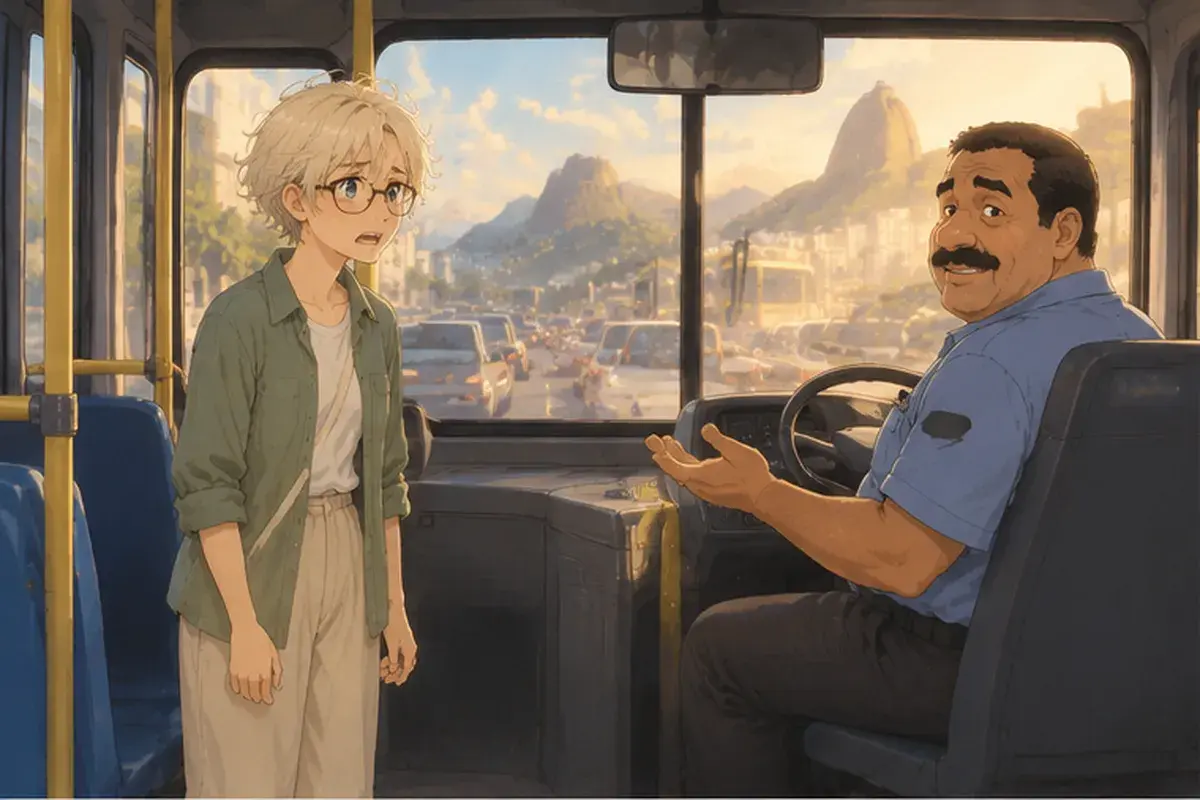
Eu falei para o motorista: "Foi engano! Quero descer." Ele respondeu: "Só no terminal, moça."
I told the driver: "It was a mistake! I want to get off." He answered: "Only at the terminal, miss."

Esqueci de carregar o celular. Sem bateria, sem localização, sem mapa!
I forgot to charge my phone. No battery, no location, no map!

No terminal, eu estava confusa. Tive medo de me perder.
At the terminal, I was confused (woman speaking). I was afraid of getting lost.

Subi uma ladeira para achar sinal. Boa ideia, sem bateria!
I went up a steep street to find a signal. Great idea, with no battery!

Um senhor do estacionamento falou: "Voltar? Só de barca!"
An older man from the parking lot said: "Go back? Only by ferry!"
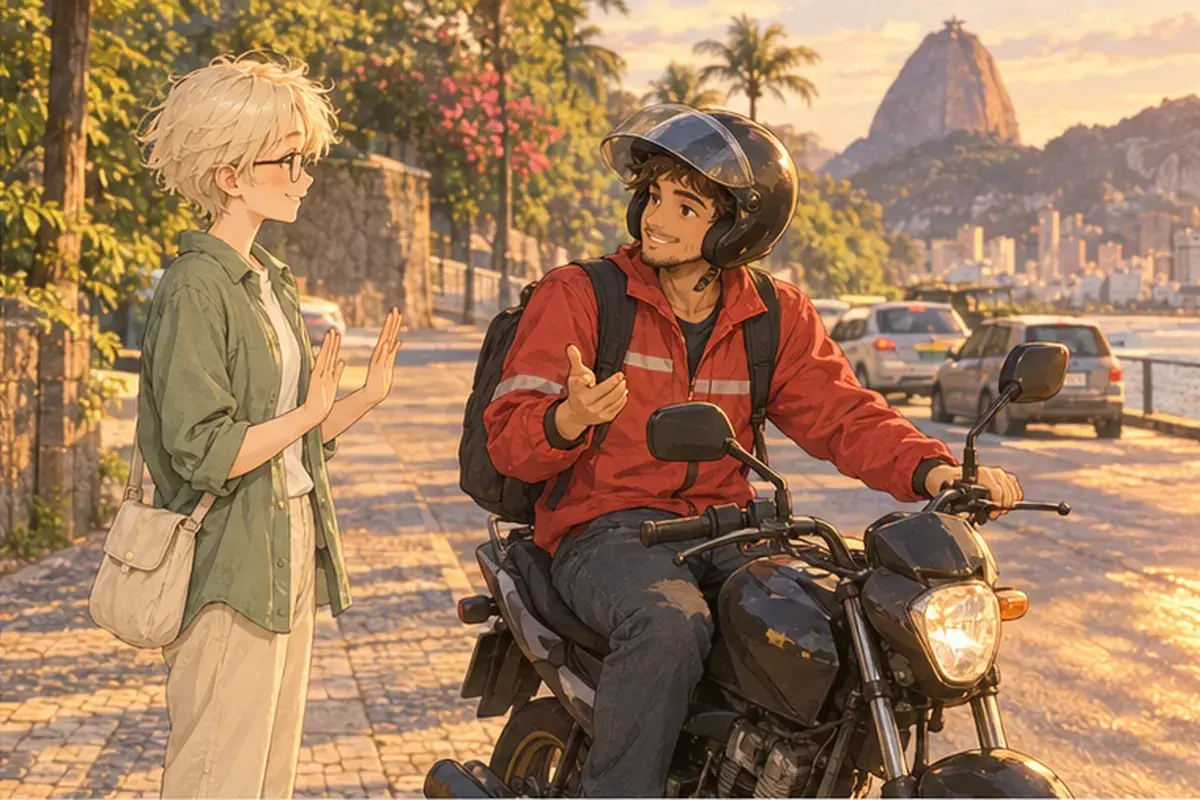
Um moço de moto falou: "Quer carona?" Eu respondi: "Obrigada, prefiro a barca."
A young guy on a motorcycle said: "Want a ride?" I answered: "Thanks, I prefer the ferry."

Fui a pé até a barca.
I went to the ferry on foot.
Fiquei em pé, no vento. O Rio inteiro e o pôr do sol!
I stood in the wind. All of Rio and the sunset!

A vista foi a melhor da viagem!
The view was the best part of the trip!
Grammar for this text
- Teve um acidente na ponte — teve is the preterite of ter, the ele form (irregular: tive, teve, tivemos, tiveram). ter means not only "to have" but also "there is, to happen": tem — there is (now), teve — there was (in the past).
- Fui a pé até a barca — fui is the eu form of ir (to go) in the preterite: "I went". ser (to be) has the same form; here a place and a way of getting there follow (a pé, até), so it's ir. a pé — on foot.
- A vista foi a melhor da viagem — foi is the ele form of ser: "was". It's the same form as for ir; here a description follows (a melhor), so it's ser. The same in Foi engano! — "it was a mistake".
- Tive medo de me perder — tive is the eu form of ter; ter medo — to be afraid, in the preterite "I was scared". After de comes an infinitive, and me stays before the verb: perder-se.
- eu estava confusa — a ready-made background form: estava is the eu / ele form of estar in the imperfect, "was". It describes a state, not an event. The rule comes in unit 11; for now learn it as a whole.
- Quer carona? — carona is a free ride in someone else's car or motorcycle; Quer carona? — "Want a ride?". Só de barca — só is "only", de barca is "by ferry": de + a vehicle.
Words and grammar of the unit: Take the bus without getting lost.
Learn the words from the texts with flashcards
In the app, you can tap any word in a text to see its translation, forms and examples, and new words stick with flashcards. 15 minutes a day.
Start for freeEverything is open for free. No card needed to sign up.