

Portuguese dialogue with translation · A1 · 14 lines
Você está melhor? Are you better?
Comic · 8 panels

- Bia
Bom dia, Nina! Você está melhor?
Good morning, Nina! Are you better?
- Nina
Mais ou menos. A febre passa, mas a tosse está pior.
So-so. The fever is going away, but the cough is worse.
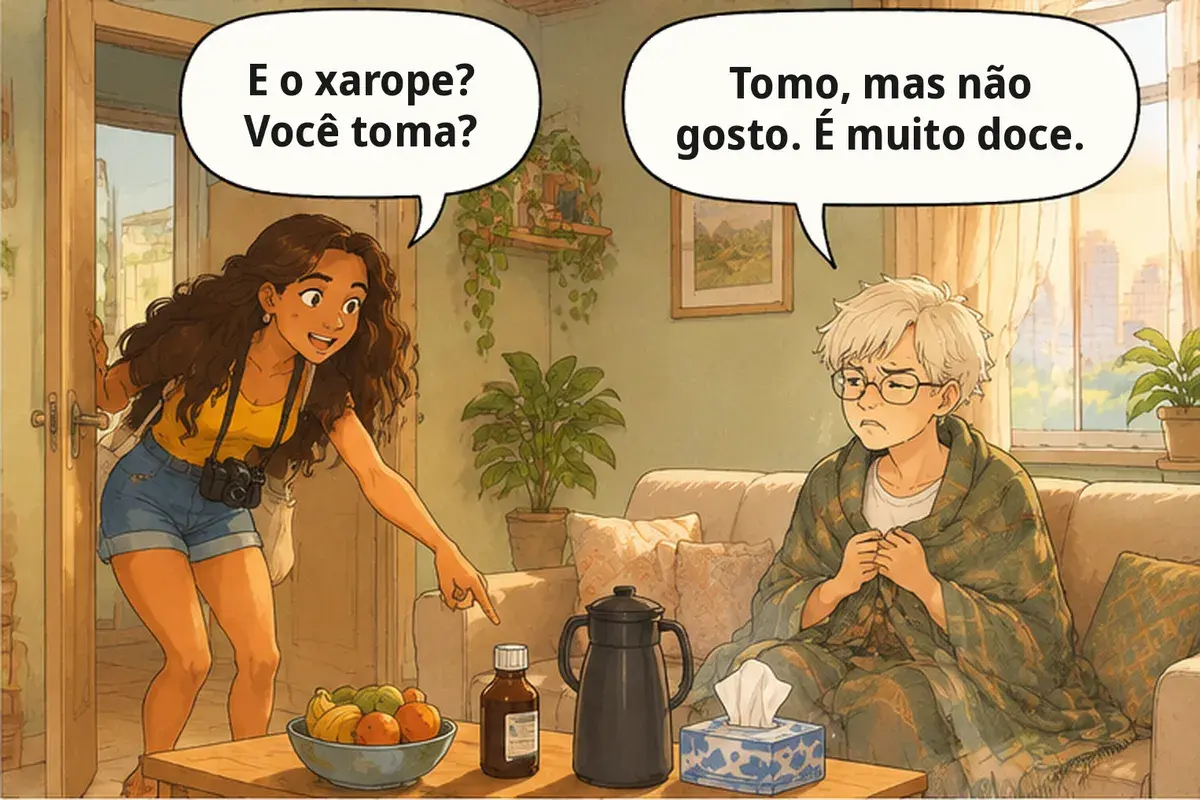
- Bia
E o xarope? Você toma?
And the syrup? Are you taking it?
- Nina
Tomo, mas não gosto. É muito doce.
I take it, but I don't like it. It's very sweet.

- Léo
E o sono? Você consegue dormir?
And what about sleep? Can you sleep?
- Nina
Não consigo. E estou com sede o dia todo.
I can't. And I'm thirsty all day.

- Léo
Então você deve beber muita água. Café não é água.
Then you should drink a lot of water. Coffee isn't water.
- Bia
E suco de laranja! Tem muita vitamina.
And orange juice! It has a lot of vitamins.

- Nina
Eu sei… Mas só um café?
I know… But just one coffee?
- Léo
Não.
No.

- Léo
Hoje é dia de repouso: cama, chá e pijama.
Today is a day of bed rest: bed, tea and pajamas.
- Bia
Hoje eu volto cedo, com chocolate!
I'll be back early today, with chocolate!

- Léo
Cedo para a Bia é meia-noite.
Early for Bia is midnight.

- Nina
Obrigada, pessoal. Só de falar com vocês, eu já estou melhor.
Thanks, guys. Just from talking to you, I'm already better.
Grammar for this text
- Você está melhor? — melhor means "better" and pior means "worse". They are words of their own, like in English, not "more good" or "more bad". They are the same for men and women.
- Você consegue dormir? / Não consigo — consegue and consigo are the você and eu forms of the irregular verb conseguir. It isn't "to be allowed", it's "can, to manage to". So Não consigo — "I can't" (fall asleep).
- Hoje eu volto cedo — the present tense with hoje for the future: "I'll be back early today". The form vou voltar comes in unit 13.
- Cedo para a Bia é meia-noite — a joke: Bia is always late, so for her "early" means midnight. para a Bia — "for Bia".
- Só de falar com vocês, eu já estou melhor — só de + infinitive: "just from (doing something)"; estou is the eu form of estar. Literally: "just from talking with you (all), I'm already better".
- E o xarope? Você toma? — you "take" syrup and medicine with tomar, the same verb as for coffee: tomar xarope, tomar remédio. The answer Tomo repeats the verb instead of "yes".
- Tem muita vitamina. — tem here means "it has": "it has a lot of vitamins".
- Hoje é dia de repouso: cama, chá e pijama. — repouso is "rest, bed rest". Léo lists things without a verb, like a to-do list.
Words and grammar of the unit: Say what hurts at the pharmacy.
Learn the words from the texts with flashcards
In the app, you can tap any word in a text to see its translation, forms and examples, and new words stick with flashcards. 15 minutes a day.
Start for freeEverything is open for free. No card needed to sign up.