

Portuguese dialogue with translation · A1 · 10 lines
Tenho uma novidade! I have some news!
Comic · 10 panels

- Bia
Pessoal! Tenho uma novidade: um trabalho num show grande, sábado!
Guys! I have some news: a job at a big show, on Saturday!

- Nina
Sério? Que legal! Parabéns, Bia!
Seriously? How cool! Congratulations, Bia!

- Bia
Estou animada demais!
I'm so excited! (woman speaking)

- Léo
Parabéns! Que pena, sábado estou ocupado: tem jogo do Corinthians.
Congratulations! What a shame, I'm busy on Saturday: there's a Corinthians game (man speaking).

- Bia
Léo!
Léo!

- Léo
Mentira! Eu vou ao show. Mas o show começa às oito, e você sempre chega atrasada.
Just kidding! I'm going to the show. But the show starts at eight, and you always arrive late (to a woman).

- Nina
Concordo com o Léo. É um trabalho importante, Bia.
I agree with Léo. It's an important job, Bia.

- Bia
Eu atrasada? Talvez um pouco. Eu acho que vocês têm razão.
Me, late? Maybe a little. I think you guys are right (woman speaking).
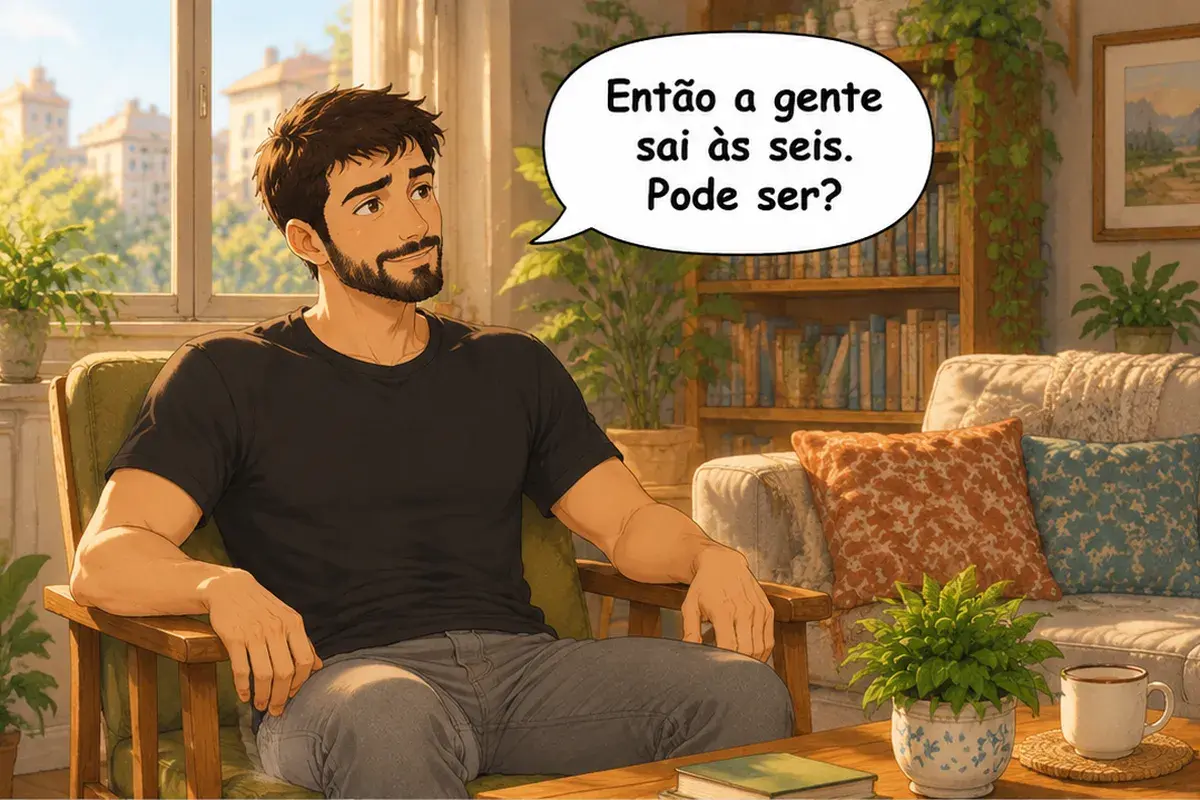
- Léo
Então a gente sai às seis. Pode ser?
So we're leaving at six. Does that work?

- Bia
Pode ser! Beijo, pessoal!
Sure! Kisses, guys!
Grammar for this text
- Que pena, sábado estou ocupado: tem jogo do Corinthians. — Que pena — what a shame; tem jogo — there's a game; do = de + o.
- Mentira! — literally "a lie!"; here it means "just kidding, that's not true". Among friends people also say it when they're surprised: "No way!".
- Concordo com o Léo. — concordo is the eu form of concordar (to agree). It takes com: "to agree with someone".
- Eu atrasada? Talvez um pouco. — there's no verb: "Me — late?", said in surprise. talvez — maybe; here it stands alone.
- Eu acho que vocês têm razão. — acho que + a sentence: "I think (that)...". têm with a circumflex is the vocês / eles / elas form of ter, and tem without it is the você / ele / ela form; they sound the same. ter razão — to be right.
- Então a gente sai às seis. — sai is the você / ele / ela form of sair (to leave, to go out); with a gente the verb takes this same form. The present tense with an exact time is already a plan, like English "we're leaving at six".
- Pode ser? — pode is the ele / ela form of poder; literally "can it be?", in English "does that work?", "OK?".
Words and grammar of the unit: Chat about how you feel and what's new.
Learn the words from the texts with flashcards
In the app, you can tap any word in a text to see its translation, forms and examples, and new words stick with flashcards. 15 minutes a day.
Start for freeEverything is open for free. No card needed to sign up.