

Chinese dialogue with translation · A2 · 15 lines
红包里的钱不能有四! The money in a red envelope can't have a four!
Comic · 11 panels
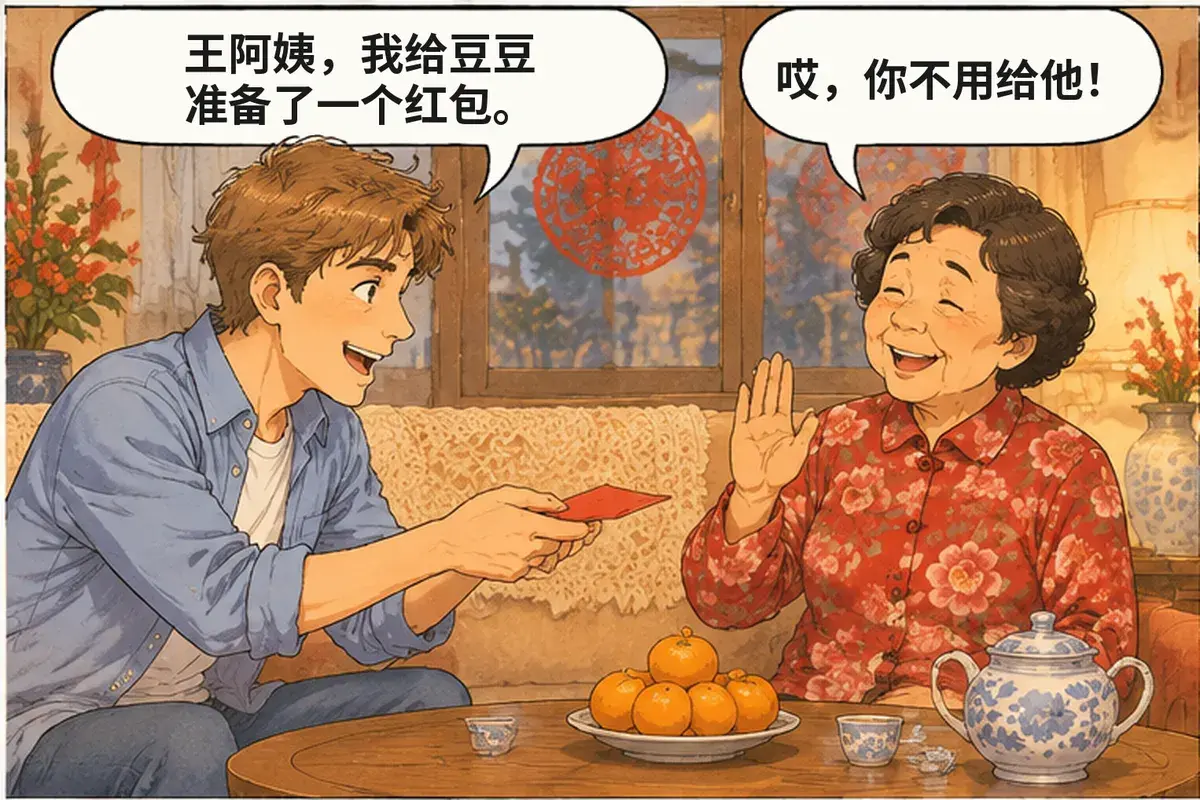
- 伊利亚
王阿姨,我给豆豆准备了一个红包。
Auntie Wang, I got a red envelope ready for Doudou.
- 王阿姨
哎,你不用给他!
Oh, you don't need to give him one!

- 伊利亚
要给!他写的福字我很喜欢。我放了四百块,行吗?
I want to! I really like the fu character he wrote. I put in four hundred yuan. Is that OK?
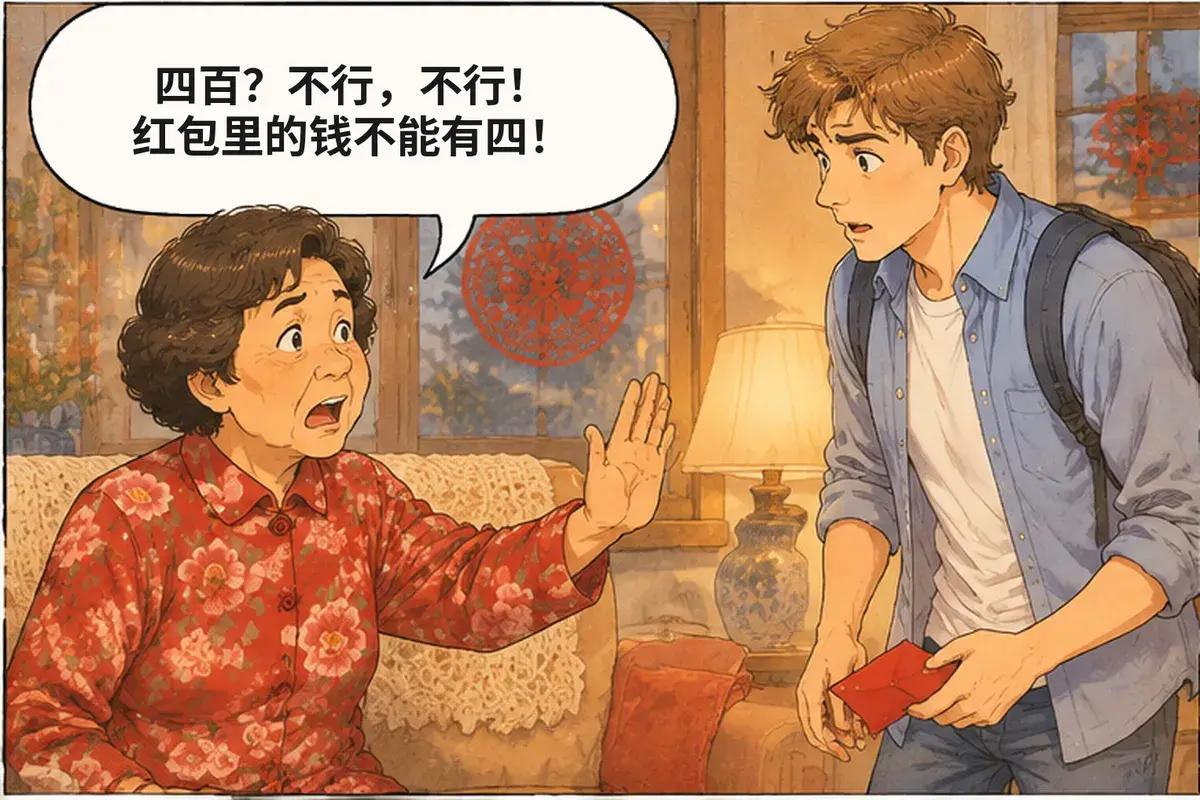
- 王阿姨
四百?不行,不行!红包里的钱不能有四!
Four hundred? No, no! The money in a red envelope can't have a four!
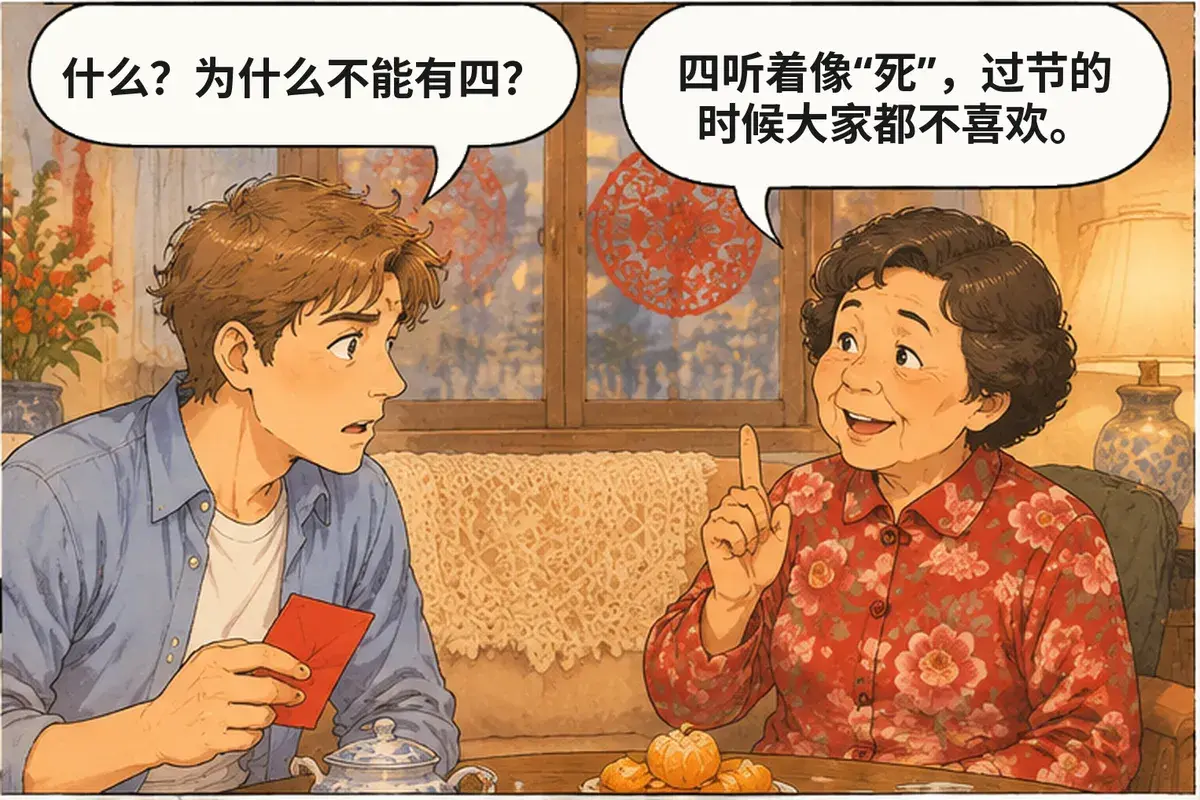
- 伊利亚
什么?为什么不能有四?
What? Why can't it have a four?
- 王阿姨
四听着像“死”,过节的时候大家都不喜欢。
Four sounds like "death," so nobody likes it during the holidays.
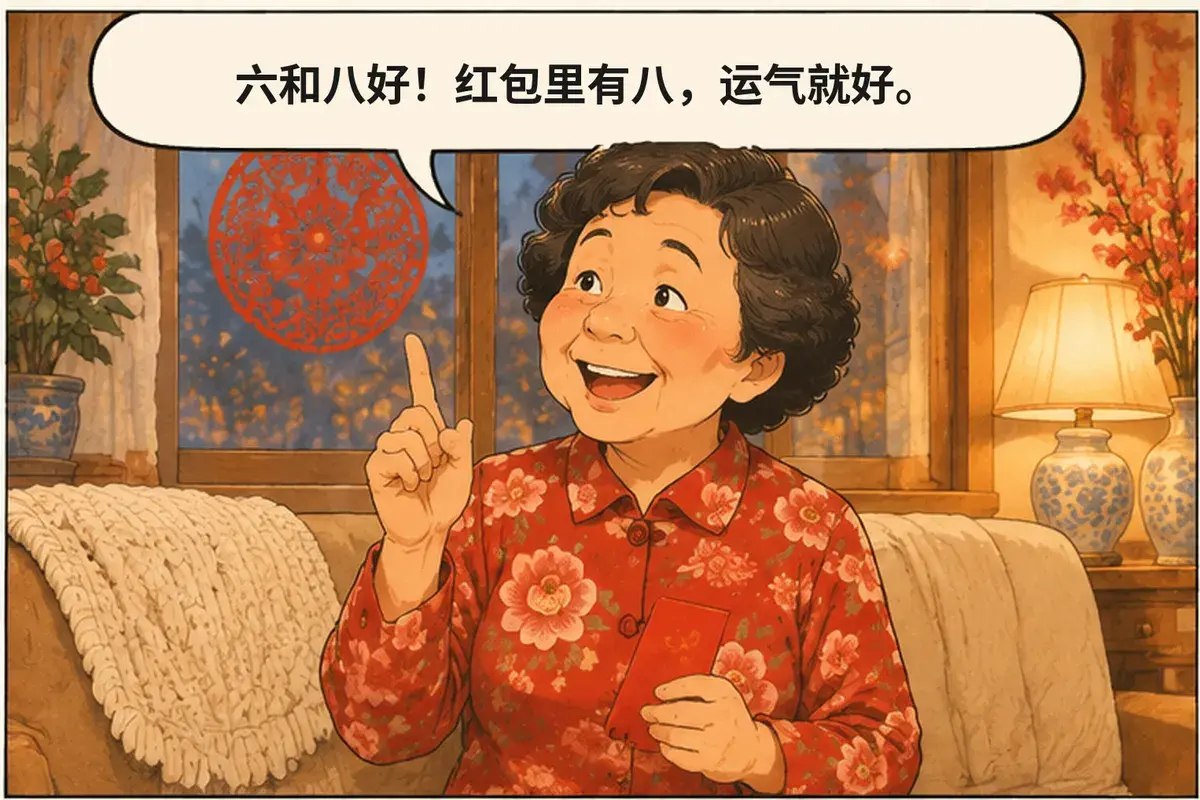
- 王阿姨
六和八好!红包里有八,运气就好。
Six and eight are good! If there's an eight in the red envelope, you'll have good luck.
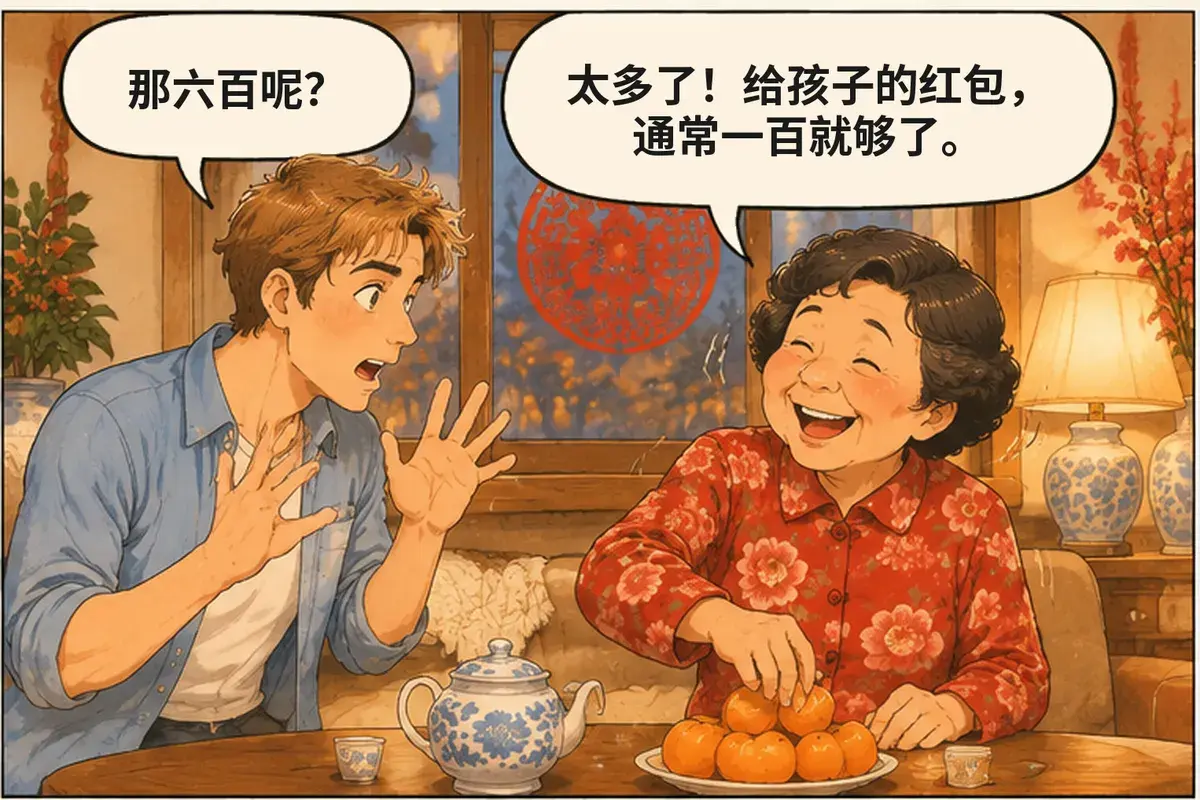
- 伊利亚
那六百呢?
What about six hundred?
- 王阿姨
太多了!给孩子的红包,通常一百就够了。
That's too much! For a child's red envelope, one hundred is usually enough.
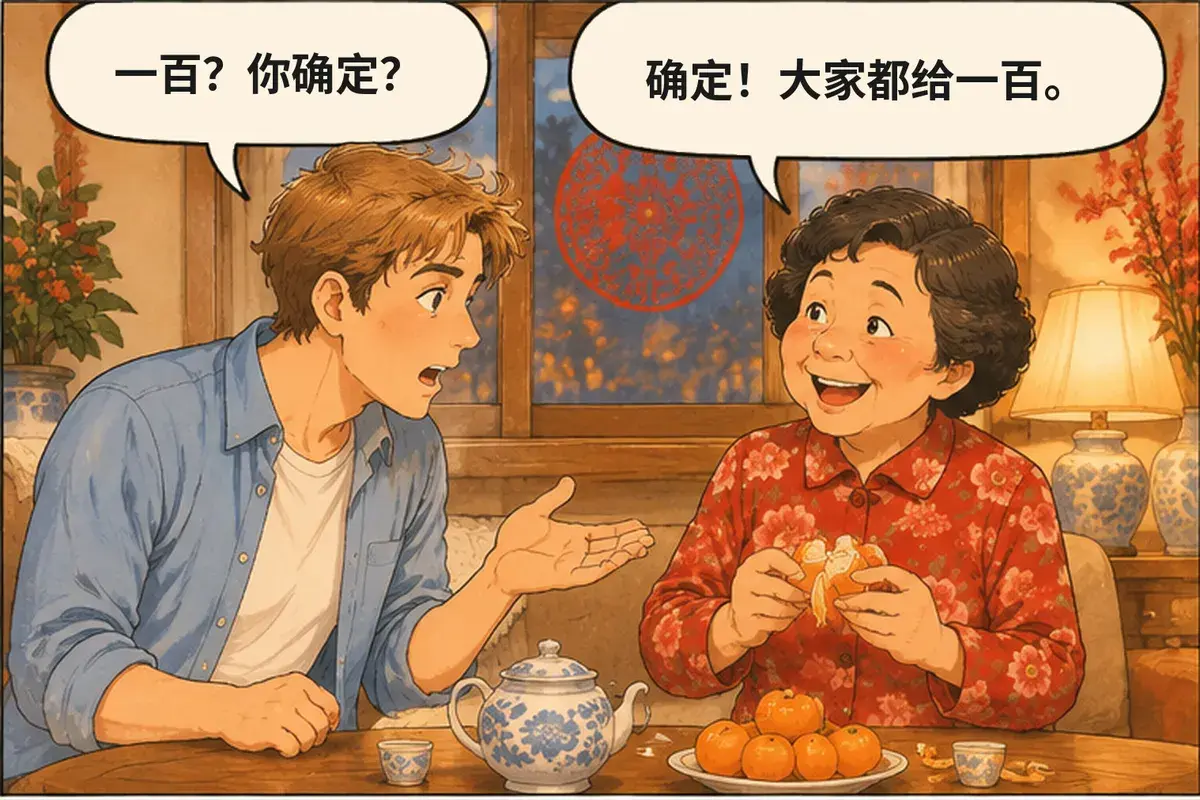
- 伊利亚
一百?你确定?
One hundred? Are you sure?
- 王阿姨
确定!大家都给一百。
I'm sure! Everybody gives one hundred.

- 伊利亚
好,那一百。王阿姨,你确实什么都知道!
OK, one hundred then. Auntie Wang, you really do know everything!
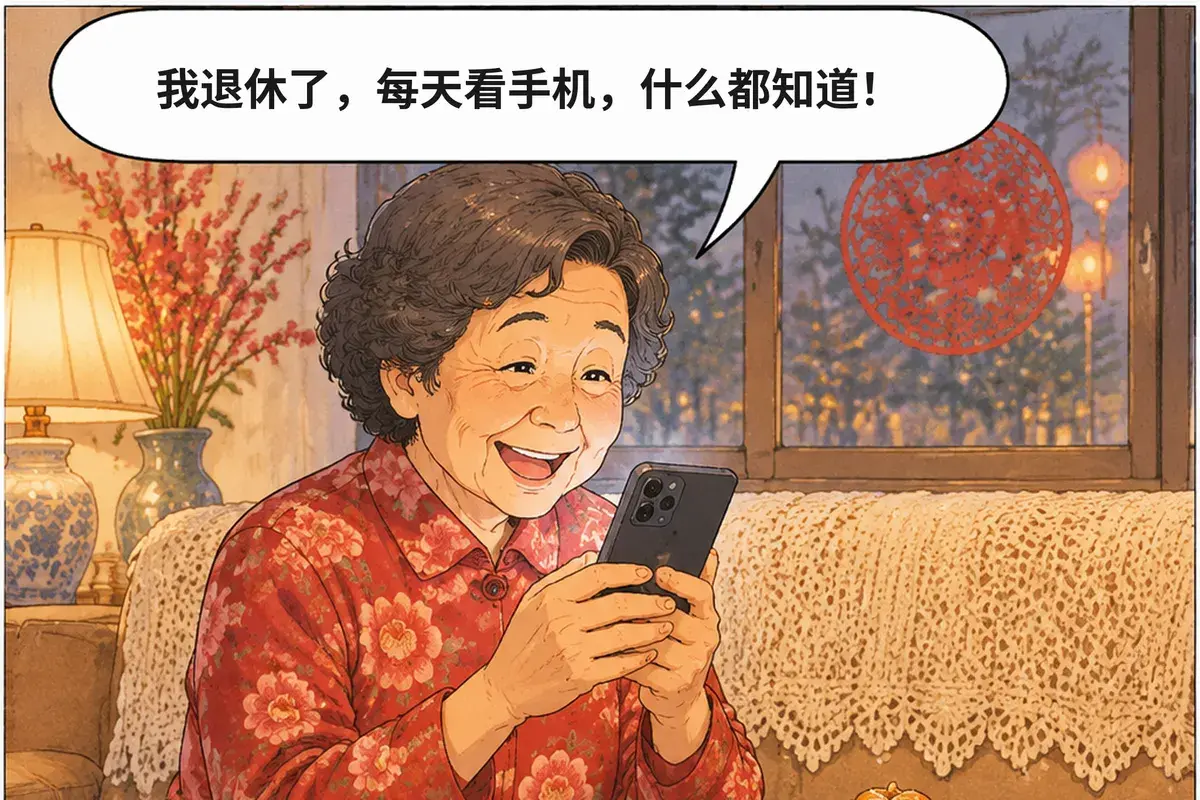
- 王阿姨
我退休了,每天看手机,什么都知道!
I'm retired and I look at my phone every day, so I know everything!

- 豆豆
哥哥!你们在说我的红包吗?你老实说,有多少钱?
Big brother! Are you talking about my red envelope? (to several people) Tell me honestly, how much money is in it?

- 伊利亚
春节那天你自己看!
You'll see for yourself on Spring Festival day!
Grammar for this text
红包 里 的 钱 不 能 有 四! — 红包 (hóngbāo) is a red envelope with money: at Spring Festival older people give it to children. People don't put in an amount with a four, because 四 (sì) is an unlucky number: its sound has an unfortunate association. Hence 四 听 着 像 “死” — "four sounds like 'death'": 死 (sǐ) means "to die", 听 着 means "when you hear it", and 像 means "to be like". The lucky number is 八: 红包 里 有 八, 运气 就 好 — 运气 (yùnqi) means "luck"; 就 here means "then": "there's an eight, then there's luck".
给 孩子 的 红包 — a description before the noun (the grammar of this unit): "a red envelope given to a child". Likewise 他 写 的 福 字 — "the fu character he wrote".
通常 一百 就 够 了 — 通常 (tōngcháng) means "usually, as a rule"; 就 here means "already, that's enough": "as a rule, a hundred is already enough".
你 确定? — 确定 (quèdìng) means "to be sure". The answer repeats the word: 确定! — "I'm sure!".
你 确实 什么 都 知道! — 确实 (quèshí) means "really, indeed": Ilya confirms what he has just seen for himself. 什么 都 means "everything", literally "whatever, all"; for now learn it as a ready-made phrase.
我 退休 了 — 退休 (tuìxiū) means "to retire"; 了 means "it has become so": now Auntie Wang is retired and has a lot of time.
你 老实 说 — 老实 (lǎoshi) means "honest"; 老实 说 means "tell me honestly" or "honestly".
春节 那 天 你 自己 看! — "You'll look for yourself on Spring Festival day": the envelope is opened only on the holiday.
Words and grammar of the unit: Get your home ready for the holiday.
Learn the words from the texts with flashcards
In the app, you can tap any word in a text to see its translation, forms and examples, and new words stick with flashcards. 15 minutes a day.
Start for freeEverything is open for free. No card needed to sign up.