

Chinese dialogue with translation · A1 · 12 lines
四点,不是十点! Four o'clock, not ten!
Comic · 10 panels

- 晓雨
伊利亚,明天星期六,你有时间吗?
Ilya, tomorrow is Saturday. Do you have time?
- 伊利亚
有!几点?
I do! What time?
- 晓雨
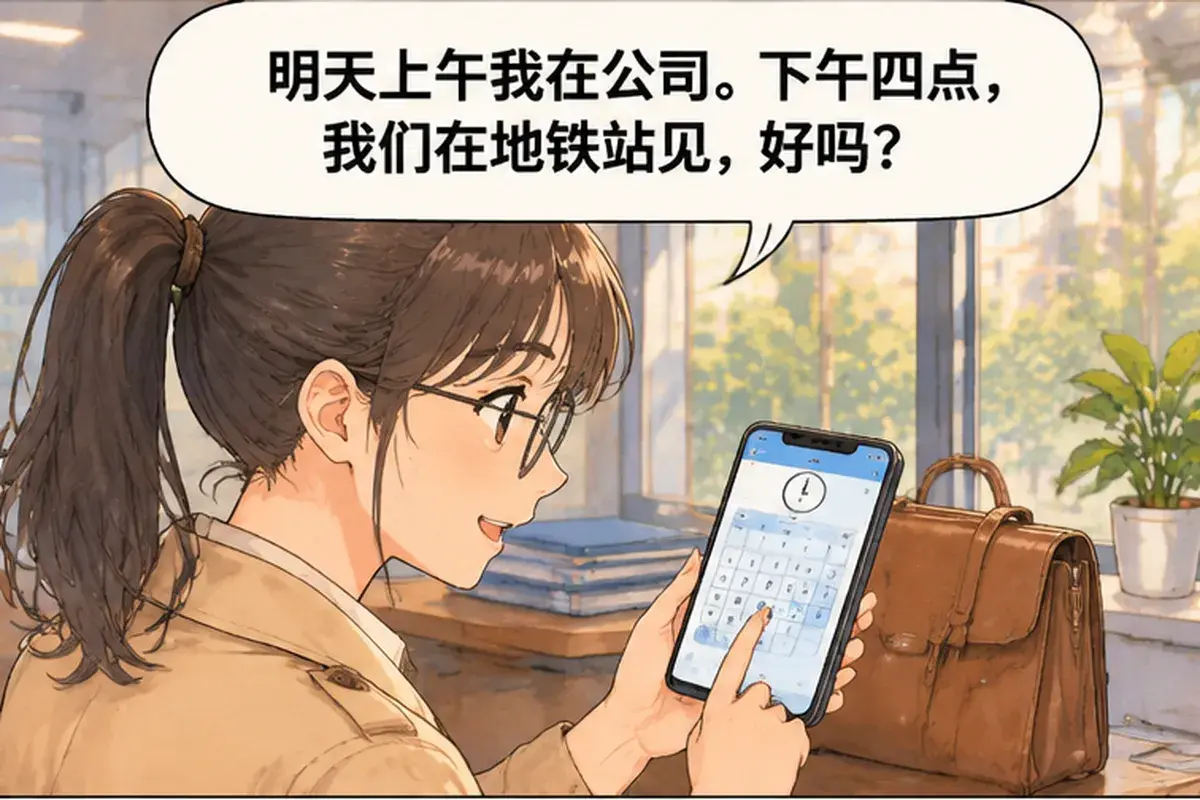
明天上午我在公司。下午四点,我们在地铁站见,好吗?
Tomorrow morning I'll be at the office. At four in the afternoon, let's meet at the subway station, OK?

- 伊利亚
好的,明天见!
OK, see you tomorrow!

- 伊利亚
晓雨,我在地铁站。你在哪里?
Xiaoyu, I'm at the subway station. Where are you?

- 晓雨
地铁站?我在公司!现在上午十点!
The subway station? I'm at the office! It's ten in the morning now!

- 伊利亚
对,十点。我听到你说上午十点!
Right, ten. I heard you say ten in the morning!

- 晓雨
不对!下午四点。四点,不是十点!
That's wrong! Four in the afternoon. Four o'clock, not ten!
- 伊利亚
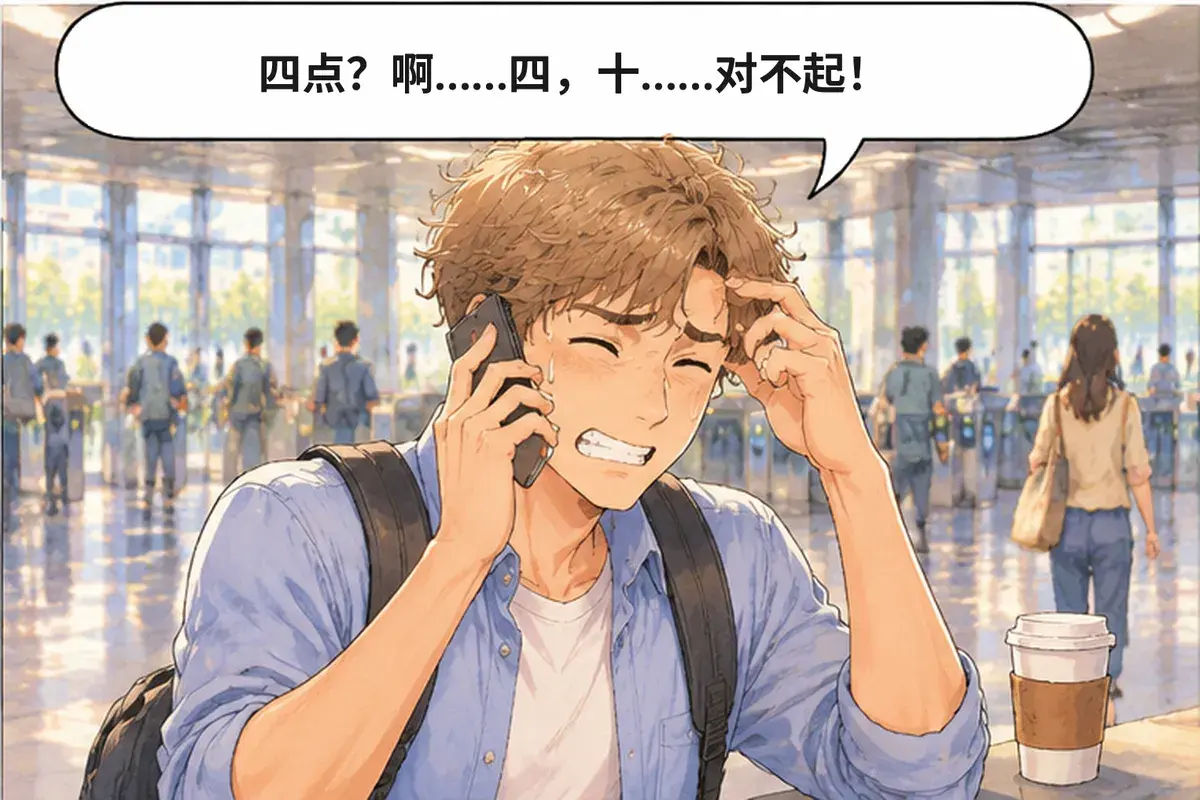
四点?啊……四,十……对不起!
Four o'clock? Oh… four, ten… Sorry!

- 晓雨
没事!你去喝一杯咖啡吧。
It's nothing! Why don't you go have a cup of coffee?

- 伊利亚
好的。下午四点,不是十点!
OK. Four in the afternoon, not ten!
- 晓雨
对!四点见!
Right! See you at four!
Grammar for this text
The first four lines are WeChat voice messages on Friday (in China people often record a voice message instead of typing): 明天 星期六 — "tomorrow is Saturday", the day is said without 是. After that it's Saturday, ten in the morning.
四 点, 不 是 十 点! — every beginner mixes up 四 (sì) "four" and 十 (shí) "ten": the difference is the sound s / sh and the tone, the falling 4th and the rising 2nd. In the voice message Ilya heard 上午 (from 明天 上午 我 在 公司) and "ten", so he came in the morning.
下午 四 点, 我们 在 地铁站 见 — the order is when — where — what we do. 见 is "to see each other": 明天 见 — "see you tomorrow", 四 点 见 — "see you at four".
现在 上午 十 点! — the time is said without 是. 上午 is before noon, 下午 is after noon; the part of the day goes before the hour.
我 听到 你 说 上午 十 点! — 听到 is "to hear": 听 "to listen" + 到 "got there". Chinese verbs don't change: that Xiaoyu said it yesterday is clear from the scene, and English adds "said". The way to show a finished action comes in unit 12.
不对! 下午 四 点。 — 不对 means "wrong, that's not right": this is how you correct someone. 不 是 十 点 is "not ten": 不 是 says what it isn't, while 不对 says "that's a mistake".
我 在 公司! — 公司 is "company"; this is how people say "I'm at the office, at work". Xiaoyu is at work on a Saturday morning: in China this happens.
你 去 喝 一 杯 咖啡 吧。 — 去 喝 is "go and drink": first where you go, then what for. 吧 makes it soft advice, "why don't you…". 一 杯 (yì bēi) is a set phrase from unit 3.
Words and grammar of the unit: Agree on a time.
Learn the words from the texts with flashcards
In the app, you can tap any word in a text to see its translation, forms and examples, and new words stick with flashcards. 15 minutes a day.
Start for freeEverything is open for free. No card needed to sign up.