

French dialogue with translation · B2 · 18 lines
Toi, tu es déjà passé par là You've already been through this
Comic · 18 panels
- Hugo
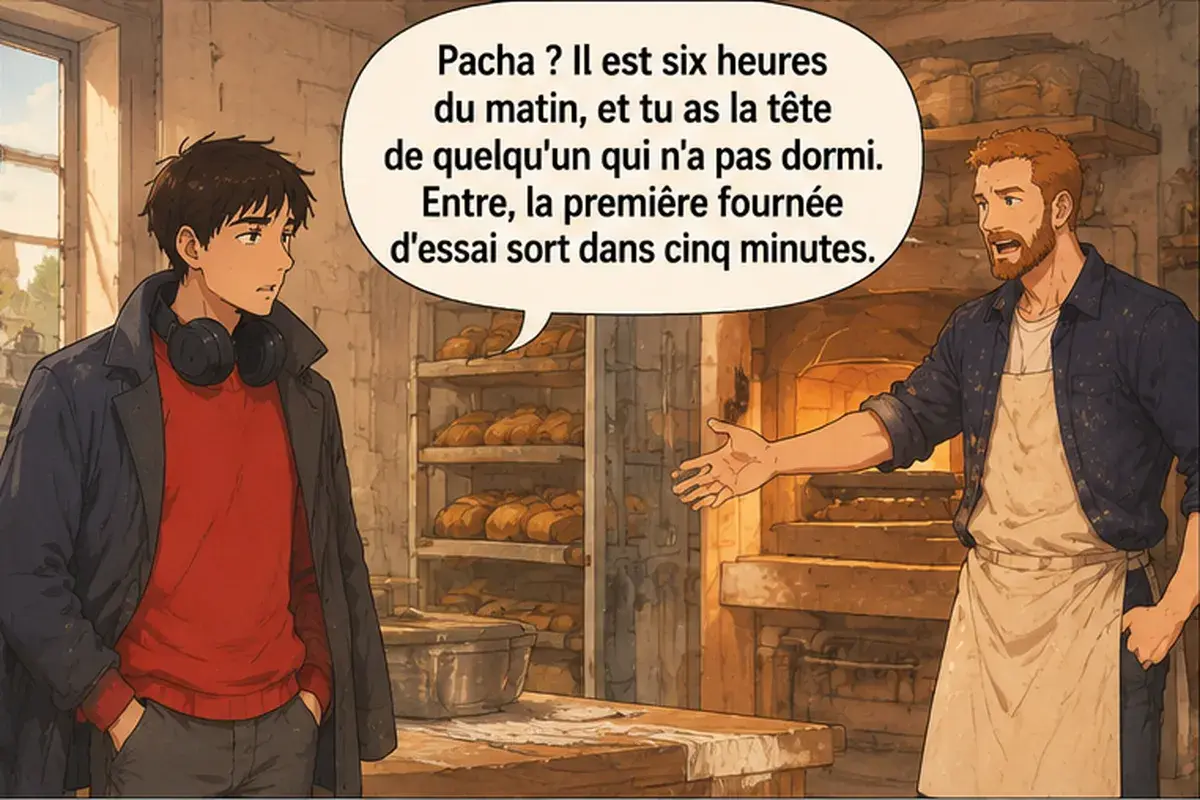
Pacha ? Il est six heures du matin, et tu as la tête de quelqu'un qui n'a pas dormi. Entre, la première fournée d'essai sort dans cinq minutes.
Pacha? It's six in the morning, and you look like someone who hasn't slept. Come in, the first test batch comes out in five minutes.

- Pacha
Je n'ai pas fermé l'œil. J'étais hier chez le docteur Nguyen : elle dit que c'est du surmenage, et que je dois me faire arrêter une semaine.
I haven't slept a wink. I was at Dr. Nguyen's yesterday: she says it's overwork, and that I have to get put on sick leave for a week.

- Hugo
Une semaine d'arrêt ? Bravo. Moi, il m'a fallu cinq ans et une crise dans un ascenseur pour en arriver là.
A week of sick leave? Well done. It took me five years and an attack in an elevator to get there.
- Pacha
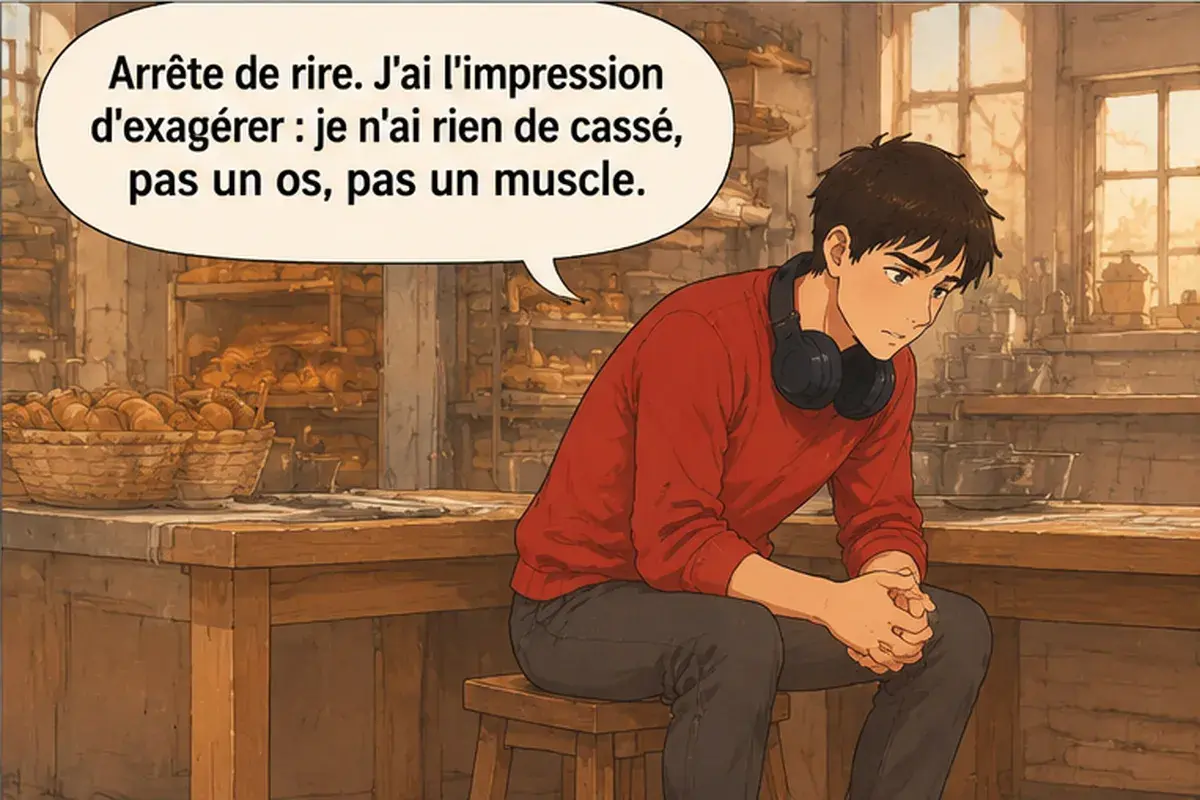
Arrête de rire. J'ai l'impression d'exagérer : je n'ai rien de cassé, pas un os, pas un muscle.
Stop laughing. I feel like I'm exaggerating: I have nothing broken, not one bone, not one muscle.

- Hugo
Et moi, tu crois que j'avais quelque chose de cassé ? Mon sang, mon cœur, tout était normal. Et je manquais de souffle au deuxième étage.
And me, do you think I had something broken? My blood, my heart, everything was normal. And I was short of breath on the second floor.

- Pacha
Mais toi, c'était ton bureau : cinq ans de tableaux et de réunions. Moi, j'aime mon travail, je ne veux pas tout quitter.
But for you it was your office: five years of spreadsheets and meetings. Me, I love my job, I don't want to quit everything.

- Hugo
Je ne te demande pas de tout quitter. Moi aussi, j'aimais mon travail, au début. Mais plus je me forçais, plus j'allais mal, et j'étais tellement inconscient que je trouvais ça normal.
I'm not asking you to quit everything. I loved my job too, at first. But the more I forced myself, the worse I got, and I was so reckless that I thought it was normal (man speaking).

- Pacha
Et ça commençait comment, pour toi ?
And how did it start for you?

- Hugo
Par l'estomac. Le dimanche soir, j'avais mal à l'estomac, puis l'anxiété a gagné toute la semaine, et les cauchemars ont suivi : mon cerveau ne s'arrêtait plus.
With my stomach. On Sunday evenings my stomach hurt, then the anxiety took over the whole week, and the nightmares followed: my brain just wouldn't stop.

- Pacha
Moi, c'est le sifflement. Plus il fait noir, plus je l'entends, et j'ai l'impression d'être seul avec lui. Je n'en ai même pas parlé à Inès.
For me it's the whistling. The darker it is, the more I hear it, and I feel like I'm alone with it (man speaking). I haven't even talked to Inès about it.

- Hugo
Elle va te répondre : « Je te l'avais dit ». Et ensuite elle prendra le train pour t'apporter du thé.
She'll answer you: "I told you so." And then she'll take the train to bring you tea.
- Pacha
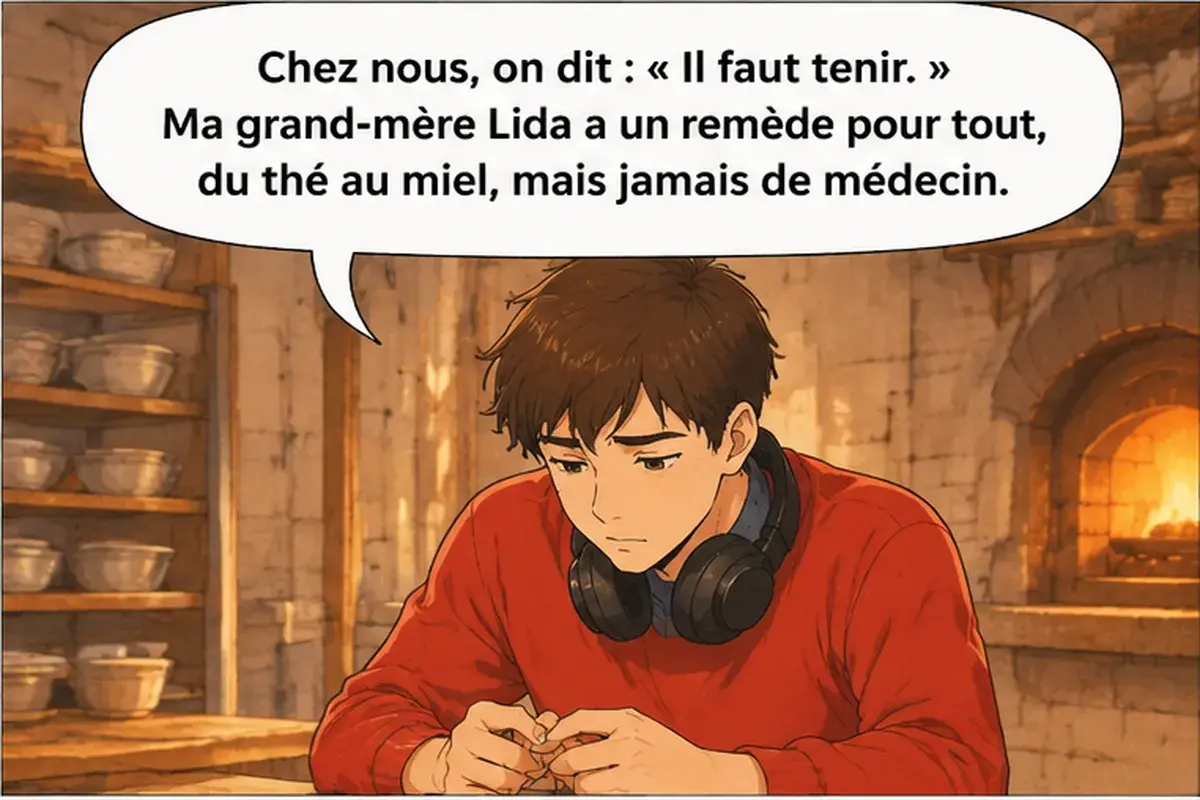
Chez nous, on dit : « Il faut tenir. » Ma grand-mère Lida a un remède pour tout, du thé au miel, mais jamais de médecin.
Back home, people say: "You have to hold on." My grandmother Lida has a remedy for everything, tea with honey, but never a doctor.
- Hugo
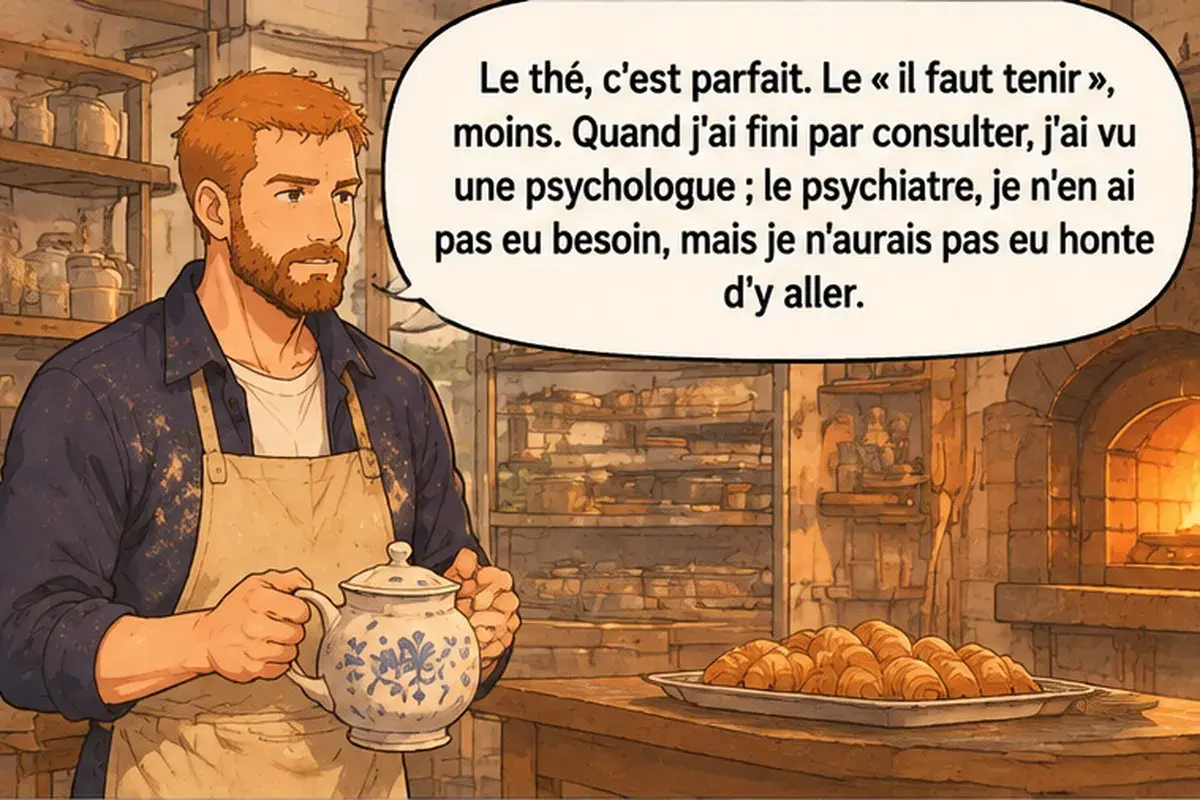
Le thé, c'est parfait. Le « il faut tenir », moins. Quand j'ai fini par consulter, j'ai vu une psychologue ; le psychiatre, je n'en ai pas eu besoin, mais je n'aurais pas eu honte d'y aller.
Tea is perfect. The "you have to hold on," less so. When I finally went to see someone, I saw a psychologist; a psychiatrist, I didn't need one, but I wouldn't have been ashamed to go.

- Pacha
Je sais que mon cas n'est pas le tien. Mais ça me fait du bien d'entendre que tu t'en es sorti.
I know my case isn't yours. But it does me good to hear that you got through it (to a man).

- Hugo
Je suis conscient que ce n'est pas la même chose : toi, tu aimes ton métier, moi, je le subissais.
I'm aware that it's not the same thing: you love your job, and I was putting up with mine (man speaking).

- Pacha
Et maintenant, tu dors mieux ?
And now, do you sleep better?

- Hugo
Depuis que je me lève à quatre heures, je dors d'un sommeil profond, et ma vie est plus saine, même si le travail est très physique. Tiens, mange : du pain au levain, rien d'autre.
Ever since I've been getting up at four, I sleep deeply, and my life is healthier, even though the work is very physical. Here, eat: sourdough bread, nothing else.

- Pacha
Je ne l'enregistre pas, cette fois : j'écoute seulement. Sous la croûte qui craque, j'entends à peine le sifflement.
I'm not recording it this time: I'm just listening. Under the crust that crackles, I can barely hear the whistling.
Grammar for this text
- il m'a fallu cinq ans —
il fautin the past:il m'a fallumeans "it took me." une crise dans un ascenseur —une criseis an attack (of panic, of dizziness). - je n'ai rien de cassé, pas un os, pas un muscle —
rien de cassé: afterrienplus an adjective you putde. pas un os — "not a single bone"; inun osthe s is pronounced, indes osit is silent. - plus je me forçais, plus j'allais mal — "the more..., the worse..." (
plus… plus…, block 1); both verbs are in the imperfect because it's about the past. j'étais tellement inconscient que je trouvais ça normal —inconscientmeans "reckless, not aware." - Elle va te répondre : « Je te l'avais dit » — two pronouns in a row:
te("you") andl'("it"); it means "I told you so." elle prendra le train — the future tense: "she'll take the train." - je n'aurais pas eu honte d'y aller — the past conditional: "I wouldn't have been ashamed."
ymeans "there," that is, to the psychiatrist. le psychiatre — a doctor who can prescribe medication; une psychologue — not a doctor; she listens and talks. - Depuis que je me lève à quatre heures, je dors d'un sommeil profond —
depuis quewith the present: it began and is still going on (block 1). plus saine, très physique —sain("healthy") andphysique("physical"). - Je suis conscient que ce n'est pas la même chose —
conscientmeans "aware." moi, je le subissais —lehere means "it," that is, his job;subirmeans to put up with, to endure. - tu t'en es sorti — "you got through it";
enhere means "out of it."
Words and grammar of the unit: Explain a complicated health problem to a doctor.
Learn the words from the texts with flashcards
In the app, you can tap any word in a text to see its translation, forms and examples, and new words stick with flashcards. 15 minutes a day.
Start for freeEverything is open for free. No card needed to sign up.