

French story with translation · B2 · 16 lines
On lui a dit qu'il faudrait revenir They told him he'd have to come back
Comic · 16 panels

Hier soir, Hugo est venu dîner chez moi avec la tête d'un homme qui a vu quatre guichets et entendu quatre réponses différentes.
Last night, Hugo came to my place for dinner looking like a man who had seen four counters and heard four different answers.

Tout a commencé à quatre heures du matin : il a lavé sa veste de boulanger, et son passeport était resté dans la poche.
It all started at four in the morning: he washed his baker's jacket, and his passport had been left in the pocket.

Le passeport est sorti de la machine en morceaux, donc il devait le renouveler. Pour lui, la démarche allait prendre dix minutes.
The passport came out of the machine in pieces, so he had to renew it. As far as he was concerned, the process was going to take ten minutes.
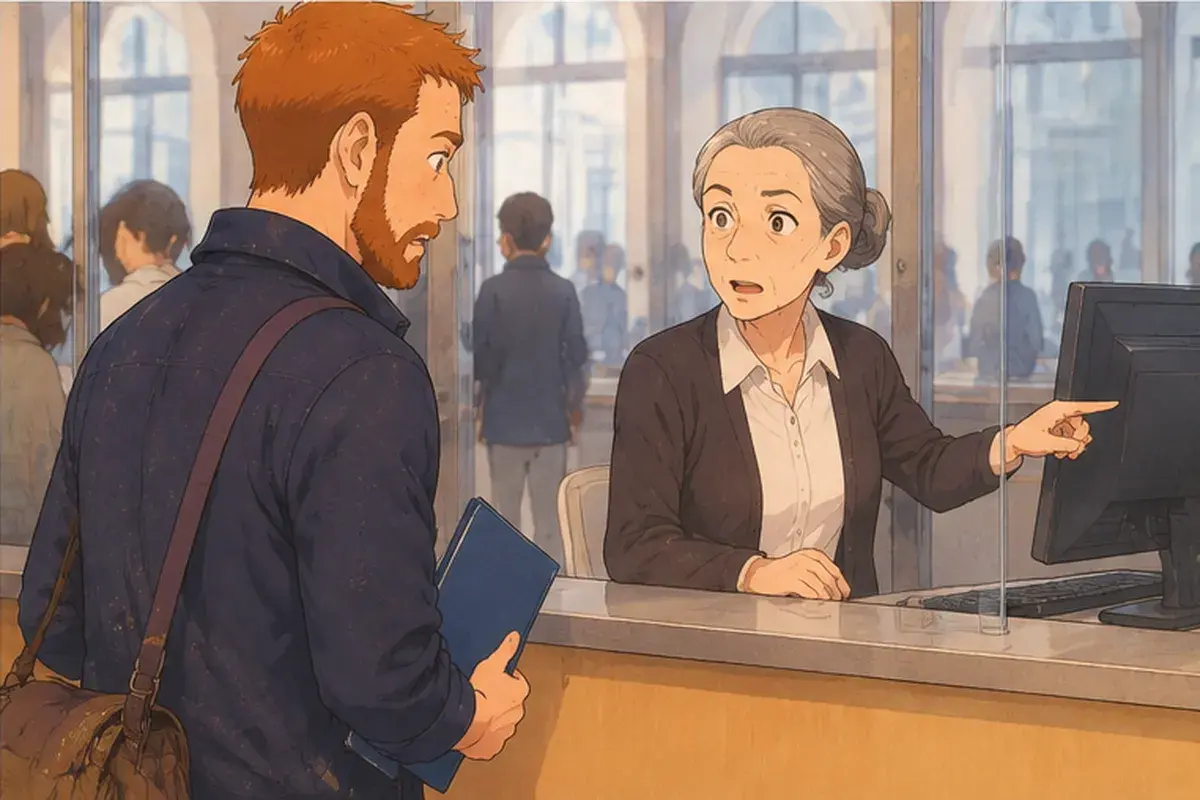
À neuf heures, à la mairie, une fonctionnaire lui a dit qu'il fallait d'abord faire la demande sur le site national du ministère.
At nine, at city hall, an official told him he first had to make the application on the ministry's national website.

Dans le couloir de la mairie, il a rempli le formulaire sur le site en quarante minutes ; puis un message l'a averti qu'il manquait son acte de naissance.
In the hallway of city hall, he filled out the form on the website in forty minutes; then a message warned him that his birth certificate was missing.

Hugo a expliqué qu'il avait toujours eu la nationalité française. La fonctionnaire a répondu qu'en l'absence de l'acte, elle ne pouvait pas traiter la demande.
Hugo explained that he had always had French nationality. The official answered that without the certificate, she couldn't process the application.

Il a donc appelé la mairie de Saint-Malo, où il est né. L'employé lui a promis qu'il enverrait l'acte dans la journée.
So he called city hall in Saint-Malo, where he was born. The clerk promised him he would send the certificate that day.

À deux heures, toujours rien : Hugo en avait marre et il avait presque renoncé. Il est retourné à la mairie pour demander conseil, et il a fait vingt minutes de queue dans la mauvaise file.
At two o'clock, still nothing: Hugo was fed up and had almost given up. He went back to city hall to ask for advice, and he stood in line for twenty minutes in the wrong line.

Un agent lui a dit : « Ce n'est pas la bonne file, monsieur. » Hugo, qui jette chaque papier dans la bonne poubelle sans jamais se tromper, n'a pas su quoi répondre.
An employee told him: "This isn't the right line, sir." Hugo, who puts every scrap of paper in the right trash can without ever making a mistake, didn't know what to say.

Dans la bonne file, il était au rang soixante-deux. Pendant qu'il attendait, le courriel de Saint-Malo est enfin arrivé.
In the right line, he was number sixty-two. While he waited, the email from Saint-Malo finally arrived.

À la réception de l'acte, il a pu accéder au site avec son téléphone, le téléverser et envoyer sa demande sans quitter la file.
Upon receipt of the certificate, he was able to access the website with his phone, upload it and send his application without leaving the line.

Il a reçu tout de suite un accusé de réception. À la mairie, on lui a dit qu'il faudrait revenir avec une photo.
He immediately got a return receipt. At city hall, they told him he would have to come back with a photo.

À table, il a tout raconté avec « elle m'a dit que » ou « il m'a dit que » à chaque phrase, comme un vrai journaliste.
At the table, he told the whole story with "she told me that" or "he told me that" in every sentence, like a real journalist.

J'ai ri, mais cette histoire m'a révélé quelque chose : un Français de naissance se perd, lui aussi, dans les guichets.
I laughed, but this story revealed something to me: even someone French by birth gets lost at the counters.

Après ma matinée à la préfecture, ça m'a fait du bien : je ne suis pas le seul à qui il manque une pièce.
After my morning at the préfecture, it did me good: I'm not the only one who's missing a document (man speaking).

Hugo a promis qu'il m'apporterait du pain le lendemain. Pour une journée de guichets, c'était déjà une victoire.
Hugo promised he would bring me some bread the next day. For a day of counters, that was already a victory.
Grammar for this text
- une fonctionnaire lui a dit qu'il fallait d'abord faire la demande —
une fonctionnaireis a female official (the same word is used for a man or a woman). In the report,il fautbecameil fallait. - un message l'a averti qu'il manquait son acte de naissance —
l'here means "him" (Hugo), not the article.un acte de naissanceis a birth certificate from city hall;actehere means "official document", not "act" as in "deed". - qu'en l'absence de l'acte, elle ne pouvait pas traiter la demande —
en l'absence demeans "in the absence of" and is official language.Je ne peux pasbecameelle ne pouvait pas. - qu'il enverrait l'acte dans la journée —
j'enverrai("I'll send") becomesil enverraitin the report: the future stem plus the imperfect ending. - Hugo a expliqué qu'il avait toujours eu la nationalité française — "I've always had" (
j'ai toujours eu) goes one step further back in the report:il avait toujours eu. This is the past perfect, covered in more detail in unit 15. - On lui a dit qu'il faudrait revenir —
onmeans "they told him" (who exactly doesn't matter);il faudra revenirbecameil faudrait revenir. Anddemainin a report turns into le lendemain. - À la réception de l'acte — "when he received the certificate"; next to it,
un accusé de réceptionis a confirmation that your application was received. - Hugo en avait marre —
en avoir marreis casual for "to be fed up";en avait marremeans "he was already fed up" (imperfect).
Words and grammar of the unit: Handle paperwork at the préfecture.
Learn the words from the texts with flashcards
In the app, you can tap any word in a text to see its translation, forms and examples, and new words stick with flashcards. 15 minutes a day.
Start for freeEverything is open for free. No card needed to sign up.