

French dialogue with translation · B1 · 18 lines
J'aimerais que vous me laissiez travailler I'd like you to let me work (to several people)
Comic · 18 panels
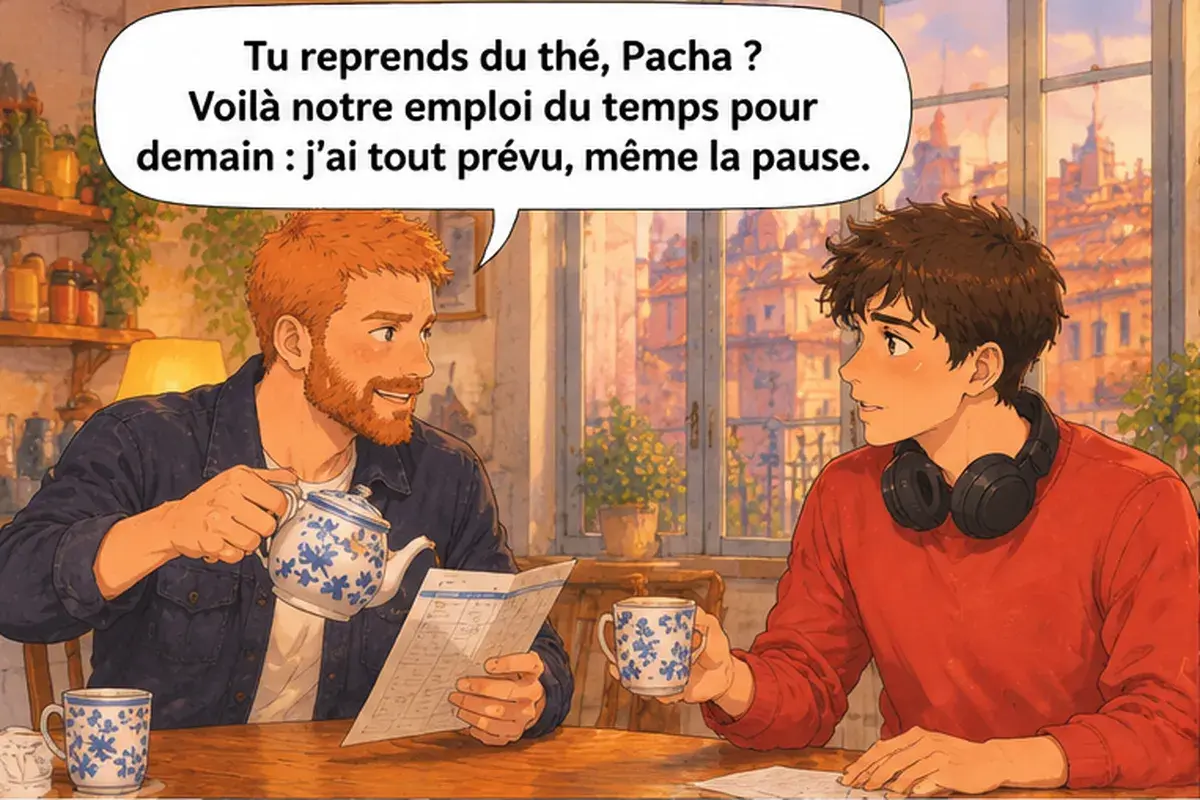
- Hugo
Tu reprends du thé, Pacha ? Voilà notre emploi du temps pour demain : j'ai tout prévu, même la pause.
Do you want more tea, Pacha? Here's our schedule for tomorrow: I've planned everything, even the break.

- Inès
Tu as écrit « flâner » de quatorze heures à quinze heures ? On ne flâne pas sur rendez-vous, Hugo !
Did you write "stroll" from 2 p.m. to 3 p.m.? You can't stroll by appointment, Hugo!

- Hugo
Si, on peut. Je veux que tu flânes avec moi, et pas avec ton téléphone.
Yes, we can. I want you to stroll with me, and not with your phone.

- Inès
Tu es tellement exigeant ! Mon seul désir, c'est de ne regarder l'heure qu'au dîner.
You're so demanding! My one desire is to look at the time only at dinner.

- Pacha
Je peux parler ? J'aimerais que vous me laissiez travailler jusqu'à midi, parce que mon client attend.
Can I speak? I'd like you to let me work until noon, because my client is waiting (to several people).

- Hugo
D'accord. Moi, je suis obligé d'aller voir une boulangerie à sept heures, c'est plus fort que moi.
All right. As for me, I have to go see a bakery at seven, I can't help it (man speaking).

- Inès
Et moi, je veux que tu enregistres la péniche sur le canal, Pacha : son moteur fait un bruit magnifique.
And I want you to record the barge on the canal, Pacha: its engine makes a magnificent sound.

- Pacha
Avec plaisir. Mais il faut que je protège ma perche : sur la berge, tout glisse.
I'd love to. But I have to protect my boom pole: on the bank, everything slips.

- Inès
Et demain soir, cassoulet ! Vous désirez du cassoulet, Monsieur Hugo ? Je ne vous force pas, je vous supplie.
And tomorrow night, cassoulet! Would you like some cassoulet, Monsieur Hugo? I'm not forcing you, I'm begging you (formal).

- Hugo
Il y a de la viande dedans, donc non. Mais par respect pour le Sud, je veux bien le sentir.
There's meat in it, so no. But out of respect for the South, I'm willing to smell it.

- Pacha
Je vous soutiens tous les deux : Hugo sent, Inès mange, et moi, j'enregistre.
I support you both: Hugo smells, Inès eats, and I record.

- Inès
Toulouse, c'est la ville rose : des maisons en brique, un canal qui fait partie du patrimoine mondial, et des bonbons à la violette dans tous les magasins. Garde l'esprit ouvert, Hugo !
Toulouse is the pink city: brick houses, a canal that's part of world heritage, and violet-flavored candies in every store. Keep an open mind, Hugo!

- Hugo
Tu vois mon attitude ? Je fais un effort : j'ai même mis une guinguette sur l'emploi du temps, à dix-neuf heures.
Do you see my attitude? I'm making an effort: I even put a guinguette on the schedule, at seven p.m.

- Inès
Une guinguette ! De la musique, de l'énergie, et moi qui danse jusqu'à minuit !
A guinguette! Music, energy, and me dancing until midnight!

- Hugo
Je t'autorise à danser, mais pas à choisir la musique. Et désormais, celui qui arrive en retard paie le café.
I allow you to dance, but not to choose the music. And from now on, whoever arrives late pays for the coffee.

- Inès
C'est une règle contre moi ! Et ma liberté, alors ?
That's a rule against me! And what about my freedom?

- Hugo
Ta liberté commence à quatorze heures. Et moi, il est vingt et une heures : il faut que j'y aille.
Your freedom starts at 2 p.m. And as for me, it's nine p.m.: I have to go.
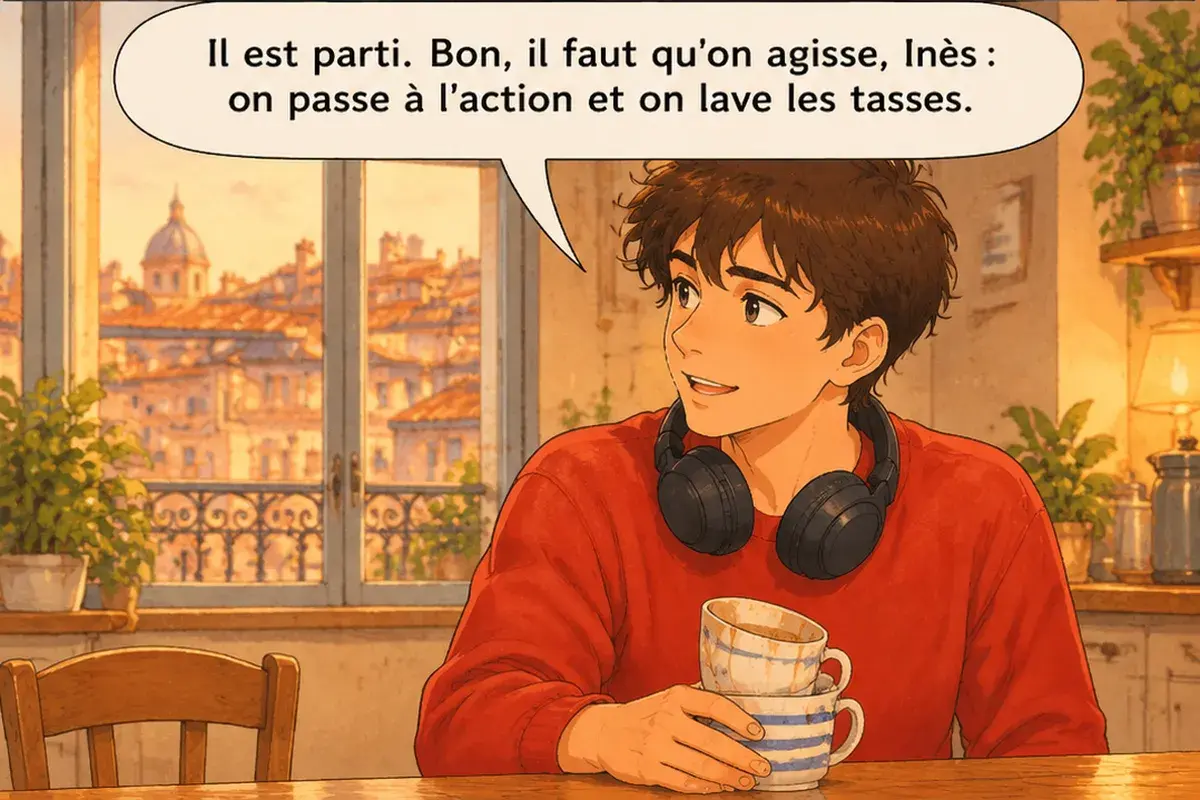
- Pacha
Il est parti. Bon, il faut qu'on agisse, Inès : on passe à l'action et on lave les tasses.
He's gone. Well, we have to act, Inès: we're taking action and washing the cups.
Grammar for this text
- J'aimerais que vous me laissiez travailler — I'd like you to let me work.
j'aimeraismeans "I'd like" (aimerin the conditional, A2). When you want other people to do something, it is followed byqueand the subjunctive:vous laissez→que vous laissiez. It looks like the imperfect, but it's a different form (see the unit's grammar). - Je veux que tu flânes avec moi — I want you to stroll with me.
flânermeans to walk around with no goal, looking at things. On ne flâne pas sur rendez-vous — You can't stroll by appointment. It's a joke: you can't walk around aimlessly on a schedule, like a doctor's visit. - Il faut que je protège ma perche — I have to protect my boom pole. Also il faut qu'on agisse — we have to act:
qu'on=que+on.Agirworks likefinir:nous agissons→qu'on agisse. - il faut que j'y aille — I have to go. It's a ready-made phrase:
y("there") +aille, a special form ofaller(we'll look at it in unit 21). Learn it as a whole. - Vous désirez du cassoulet, Monsieur Hugo ? — Would you like some cassoulet, Monsieur Hugo? (formal)
Vous désirez ?is what a waiter asks: "What would you like?" Inès is playing a waitress. Je ne vous force pas, je vous supplie — I'm not forcing you, I'm begging you.forcermeans "to force",suppliermeans "to beg". - Garde l'esprit ouvert — Keep an open mind (literally "keep your mind open"). celui qui arrive en retard — whoever arrives late (
celui qui, unit 5). - Tu reprends du thé ? — Do you want more tea?
reprendreat the table means "to take more". c'est plus fort que moi — I can't help it.
Words and grammar of the unit: Say what you want others to do.
Learn the words from the texts with flashcards
In the app, you can tap any word in a text to see its translation, forms and examples, and new words stick with flashcards. 15 minutes a day.
Start for freeEverything is open for free. No card needed to sign up.