

French dialogue with translation · B1 · 18 lines
J'ai une nouvelle à vous annoncer I have some news to tell you (to several people)
Comic · 18 panels

- Pacha
Vous êtes assis ? J'ai une nouvelle à vous annoncer.
Are you sitting down? I have some news to tell you. (to several people)

- Hugo
Il est huit heures et demie. À neuf heures, je dors, même si la maison brûle.
It's half past eight. At nine I sleep, even if the house is on fire.

- Inès
Laisse-le parler ! Ça fait trois jours qu'il regarde son téléphone toutes les cinq minutes. C'est le courriel de Lyon ?
Let him talk! For three days he's been looking at his phone every five minutes. Is it the email from Lyon?

- Pacha
Oui, je l'ai reçu cet après-midi. Madame Lefèvre m'écrit que le poste est pour moi.
Yes, I got it this afternoon. Madame Lefèvre writes me that the position is mine.

- Inès
Ils te prennent ? Je suis bouche bée ! Je te félicite !
They're hiring you? My jaw is on the floor! I congratulate you!

- Hugo
Je me réjouis pour toi, et je ne suis pas étonné : tu entends tout, même quand on ne dit rien.
I'm so happy for you, and I'm not surprised: you hear everything, even when nobody says anything. (man speaking)

- Pacha
Merci. J'ai peur, mais j'ai décidé d'accepter. Le contrat de travail arrive demain, avec une période d'essai.
Thanks. I'm scared, but I've decided to accept. The employment contract arrives tomorrow, with a trial period.

- Inès
Tu es chanceux ! Et ça démarre quand ?
You're lucky! And when does it start? (to a man)

- Pacha
Madame Lefèvre propose une date d'embauche dans quelques semaines. Je compte arriver avant, pour m'organiser.
Madame Lefèvre is suggesting a start date in a few weeks. I'm planning to arrive before that, to get organized.
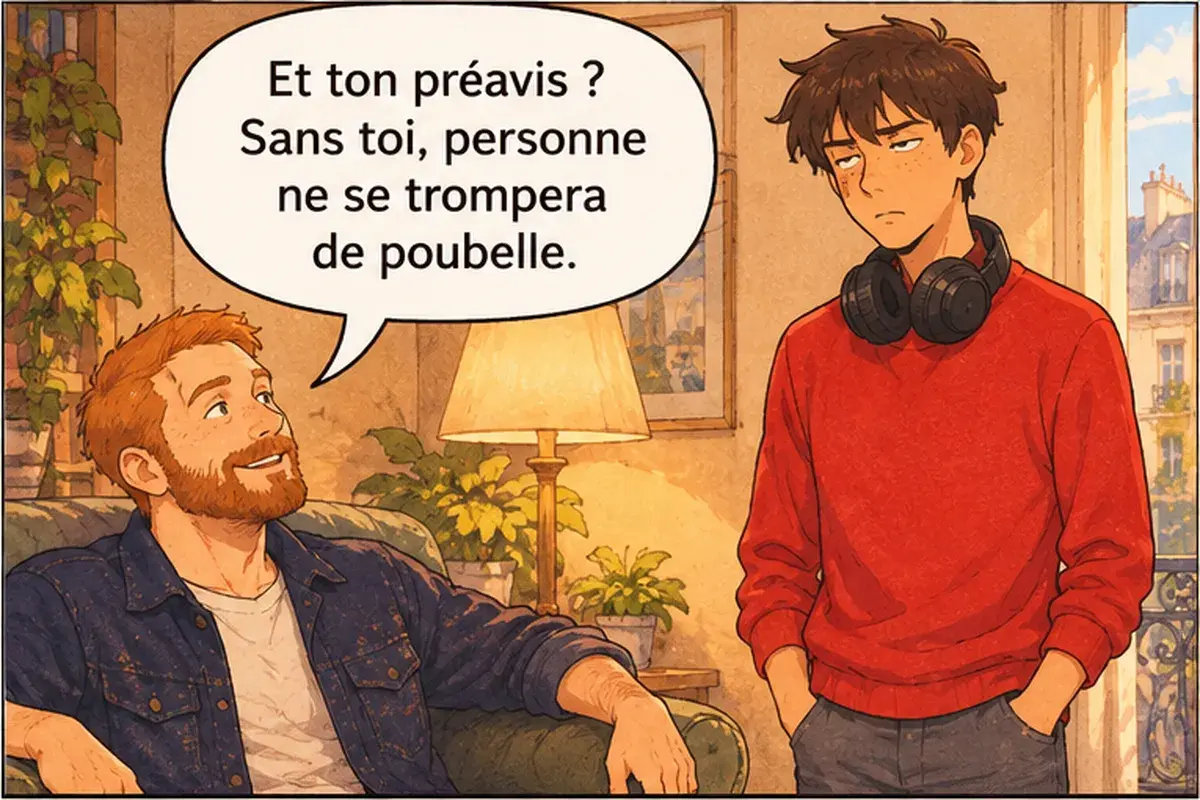
- Hugo
Et ton préavis ? Sans toi, personne ne se trompera de poubelle.
And your notice? Without you, no one will put the trash in the wrong bin.
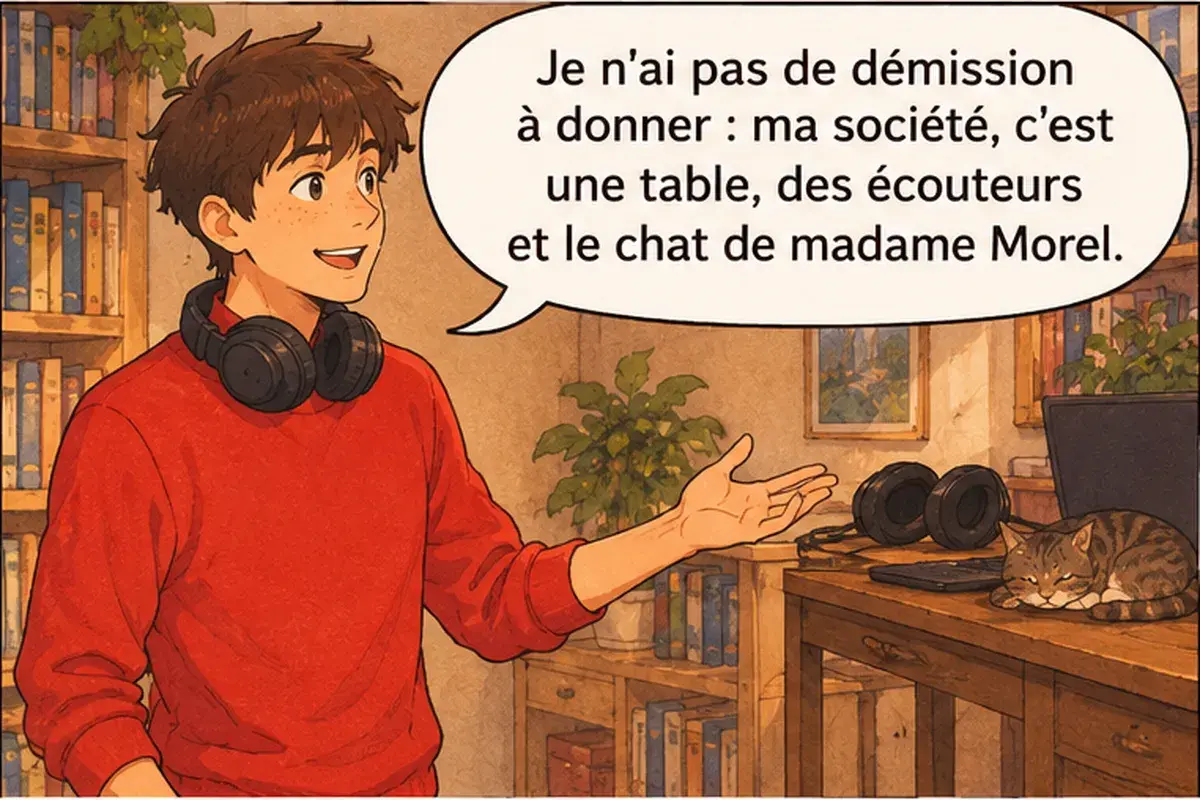
- Pacha
Je n'ai pas de démission à donner : ma société, c'est une table, des écouteurs et le chat de madame Morel.
I don't have a resignation to hand in: my company is a table, headphones, and Madame Morel's cat.

- Hugo
Alors pas de préavis, mais un pot de départ chez Momo. J'apporte le pain.
Then no notice, but a going-away party at Momo's. I'll bring the bread.
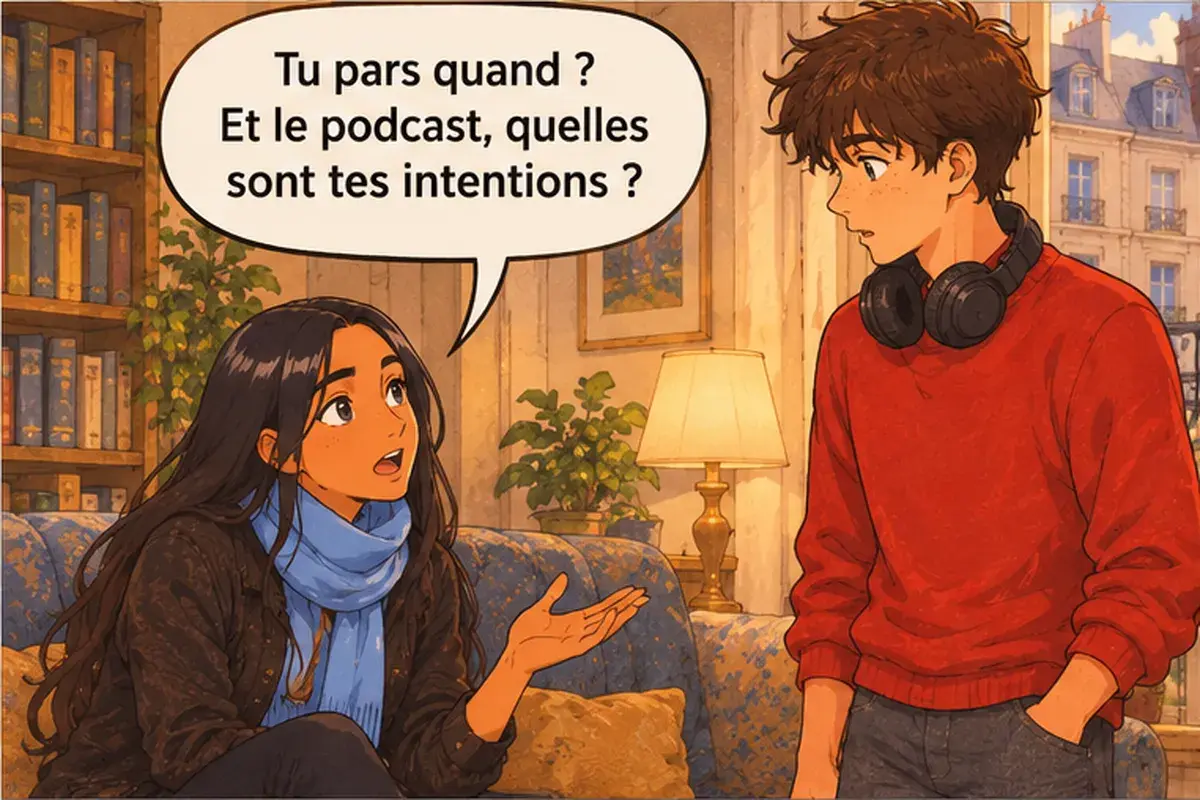
- Inès
Tu pars quand ? Et le podcast, quelles sont tes intentions ?
When are you leaving? And the podcast, what are your plans?
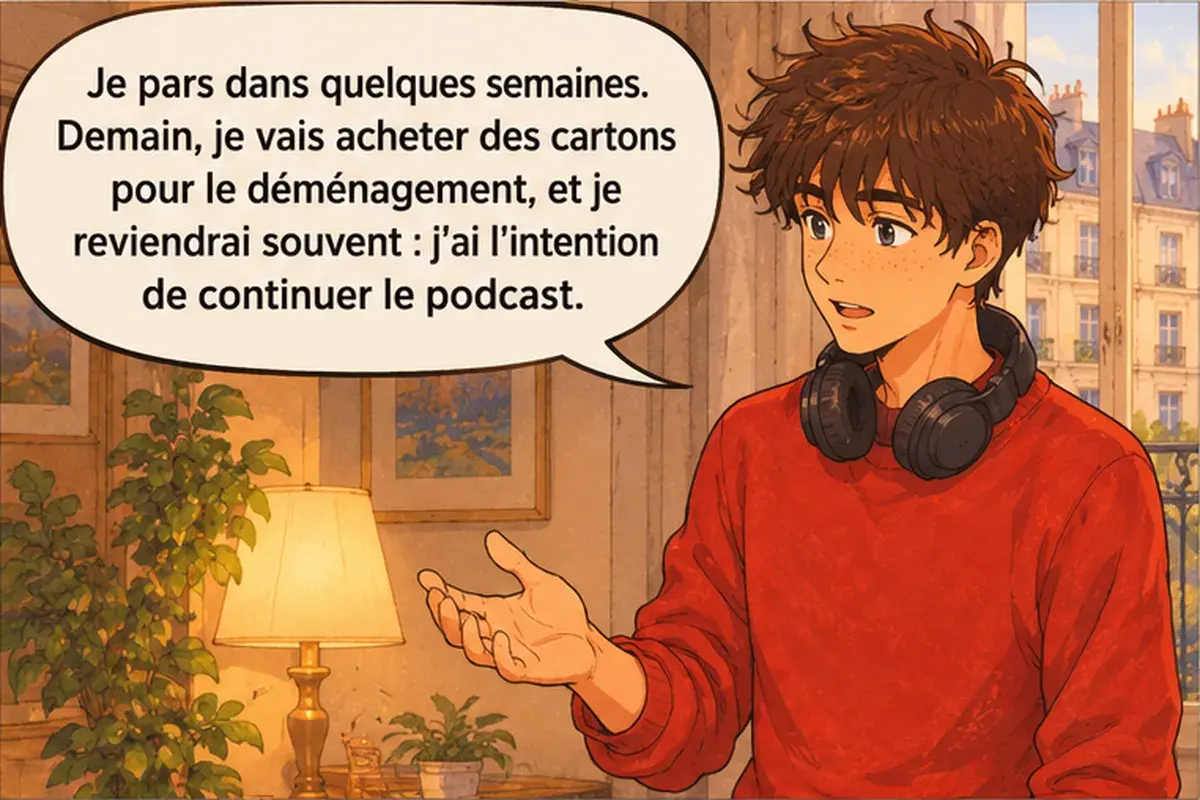
- Pacha
Je pars dans quelques semaines. Demain, je vais acheter des cartons pour le déménagement, et je reviendrai souvent : j'ai l'intention de continuer le podcast.
I'm leaving in a few weeks. Tomorrow I'm going to buy some boxes for the move, and I'll come back often: I intend to keep doing the podcast.

- Hugo
Alors je voudrais que tu prennes un de mes pains. Il faut que tu le manges avant d'arriver.
Then I'd like you to take one of my loaves with you. You have to eat it before you get there.

- Inès
À ta place, j'accepterais aussi. Tu vas nous manquer, mais je ne veux pas que tu restes pour nous.
If I were you, I'd accept too. We're going to miss you, but I don't want you to stay for us.

- Pacha
Pour moi, c'est un nouveau départ, mais je ne pars pas définitivement : je fais mes valises, pas mes adieux.
For me it's a fresh start, but I'm not leaving for good: I'm packing my bags, not saying goodbye.

- Hugo
Il est neuf heures. Je te félicite encore, Lyonnais, et j'attends ton premier jeu avec impatience. Maintenant, je dors.
It's nine o'clock. I congratulate you again, Lyonnais, and I can't wait for your first game. Now I'm going to sleep.
Grammar for this text
- J'ai une nouvelle à vous annoncer —
une nouvellemeans “a piece of news” (notnouveau, “new”);annoncermeans “to announce, to tell something important.” This is how you start a serious conversation. - Je compte arriver avant, pour m'organiser —
compter+ infinitive with nodemeans “to plan to,” not “to count.”m'organiser=me+organiser. - Je me réjouis pour toi, et je ne suis pas étonné —
se réjouirmeans “to be happy” (themeis part of the verb).étonnémeans “surprised,” weaker thanstupéfaitin text 2. - Je n'ai pas de démission à donner —
donner sa démissionmeans “to hand in your resignation”; Pacha has no boss.préavisis the notice you give before you leave. Afterpasusede, notune. - Je pars dans quelques semaines — present tense: a firm plan. Demain, je vais acheter des cartons —
aller+ infinitive: soon. Je reviendrai souvent — the-aiform: a promise. The present tense also stands for the future in Le contrat de travail arrive demain. - Je voudrais que tu prennes un de mes pains — after
je voudrais quecomes the subjunctive (unit 10):prennesis fromprendre(tu prends), andmangeslooks just like the present tense. Thelein tu le manges means “it.” - il faut que — works the same way: the subjunctive follows it too.
- À ta place, j'accepterais aussi —
à ta place+ conditional (unit 3). Je fais mes valises, pas mes adieux —faire ses valisesmeans “to pack your bags”;adieumeans “goodbye forever.”
Words and grammar of the unit: Share big news.
Learn the words from the texts with flashcards
In the app, you can tap any word in a text to see its translation, forms and examples, and new words stick with flashcards. 15 minutes a day.
Start for freeEverything is open for free. No card needed to sign up.