

Spanish story with translation · B1 · 18 lines
Cómo discutí con mi mejor amigo How I had a fight with my best friend
Comic · 10 panels

Nacho es mi mejor amigo desde el colegio. En veinte años nunca tuvimos una discusión seria… hasta el sábado.
Nacho has been my best friend since school. In twenty years we never had a serious argument… until Saturday.
Vino a cenar a mi casa, probó mi tortilla y dijo delante de todos: «Sin cebolla no es tortilla».
He came to dinner at my place, tried my tortilla and said in front of everyone, "Without onion, it's not a tortilla."

Quise reírme, pero no pude: me ofendí como un niño.
I tried to laugh, but I couldn't: I got offended like a child (man speaking).
Él me llamó mentiroso y yo le respondí con un insulto estúpido.
He called me a liar, and I answered him with a stupid insult.
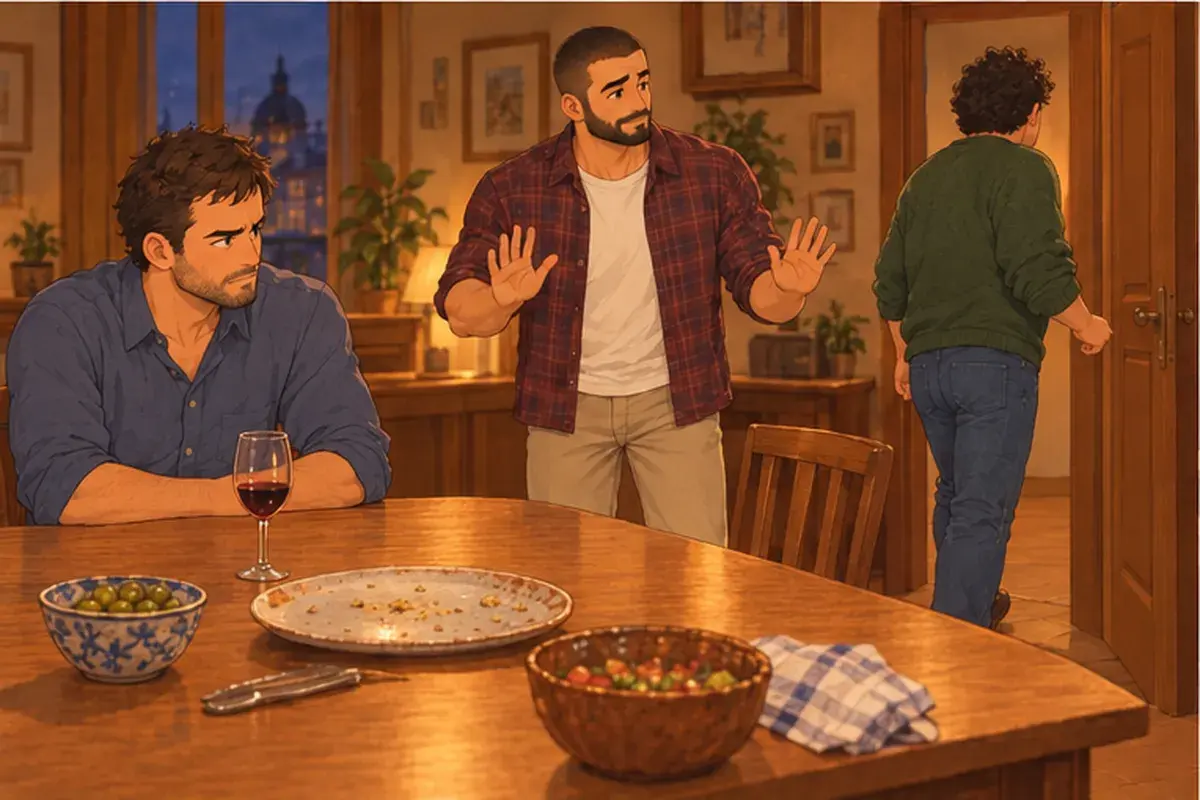
Sergio pidió calma, pero ninguno de los dos se calló, y al final Nacho se fue.
Sergio asked for calm, but neither of us went quiet, and in the end Nacho left.

Mi enfado duró dos días. El lunes, para estar seguro, llamé a mi abuela, a Sevilla.
My anger lasted two days. On Monday, just to be sure, I called my grandmother in Seville (man speaking).
«Abuela, tu tortilla es sin cebolla, ¿verdad?» Ella se puso a reír.
"Grandma, your tortilla has no onion, right?" She burst out laughing.

«Pablo, hijo, yo siempre la hago con cebolla. La corto muy pequeña y tú nunca la has notado».
"Pablo, honey, I always make it with onion. I chop it really small, and you've never noticed it."
No supe qué decir. ¡Veinte años comiendo cebolla, y yo le juré a Nacho que no!
I didn't know what to say. Twenty years of eating onion, and I swore to Nacho it had none!

Le escribí: «¿Hablamos en privado?». Leyó el mensaje, pero no respondió.
I wrote to him, "Shall we talk in private?" He read the message but didn't reply.
Mientras tanto, Sergio me comentó un rumor: por lo visto, Nacho vino borracho y me insultó.
Meanwhile, Sergio mentioned a rumor to me: apparently, Nacho showed up drunk and insulted me.

«Mentira», le dije. «Nacho no mintió ni insultó a nadie. Él es inocente: el culpable soy yo».
"That's a lie," I told him. "Nacho didn't lie or insult anyone. He's innocent: I'm the one to blame." (man speaking)

Cuando me calmé, hice otra tortilla, esta vez con cebolla, y fui a su casa.
When I calmed down, I made another tortilla, this time with onion, and went to his place.
Le pedí perdón y le confesé la verdad. Tuve que admitir mi error, y no fue fácil.
I apologized to him and confessed the truth. I had to admit my mistake, and it wasn't easy.

Nacho se quedó callado un momento. Luego se rio y me dio un abrazo.
Nacho went quiet for a moment. Then he laughed and gave me a hug.
«Yo también fui un tonto», dijo. «Tu tortilla no estaba tan mal».
"I was a fool too," he said. "Your tortilla wasn't that bad."

Hicimos las paces en dos minutos: reconciliarse con un amigo de verdad es fácil.
We made up in two minutes: reconciling with a true friend is easy.
Ahora en mi cocina hay paz… y cebolla. Pero muy poca.
Now there's peace in my kitchen… and onion. But very little.
Grammar for this text
Who did what. The story moves forward with preterite forms, and many of them are new: vino — "he came", dijo — "he said", quise… pero no pude — "I tried… but couldn't", se puso a reír — "she burst out laughing", no supe qué decir — "I didn't know what to say", leyó — "he read", se rio — "he laughed" (written without an accent).
Only the él and ellos forms change. Compare: le pedí perdón — "I apologized", but Sergio pidió calma — "Sergio asked for calm"; Nacho no mintió — "Nacho didn't lie", while about himself Pablo would say mentí.
Fui: from ir or from ser. Fui a su casa — "I went to his place" (ir), but Yo también fui un tonto — "I was a fool too" (ser). In the preterite these two verbs have the same forms; what comes next shows the meaning: a place means ir, "who I was" means ser (A2, unit 9).
Someone's exact words in quotes. «Mentira», le dije — the words are given exactly as they were said. Retelling in the past ("he said that…") is the topic of unit 14.
Word combinations. Me llamó mentiroso — "he called me a liar". Pedir calma — "to ask everyone to calm down", pedir perdón — "to apologize". Se quedó callado — "he went quiet". Hacer las paces — "to make up": paces is always plural here.
Words and grammar of the unit: Tell the story of a fight and making up.
Learn the words from the texts with flashcards
In the app, you can tap any word in a text to see its translation, forms and examples, and new words stick with flashcards. 15 minutes a day.
Start for freeEverything is open for free. No card needed to sign up.