
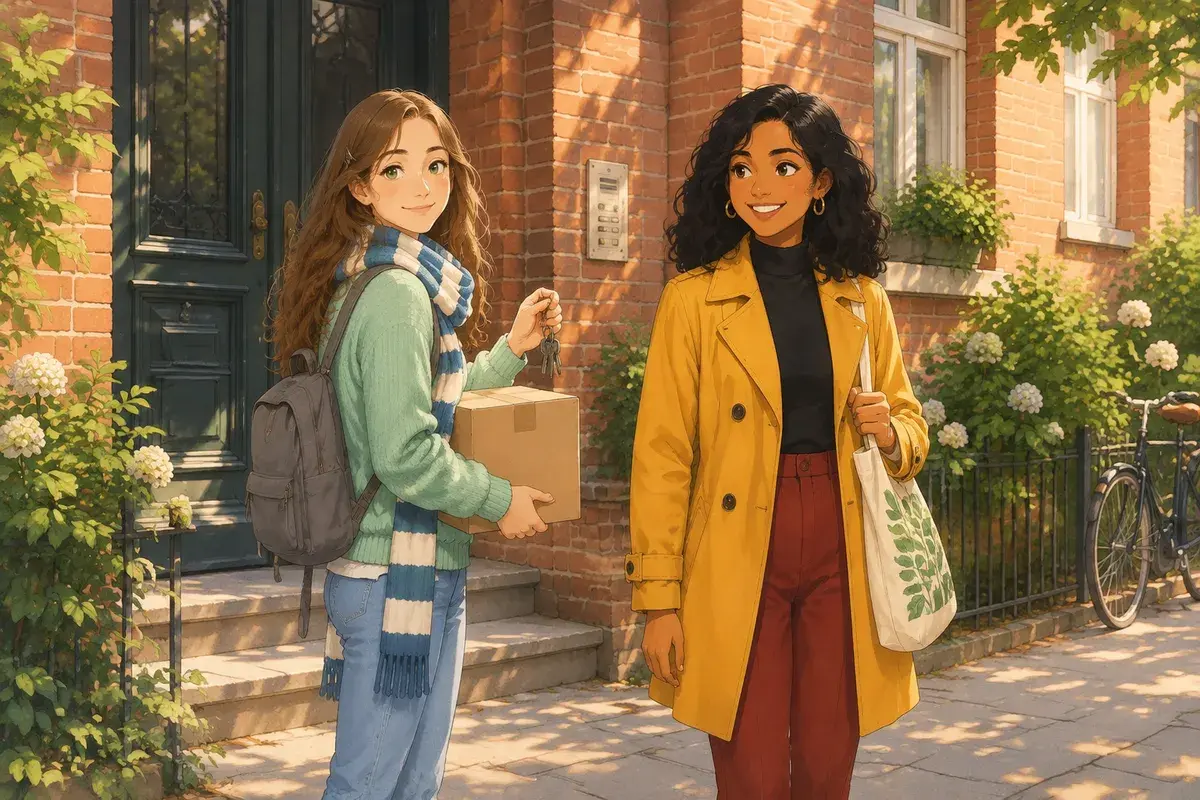
German story with translation · B2 · 14 lines
Wer hätte das gedacht? Who would have thought?
Comic · 14 panels

Liebe Katja, rückblickend kann ich dir sagen: Alles wird gut.
Dear Katja, looking back, I can tell you: Everything will be fine.

Du brichst heute auf, stotterst noch beim Einkaufen und ahnst nicht, was kommt.
You're setting out today, still stammering when you shop, and you don't suspect what's coming.

Du hast viel Neugier und Zuversicht, aber noch wenig Selbstvertrauen.
You have a lot of curiosity and optimism, but still little self-confidence.

Dass du von Anfang an Deutsch sprichst, macht dir Mut.
The fact that you speak German from the very beginning gives you courage.

Kaum zu glauben: Ich habe jetzt eine eigene Wohnung in Eimsbüttel.
Hard to believe: I now have an apartment of my own in Eimsbüttel.

Wer hätte das gedacht? Zwei Wochen Urlaub haben mein Leben verwandelt.
Who would have thought? Two weeks of vacation transformed my life.

Ein neues Kapitel hat angefangen: neue Stadt, neue Arbeit, neue Freunde.
A new chapter has begun: new city, new job, new friends.

Ich habe mich nicht neu erfunden, ich bin nur mutiger geworden.
I didn't reinvent myself, I just became braver.

Die Realität war oft anders als im Kurs: Ämter, Formulare, die vor jedem Termin ausgefüllt werden mussten, Wohnungssuche. Mit Durchhaltevermögen habe ich alles überstanden.
Reality was often different from the course: offices, forms that had to be filled out before every appointment, the apartment search. With perseverance I got through it all.

Lukas, Sabine und Priya haben mich ermutigt, aus Dankbarkeit helfe ich Mateo.
Lukas, Sabine and Priya encouraged me, and out of gratitude I'm helping Mateo.

Ich telefoniere mit Ämtern auf Deutsch und habe allein einen Mietvertrag unterschrieben.
I talk to offices on the phone in German, and I signed a lease all by myself.

Selbstständigkeit und Gelassenheit habe ich dabei gelernt: Ich stehe jetzt auf eigenen Beinen.
I learned independence and calm along the way: I'm standing on my own two feet now.

Im Nachhinein war dieser Neuanfang lohnenswert und unvorstellbar schön. Hätte mir das damals jemand gesagt, hätte ich es nicht geglaubt.
In hindsight, this fresh start was worthwhile and unimaginably wonderful. If someone had told me that back then, I wouldn't have believed it.

Ich blicke zurück, bin zuversichtlich und hoffnungsvoll. Das ist erst der Anfang: Fortsetzung folgt!
I look back, and I'm confident and hopeful. This is only the beginning: to be continued!
Grammar for this text
- Liebe Katja, rückblickend kann ich dir sagen: Alles wird gut —
rückblickend(looking back) comes first, so the verbkannfollows right after it, and thenich.diris the dative ofdu(to you);wirdcomes fromwerden. - Du brichst heute auf —
aufbrechenis a separable verb:brichstis theduform (ebecomesi, likesprechen—du sprichst), and the prefixaufgoes to the end. - stotterst noch beim Einkaufen und ahnst nicht, was kommt —
stotterstis theduform ofstottern(stemstotter-+-st).ahnenwithnichtmeans "to have no idea" (you don't know what's coming). - Wer hätte das gedacht? — "Who would have thought that?":
hätteis the Konjunktiv II (would-form) ofhaben,gedachtis the past participle ofdenken. - Kaum zu glauben — "Hard to believe".
- Ich habe mich nicht neu erfunden —
sich neu erfinden(to reinvent yourself) is reflexive:ichgoes withmich.erfundenis the past participle oferfinden(erfand,erfunden), with noge-. - Ein neues Kapitel hat angefangen —
angefangenis the past participle ofanfangen. - Dass du von Anfang an Deutsch sprichst, macht dir Mut — the
dassclause comes first and works as the subject:sprichstis at the end of it, thenmachtfollows.Mut machenmeans "to give courage"; the person is in the dative:dir. - die vor jedem Termin ausgefüllt werden mussten — the passive with a modal verb in the past: "that had to be filled out".
- Hätte mir das damals jemand gesagt, hätte ich es nicht geglaubt — a condition without
wenn: the verb comes first, in the past Konjunktiv II (would have + past participle).
Words and grammar of the unit: Look back and sum up.
Learn the words from the texts with flashcards
In the app, you can tap any word in a text to see its translation, forms and examples, and new words stick with flashcards. 15 minutes a day.
Start for freeEverything is open for free. No card needed to sign up.