

Portuguese story with translation · A1 · 11 lines
Na feira é mais barato It's cheaper at the street market
Comic · 11 panels

Todo dia o Léo dorme até tarde. No domingo ele acorda cedo, porque tem pastel na feira.
Léo sleeps late every day. On Sunday he gets up early, because there's pastel at the street market.

Eu vou com ele. A feira abre cedo e fecha ao meio-dia.
I go with him. The street market opens early and closes at noon.
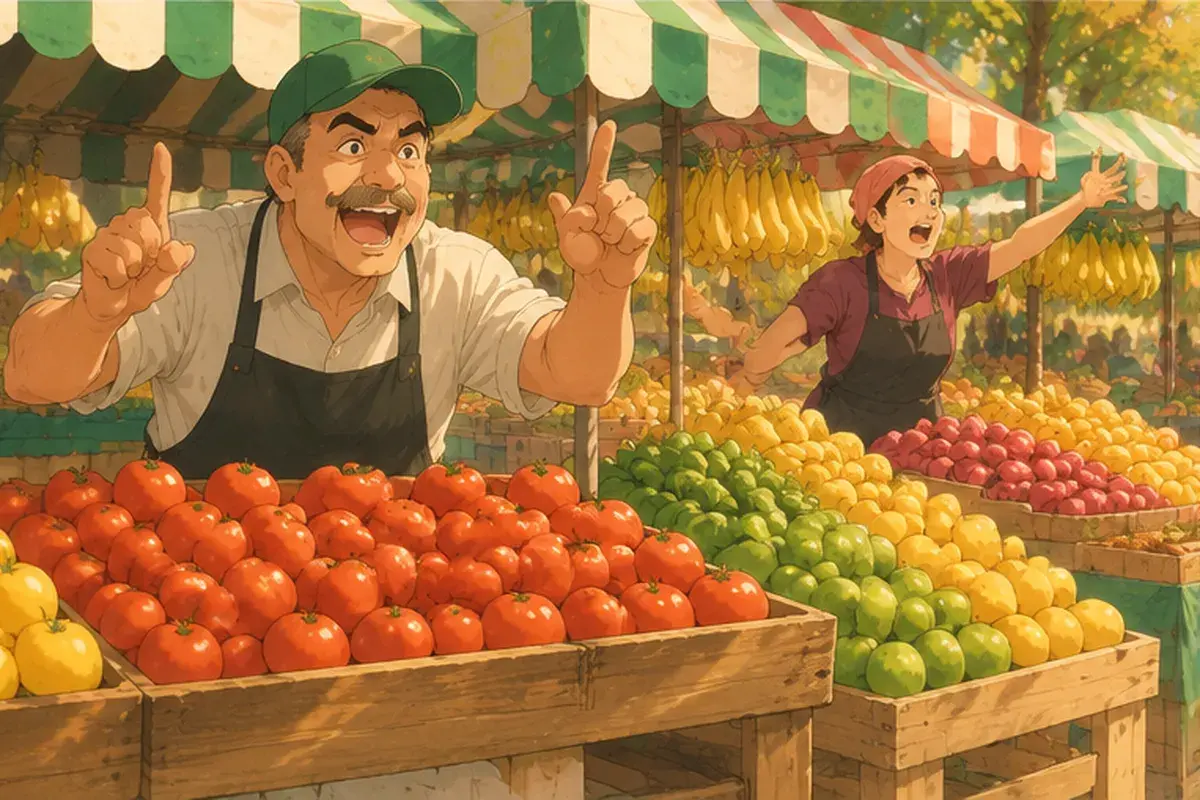
Os vendedores falam os preços muito rápido: "Um real! Um real!"
The vendors call out the prices very fast: "One real! One real!"

No shopping as lojas são caras. Na feira é mais barato.
At the mall the stores are expensive. It's cheaper at the street market.

A feira tem todas as cores! Eu quero comprar tudo: a banana amarela, o tomate vermelho e a maçã verde.
The street market has all the colors! I want to buy everything: the yellow banana, the red tomato and the green apple.

Mas então um vendedor mostra um chinelo verde e amarelo, as cores do Brasil.
But then a vendor shows a pair of green and yellow flip-flops, the colors of Brazil.

O chinelo é barato, por isso eu levo dois: um para mim e outro para a Bia.
The flip-flops are cheap, so I take two pairs: one for me and another for Bia.

O Léo olha para mim e fala: "Nina, hoje no almoço a gente come chinelo?"
Léo looks at me and says: "Nina, are we eating flip-flops for lunch today?"

Eu volto e compro as frutas também.
I go back and buy the fruit too.

O Léo compra um pastel de queijo e come em dois minutos.
Léo buys a cheese pastel and eats it in two minutes.

Ele fala: "Agora sim. A feira é boa."
He says: "Now that's more like it. The street market is good."
Grammar for this text
- Na feira é mais barato — na = em + a: "at the street market". mais barato — "cheaper": mais (more) + an adjective. The second part ("than at the mall") isn't said: it's clear anyway. There's no subject: é barato — "it's cheap (there)".
- fecha ao meio-dia — ao = a + o: "at noon". meio-dia — noon (unit 8).
- eu levo dois — levo is the eu form of levar. dois — "two (pairs)": the word chinelo isn't repeated, just like in um para mim e outro para a Bia: um — one, outro — another.
- as cores do Brasil — do = de + o. Green and yellow are the colors of the Brazilian flag; every street market sells flip-flops like these.
- Agora sim — "now that's more like it": sim (yes) makes agora (now) stronger.
- Um real! — this is how vendors call out a price: "one real". The plural is reais.
Words and grammar of the unit: Buy clothes and ask for a discount.
Learn the words from the texts with flashcards
In the app, you can tap any word in a text to see its translation, forms and examples, and new words stick with flashcards. 15 minutes a day.
Start for freeEverything is open for free. No card needed to sign up.